Courthouse and Jail Rocks

A barren, rocky landscape with a dirt path curving toward two flat-topped mesas under a hazy sky.

Detail of a circa-1875 stereograph of Courthouse and Jail Rocks. RG5899-14-1

By David L. Bristow, Editor


How were Courthouse and Jail Rocks formed?

Imagine the North Platte Valley filled to the brim with land, as it once was. Do you see the layers in Courthouse and Jail Rocks? They are mostly clay and silt that eroded from mountains to the west.

At the foot of Courthouse Rock, you stand on sediments laid down 35 million years ago. The top layers at the valley rim are about 10 million years younger. The river carved a path down through these layers. In time it became a broad valley.

Courthouse Rock is a remnant. Like Chimney Rock and Scotts Bluff, harder rock on top protected it as surrounding land eroded away.
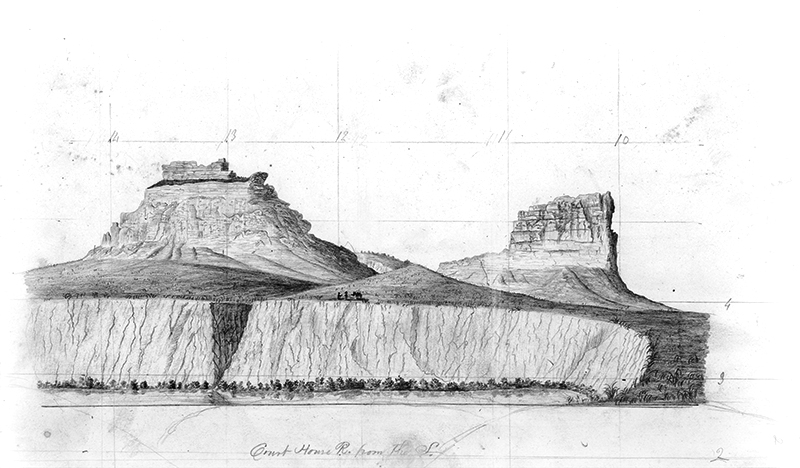
Black and white drawing of two flat-topped rock formations with a river and trees in the foreground, labeled "Court House Rock from the S.W.

“Court House R. from the S.,” 1851 drawing by William Quesenbury.


When did people arrive?

People have lived in the North Platte Valley for at least 13,000 years. Archaeologists have found ancient homes, campsites, and stone tools nearby.

Even before horses were brought from Europe, Indigenous trade networks spanned hundreds of miles. Local people exported surplus goods and imported items such as easily-flaked stone for toolmaking.

By the time Euroamerican emigrants began passing through this valley in the mid-1800s, this region was home to the Lakota, Cheyenne, and Arapaho peoples. Highly mobile on horseback, these northern plains tribes followed the bison herds. The people were forcibly removed to reservations in the 1860s and 1870s.
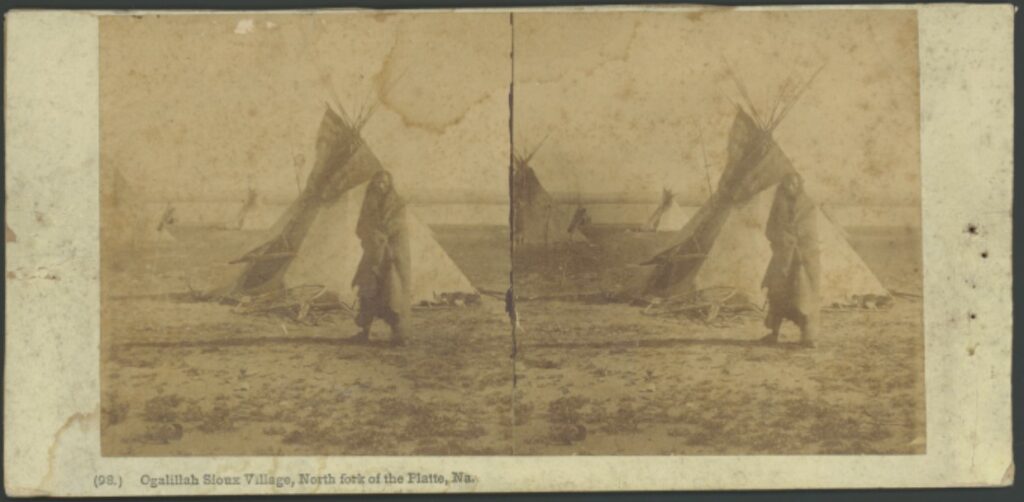
Sepia stereograph showing a person standing in front of several tipis at an Ogalallah Sioux village near the North Fork of the Platte River.

This 1859 stereograph of an Oglala Lakota village along the North Platte River is the earliest known photo of a Lakota village. RG3122-5-1


How did Courthouse Rock get its name?

This place has had many names in many languages, but most are lost to us. Travelers along the Oregon-California-Mormon trails called the main butte “the Court House” or sometimes “the Solitary Tower,” “the Church,” “the Capitol,” or “the Castle.” The smaller rock was “the Jail” or “Jail House.”

Historic sketch of a wagon train with oxen, people, and horses moving through a valley landscape, labeled “California train moving in the Platte Valley 1869.”.

Captain Carlisle’s California Train. Emigrant wagon train nooning in the Platte Valley, 1859. RG3474-0-17


For westbound travelers the Court House marked a dramatic change of scenery after weeks crossing the Plains. They marveled at how it changed size and shape when seen from different angles and in different light.

Courthouse Rock also marks a crossroads of the main east-west trail with the Sidney-Black Hills Trail used during the 1870s Black Hills gold rush.
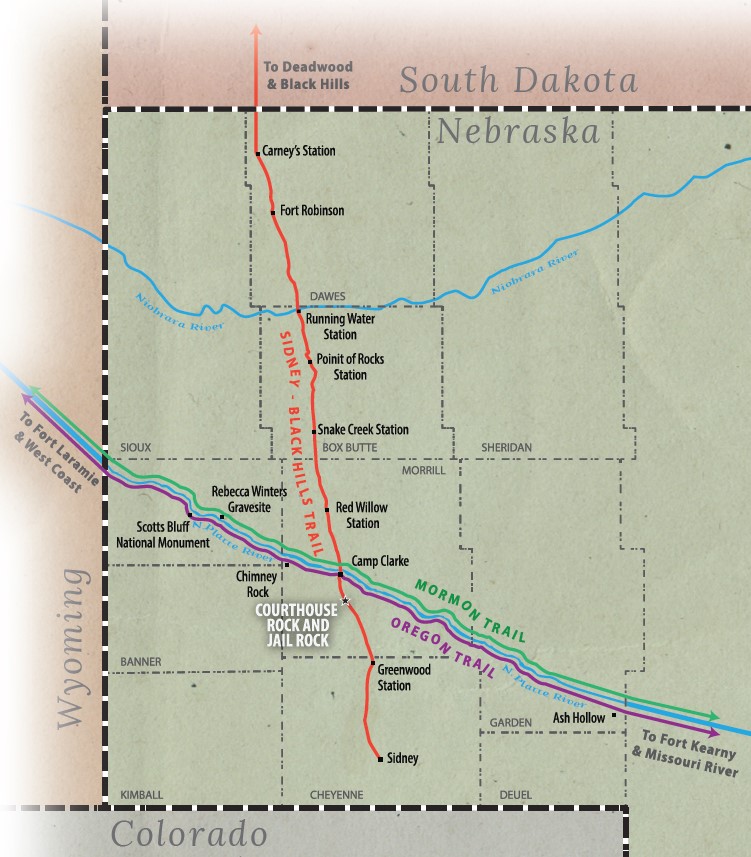
Map showing the Oregon and Mormon Trails through Nebraska, with stops and landmarks including Courthouse Rock, Chimney Rock, and the Sidney-Black Hills Trail route northward.

Map by Ben Kruse, History Nebraska


(Posted May 3, 2023.)
Become a Member!

Our members make history happen.

Join Now

You May Also Enjoy

Marker Monday: Atlas D Missile Site A

Marker Monday: Atlas D Missile Site A

With Warm Love and Best Wishes: Repairing an 1886 Holiday Heirloom

With Warm Love and Best Wishes: Repairing an 1886 Holiday Heirloom

Marker Monday: Father Flanagan’s Boys’ Home

Marker Monday: Father Flanagan’s Boys’ Home

No results found.

About NSHS

The Nebraska State Historical Society was founded in 1878 by citizens who recognized Nebraska was going through great changes and they sought to record the stories of both indigenous and immigrant peoples. It was designated a state institution and began receiving funds from the legislature in 1883. Legislation in 1994 changed NSHS from a state institution to a state agency. The division is headed by Director Daryl Bohac. They are assisted by an administrative staff responsible for financial and personnel functions, museum store services, security, and facilities maintenance for NSHS.

Explore Nebraska

Discover the real places and people of our past at these NSHS sites.

Upcoming Events

View our new and upcoming events to see how you can get involved.

Become a Member

The work we do to discover, preserve, and share Nebraska's history wouldn't be possible without the support of NSHS members.

NSHS Education

Learn more about the educational programs provided at our museums, sites, and online.

Education Digital Learning Resources

Find games, lists, and more to enhance your history education curriculum.

Latest Hall of Fame Inductee

The Nebraska Hall of Fame was established in 1961 to officially recognize prominent Nebraskans.

Listen to our Podcast

Listen to the articles and authors published in the Nebraska History Magazine with our new Nebraska History Podcast!

Nebraska Collections

NSHS's mission is to collect, preserve, and open our shared history to all Nebraskans.

Our YouTube Video Collection

Get a closer look at Nebraska's history through your own eyes, with our extensive video collections.

Additional Research Resources

NSHS's Research and Reference Services help connect you to the material we collect and preserve.

NSHS Services

Digital Resources

Find all of our digital resources, files, videos, and more, all in one easy-to-search page!

Support The Historical Society

Make a cash donation to help us acquire, preserve, and interpret Nebraska’s history. Gifts to the Nebraska State Historical Society help leave a legacy and may help your taxes, too! Support the work of NSHS.

Volunteers are the heroes of NSHS. So much history, so little time! Your work helps us share access to Nebraska’s stories at our museums and sites, the reference room, and online.