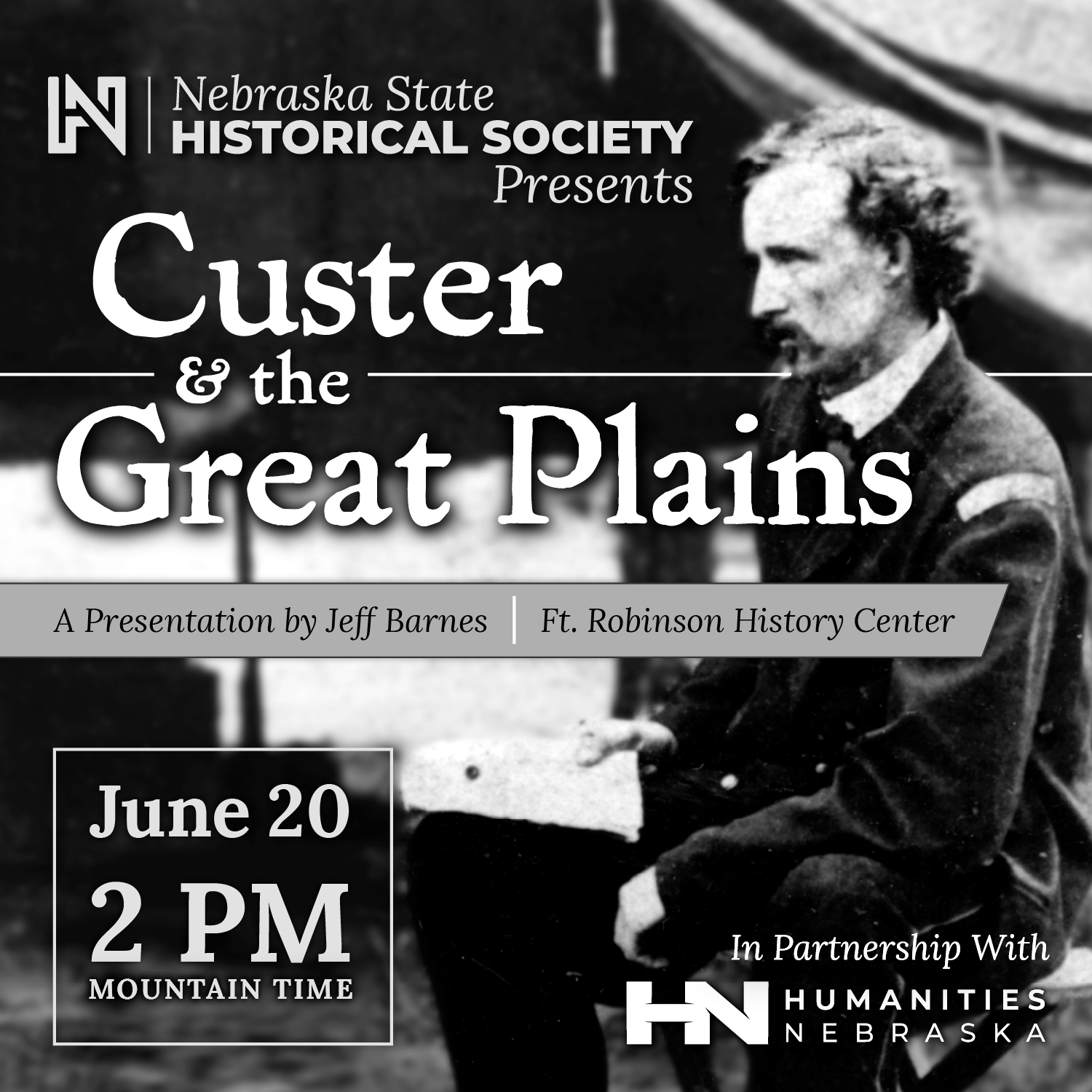
In his nine years on the Great Plains, George Armstrong Custer transformed from Civil War hero to a frontier figure, fully immersed in the vast, wild heart of the American West. Custer was sent by the U.S. Army to open the “Great American Desert” for the advent of the transcontinental railroad, but during his time here he explored and hunted the sweeping prairies, climbed the rugged peaks of its mountains, collected and shared its flora, fauna and fossils, and encountered the diverse Native cultures of the Plains.
At the Fort Robinson History Center, on Saturday, June 20th at 2pm MST, Historian Jeff Barnes will recount his research following Custer’s nine-year path across the Plains, from 1867 in Nebraska to 1876 in Montana. From a collection of imagery and stories, Barnes shows how the energy, danger, and beauty of the Plains may have influenced Custer and helped shape his complex legacy—and why his story still begs reflection a century and a half after his death at the Little Bighorn.
*Note: Fort Robinson is a state park requiring a pass from Nebraska Game and Parks to enter. Click here to purchase a park permit.
This presentation is made possible by Humanities Nebraska, the Nebraska Cultural Endowment, Cooper Foundation, and Adah & Leon Millard Foundation as part of the Humanities Nebraska Speakers Bureau. To learn more about the Humanities Nebraska Speakers Bureau: www.humanitiesnebraska.org