Spotlight on a Star: Conserving the Art of Actor Sig Arno

The career of actor Siegfried “Sig” Arno started in his native Germany in the 1910s and eventually spanned more than 100 film and theater roles across Europe and the United States. In addition to his work as a performer, Arno was also a painter — and one of his portraits recently came to the Ford Center for conservation.

The piece depicts his wife Kitty, who was an actor herself. To capture her likeness, Arno applied oil paints onto canvas in thin, fluid layers using sweeping brushwork. He portrayed Kitty wearing a filmy garment with her arms crossed. Bright red accents, including her lipstick and nail polish, pop against the predominantly blue-green palette.
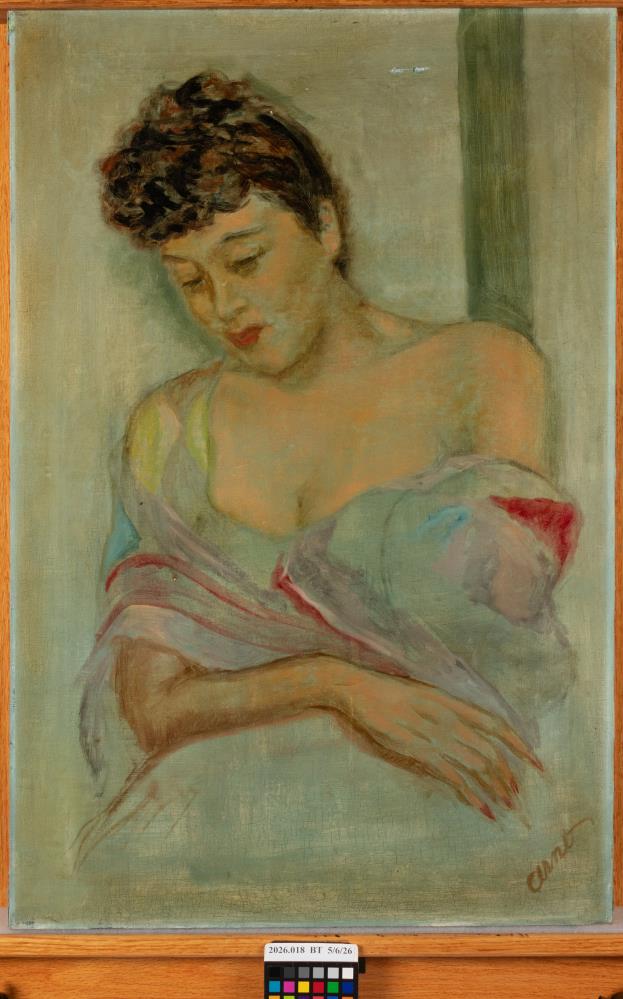
 

A woman with curly hair and bare shoulders looks down pensively, draped in a pastel-colored cloth, painted in soft, muted tones.

Sig Arno painted Kitty’s portrait in the early 20th century. The actor and artist signed the work in the bottom right corner using ochre-colored paint, as seen in this before-treatment image.


Arno later gifted the portrait to friends, who passed it down within their family to members now living in Nebraska. The current owners brought it to the Paintings Lab over a handful of concerns about its condition.
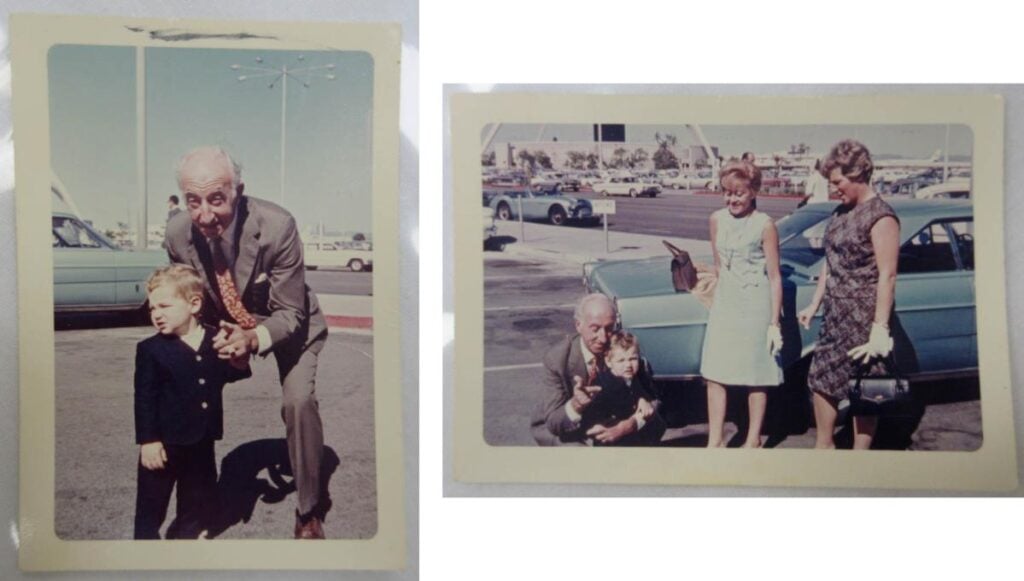
 

Two vintage photos show adults and a child standing in a parking lot beside a light blue car, with buildings and parked cars in the background.

Sig Arno in 1965, in photographs owned by family friends.


Scattered paint losses and a network of sharp cracks indicated the paint layer was vulnerable and at risk of further loss. There was also a bulge in the canvas near the right edge, and the overall varnish had yellowed and darkened with age.
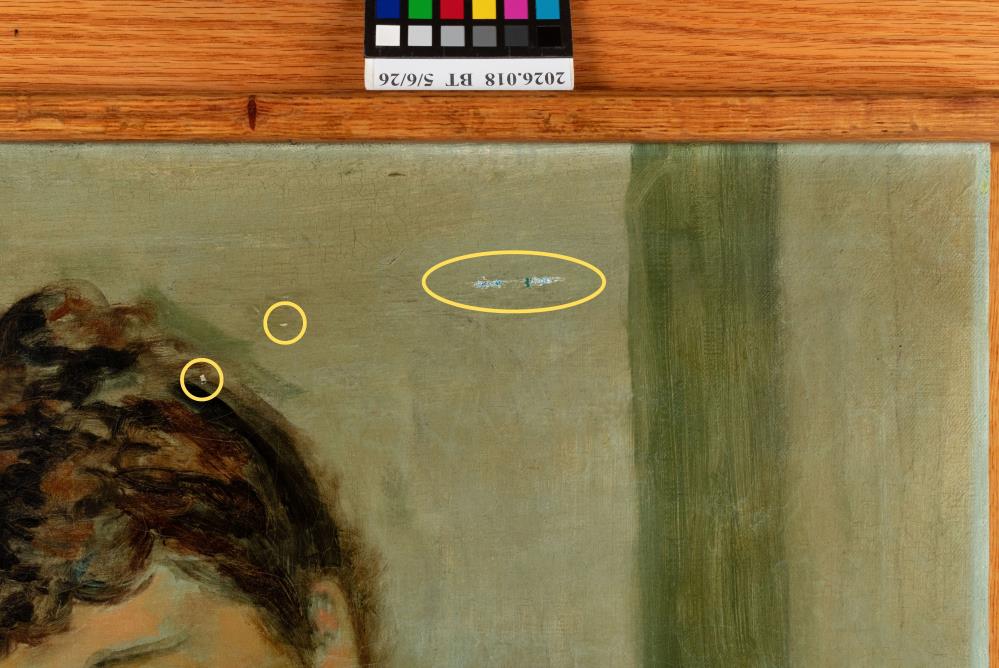
 

Close-up of a painting’s upper corner showing three small areas of paint damage circled in yellow, next to a wooden frame and a color calibration card at the top.

In the before-treatment image above, small losses of paint are visible around Kitty’s head. An impact of some kind had also caused a horizontal disturbance in the paint, about two inches long and crumbling. 
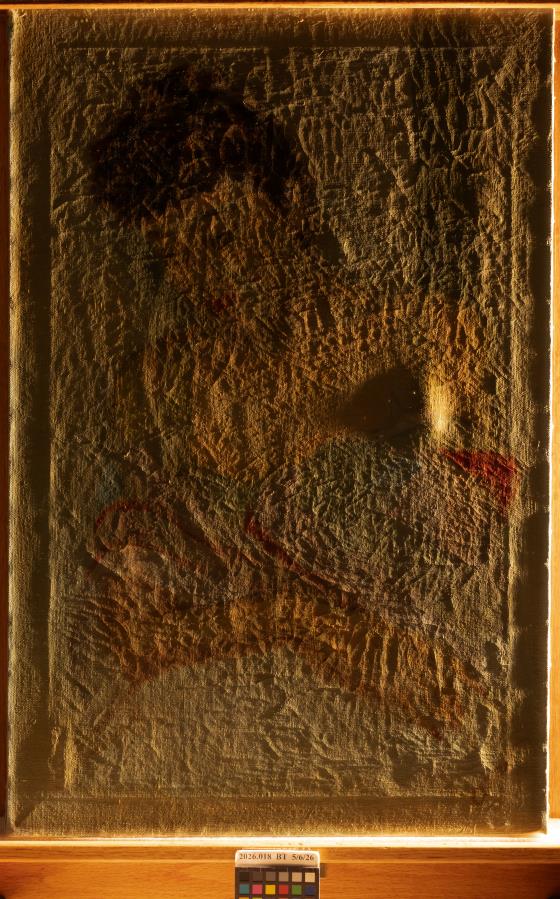
A textured, aged painting with barely visible figures illuminated by yellow light; a color calibration card is placed below the artwork.

A bulge in the canvas can be seen in a before-treatment image taken in raking light, or light from an extreme angle that shows the texture of the surface.


To conserve the painting, we first consolidated losses and sharp cracks using an adhesive. The most severely lifting cracks were further stabilized with gentle heat and pressure to relax them back into place. The bulge was progressively flattened using local humidification cycles.

The next step was to replace the discolored varnish. We carefully cleaned dirt and grime from the surface, removed the old coating, and applied a new, stable varnish that’ll protect the original paint well into the future.
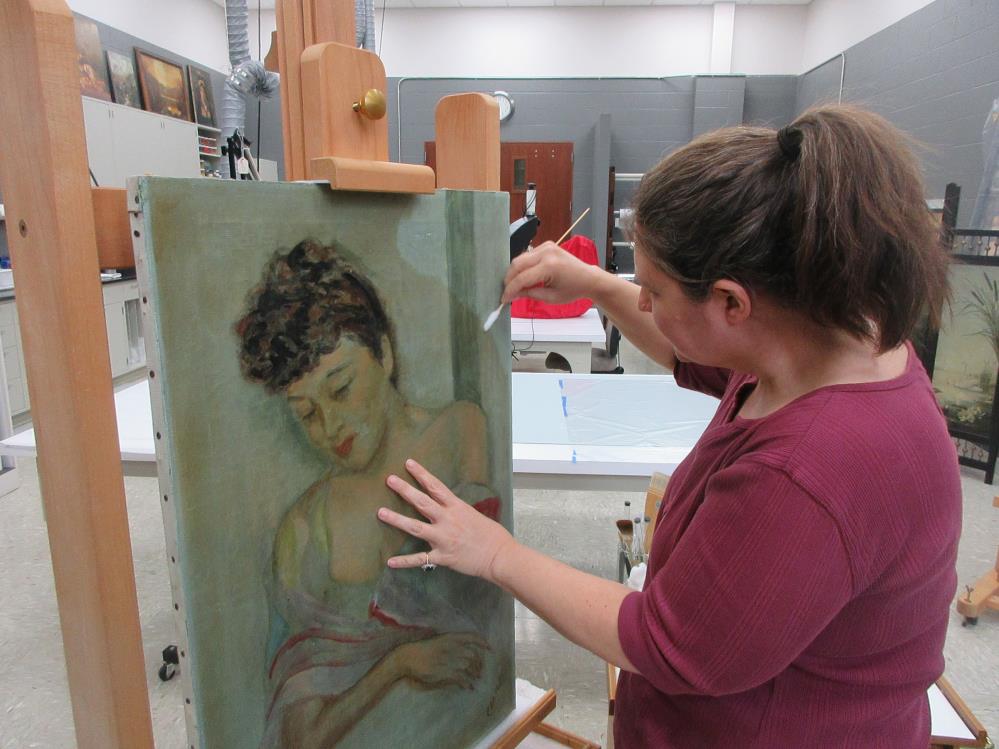
 

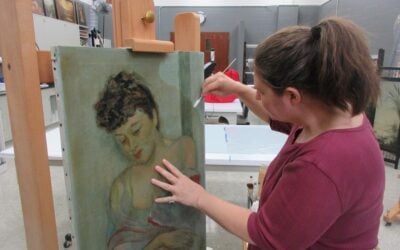
A woman in a red shirt restores a painting of a woman using a brush in an art studio.

These during-treatment images show the progression of the varnish removal. Above, Paintings Conservator Melissa Gardner clears old varnish from the top right corner of the painting using solvents chosen through testing. 
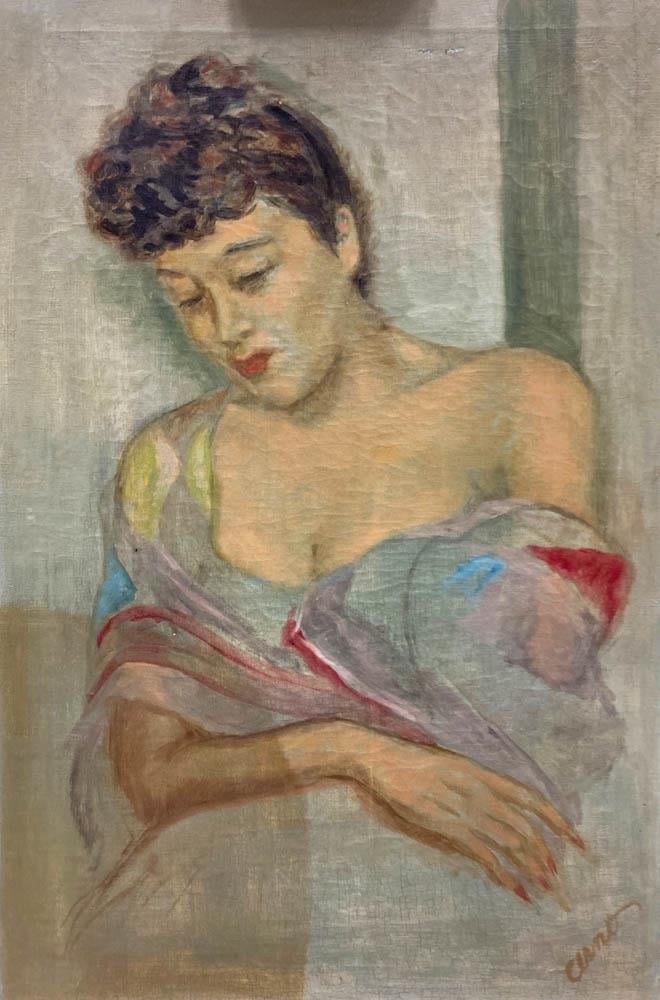
A woman with dark hair looks down, partially draped in a light, colorful shawl with soft brushstrokes. The background is muted and simple.

The varnish has been removed from all but the bottom left portion of the portrait.


With the original paint structurally sound and protected, we filled and retouched the losses using gesso and conservation paints. A final varnish layer was applied to protect both Arno’s work and the retouching.

One component of the painting that didn’t receive treatment was a small rectangular piece of canvas that had been used to patch a tear in the bottom left corner. The patch was clearly cut from one of the turnover edges and Arno’s brushstrokes extended over it seamlessly, indicating the repair was likely made by the artist himself before he started painting.
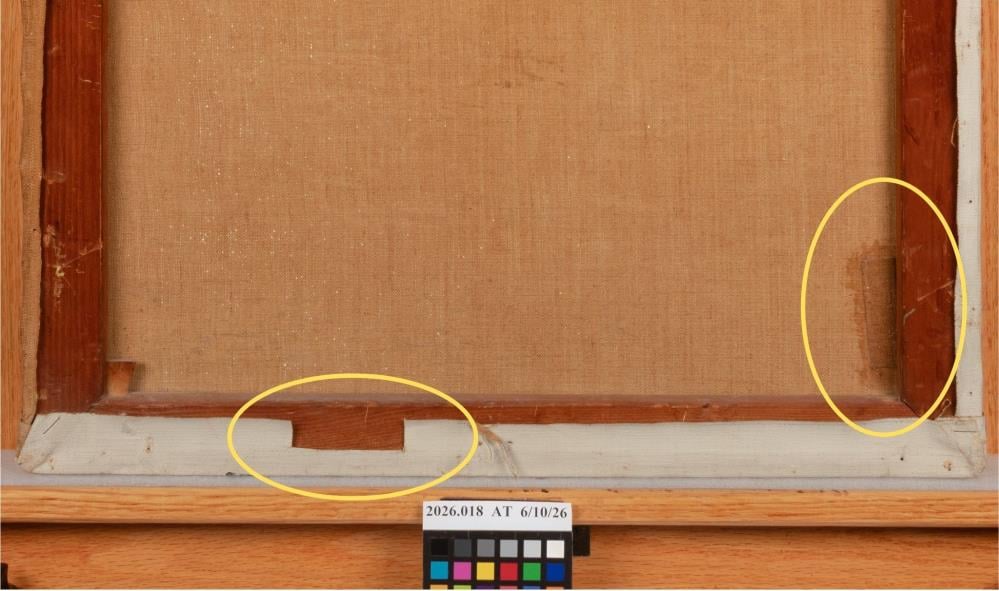
 

Back of a framed canvas painting with two damaged areas circled in yellow, one on the lower edge and one on the right edge, above a color calibration card.

The patch was applied to the back of the canvas to repair a tear about four inches long. In the image above, the patch is visible at the bottom right edge of the painting; the area from which it was cut is visible along the bottom turnover edge.


With treatment complete, the painting is now clean, stable, and reframed.

Returned to the descendants of Arno’s friends, this tribute to Kitty, with its vibrant reds and cool blues freed from decades of yellowed varnish, is ready to take center stage once again.
Become a Member!

Our members make history happen.

Join Now

You May Also Enjoy

Spotlight on a Star: Conserving the Art of Actor Sig Arno

Spotlight on a Star: Conserving the Art of Actor Sig Arno

Marker Monday: Shell Creek Pawnee Settlements

Marker Monday: Shell Creek Pawnee Settlements

Marker Monday: Republican Pawnee Village

Marker Monday: Republican Pawnee Village

No results found.

About NSHS

The Nebraska State Historical Society was founded in 1878 by citizens who recognized Nebraska was going through great changes and they sought to record the stories of both indigenous and immigrant peoples. It was designated a state institution and began receiving funds from the legislature in 1883. Legislation in 1994 changed NSHS from a state institution to a state agency. The division is headed by Director Daryl Bohac. They are assisted by an administrative staff responsible for financial and personnel functions, museum store services, security, and facilities maintenance for NSHS.

Explore Nebraska

Discover the real places and people of our past at these NSHS sites.

Upcoming Events

View our new and upcoming events to see how you can get involved.

Become a Member

The work we do to discover, preserve, and share Nebraska's history wouldn't be possible without the support of NSHS members.

NSHS Education

Learn more about the educational programs provided at our museums, sites, and online.

Education Digital Learning Resources

Find games, lists, and more to enhance your history education curriculum.

Latest Hall of Fame Inductee

The Nebraska Hall of Fame was established in 1961 to officially recognize prominent Nebraskans.

Listen to our Podcast

Listen to the articles and authors published in the Nebraska History Magazine with our new Nebraska History Podcast!

Nebraska Collections

NSHS's mission is to collect, preserve, and open our shared history to all Nebraskans.

Our YouTube Video Collection

Get a closer look at Nebraska's history through your own eyes, with our extensive video collections.

Additional Research Resources

NSHS's Research and Reference Services help connect you to the material we collect and preserve.

NSHS Services

Digital Resources

Find all of our digital resources, files, videos, and more, all in one easy-to-search page!

Support The Historical Society

Make a cash donation to help us acquire, preserve, and interpret Nebraska’s history. Gifts to the Nebraska State Historical Society help leave a legacy and may help your taxes, too! Support the work of NSHS.

Volunteers are the heroes of NSHS. So much history, so little time! Your work helps us share access to Nebraska’s stories at our museums and sites, the reference room, and online.