Marker Monday: Deer Park Hotel

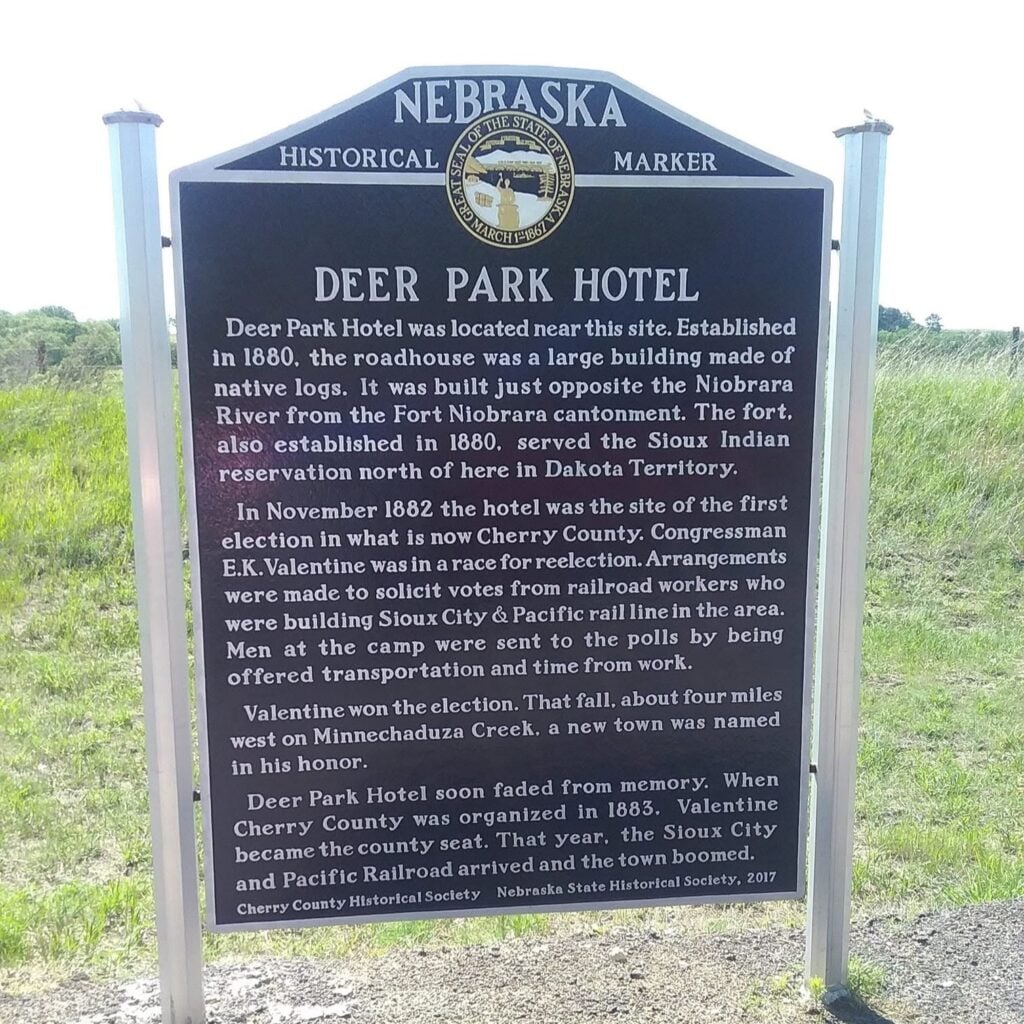
A Nebraska historical marker titled “Deer Park Hotel,” detailing the site’s history, the 1882 election, and the founding of the town of Valentine.

Photo Courtesy of Burton H.


Marker Text

Deer Park Hotel was located near this site. Established in 1880, the roadhouse was a large building made of native logs. It was built just opposite the Niobrara River from the Fort Niobrara cantonment. The fort, also established in 1880, served the Sioux Indian reservation north of here in Dakota Territory.


In November 1882 the hotel was the site of the first election in what is now Cherry County. Congressman E.K. Valentine was in a race for reelection. Arrangements were made to solicit votes from railroad workers who were building Sioux City & Pacific rail line in the area. Men at the camp were sent to the polls by being offered transportation and time from work.


Valentine won the election. That fall, about four miles west on Minnechaduza Creek, a new town was named in his honor.


Deer Park Hotel soon faded from memory. When Cherry County was organized in 1883, Valentine became the county seat. That year, the Sioux City and Pacific Railroad arrived and the town boomed.


Location

Highway 12, across from the former Dear Park Golf Course. To view the marker’s location click here.
Become a Member!

Our members make history happen.

Join Now

You May Also Enjoy

Protected: Nebraska History Magazine: Vol. 107 / No. 3 / Fall 2026

Protected: Nebraska History Magazine: Vol. 107 / No. 3 / Fall 2026

Marker Monday: Deer Park Hotel

Marker Monday: Deer Park Hotel

The story behind One of Ours, Willa Cather’s controversial, Pulitzer Prize-winning World War I novel

The story behind One of Ours, Willa Cather’s controversial, Pulitzer Prize-winning World War I novel

No results found.

About NSHS

The Nebraska State Historical Society was founded in 1878 by citizens who recognized Nebraska was going through great changes and they sought to record the stories of both indigenous and immigrant peoples. It was designated a state institution and began receiving funds from the legislature in 1883. Legislation in 1994 changed NSHS from a state institution to a state agency. The division is headed by Director Daryl Bohac. They are assisted by an administrative staff responsible for financial and personnel functions, museum store services, security, and facilities maintenance for NSHS.

Explore Nebraska

Discover the real places and people of our past at these NSHS sites.

Upcoming Events

View our new and upcoming events to see how you can get involved.

Become a Member

The work we do to discover, preserve, and share Nebraska's history wouldn't be possible without the support of NSHS members.

NSHS Education

Learn more about the educational programs provided at our museums, sites, and online.

Education Digital Learning Resources

Find games, lists, and more to enhance your history education curriculum.

Latest Hall of Fame Inductee

The Nebraska Hall of Fame was established in 1961 to officially recognize prominent Nebraskans.

Listen to our Podcast

Listen to the articles and authors published in the Nebraska History Magazine with our new Nebraska History Podcast!

Nebraska Collections

NSHS's mission is to collect, preserve, and open our shared history to all Nebraskans.

Our YouTube Video Collection

Get a closer look at Nebraska's history through your own eyes, with our extensive video collections.

Additional Research Resources

NSHS's Research and Reference Services help connect you to the material we collect and preserve.

NSHS Services

Digital Resources

Find all of our digital resources, files, videos, and more, all in one easy-to-search page!

Support The Historical Society

Make a cash donation to help us acquire, preserve, and interpret Nebraska’s history. Gifts to the Nebraska State Historical Society help leave a legacy and may help your taxes, too! Support the work of NSHS.

Volunteers are the heroes of NSHS. So much history, so little time! Your work helps us share access to Nebraska’s stories at our museums and sites, the reference room, and online.