The collection of the John G. Neihardt Center includes publications and personal belongings of the Nebraska Poet Laureate in Perpetuity. It also features gifts given to him by Nicholas Black Elk, the Oglala Lakota religious leader whose interviews with Neihardt formed the basis of his notable work Black Elk Speaks.
One of the most beloved artifacts in the collection, however, is a sculpture by the artist Mona Martinsen Neihardt.
Originally from New York, Mona studied in Paris with the sculptor Auguste Rodin. She struck up a correspondence with John after reading A Bundle of Myrrh, a book of his lyric poetry. They fell in love, and Mona moved to Nebraska to marry John in 1908.
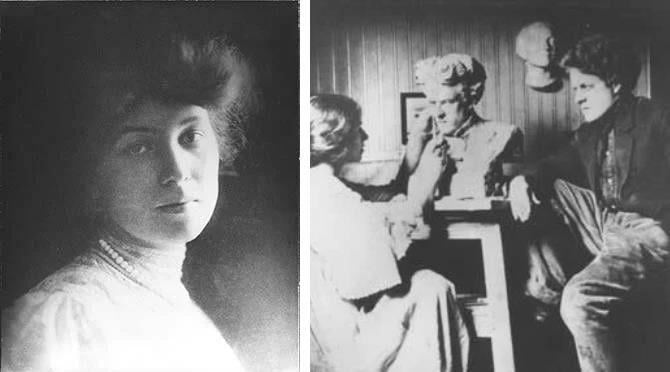
Sculptor Mona Martinsen Neihardt moved to Nebraska and married author John Neihardt in 1908. She continued to sculpt from her home studio, and they were married for nearly 50 years, until her death in 1958.
John built a studio at their Bancroft home so Mona could continue to sculpt. It was there, in 1909, that she created the cast plaster bust that would go on to become a visitor favorite at the Neihardt Center.
The sculpture is of Mona’s mother-in-law, Alice Culler Neihardt, who worked as a seamstress. Alice was a strong influence in John’s life, and John and Mona named one of their four children after her.
The bust depicts Alice with her head slightly tilted and her wavy hair gathered into a bun. Mona carved the words “Mother of John Neihardt” across Alice’s shoulders and signed the work below that. She also painted the sculpture and applied a protective varnish.
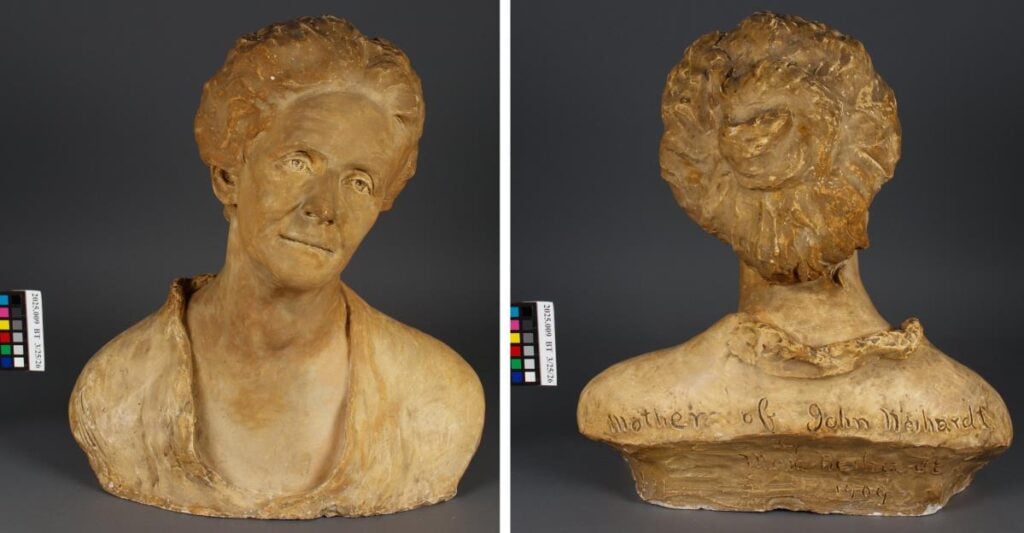
The cast plaster sculpture of Alice Culler Neihardt, pictured here in before-treatment images, is part of the collection of the John G. Neihardt Center in Bancroft. The Neihardt Center is an affiliate of the Nebraska State Historical Society and managed by the John G. Neihardt Foundation.
The Neihardt Center sought to have the work conserved so it could remain safely on long-term exhibition. While the bust arrived at the Ford Center structurally sound, it had a disturbing gray appearance.
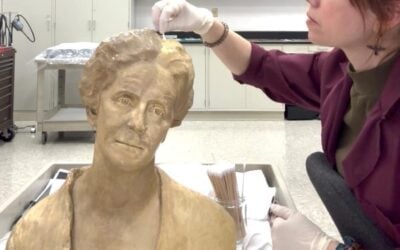
Treatment began by vacuuming the sculpture to remove loose dirt and particulate matter. Then we set out to clean the embedded soot and grime from the surface.
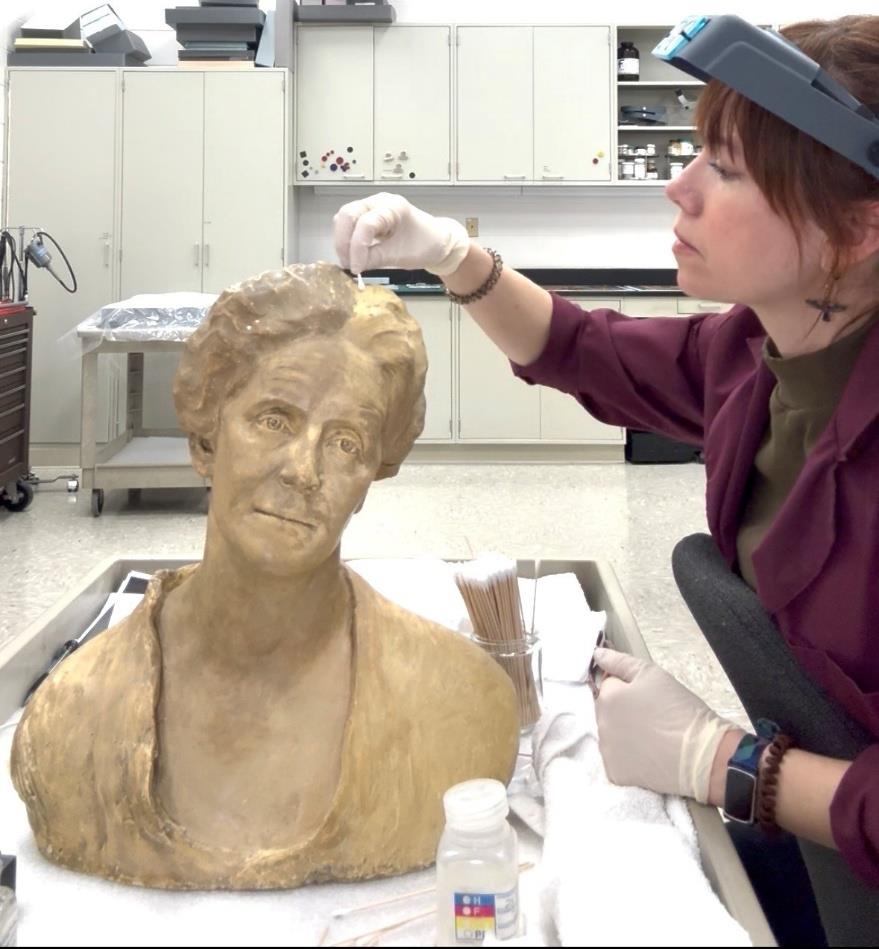
In this during-treatment image, Objects Conservator Rebecca Cashman removes dirt and grime from the surface of the sculpture.
Some areas, such as the top of Alice’s head, cleaned up easily using aqueous solutions chosen through testing. But other areas remained gray. We realized these large gray patches were actually overpaint, which had been applied at some point to disguise losses in the original paint.
We examined the sculpture under ultraviolet light to confirm how much of the paint was original and how much was overpainting applied at a later date. The exam showed that the overpainting was extensive, especially on Alice’s face and neck.
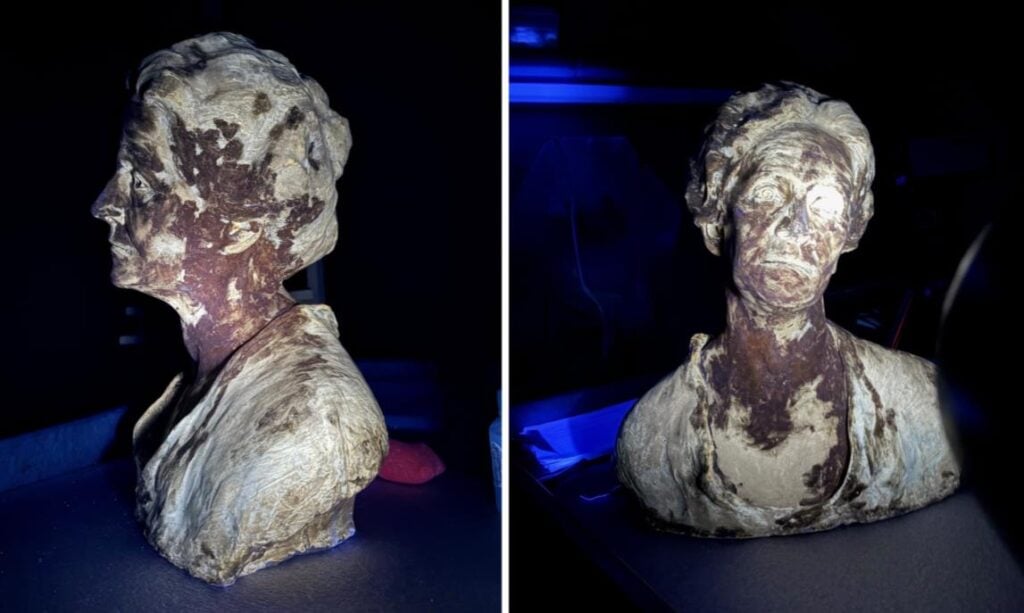
The extent of the overpainting is visible in these during-treatment images taken under ultraviolet light. The overpainted areas appear dark under UV light.
To remove the overpaint, we created and tested several solvent-based poultices. We ultimately used one that was able to take off the gray overpainting without disturbing the original paint and varnish below.
Removing the overpainting, however, exposed all the losses it had previously camouflaged.
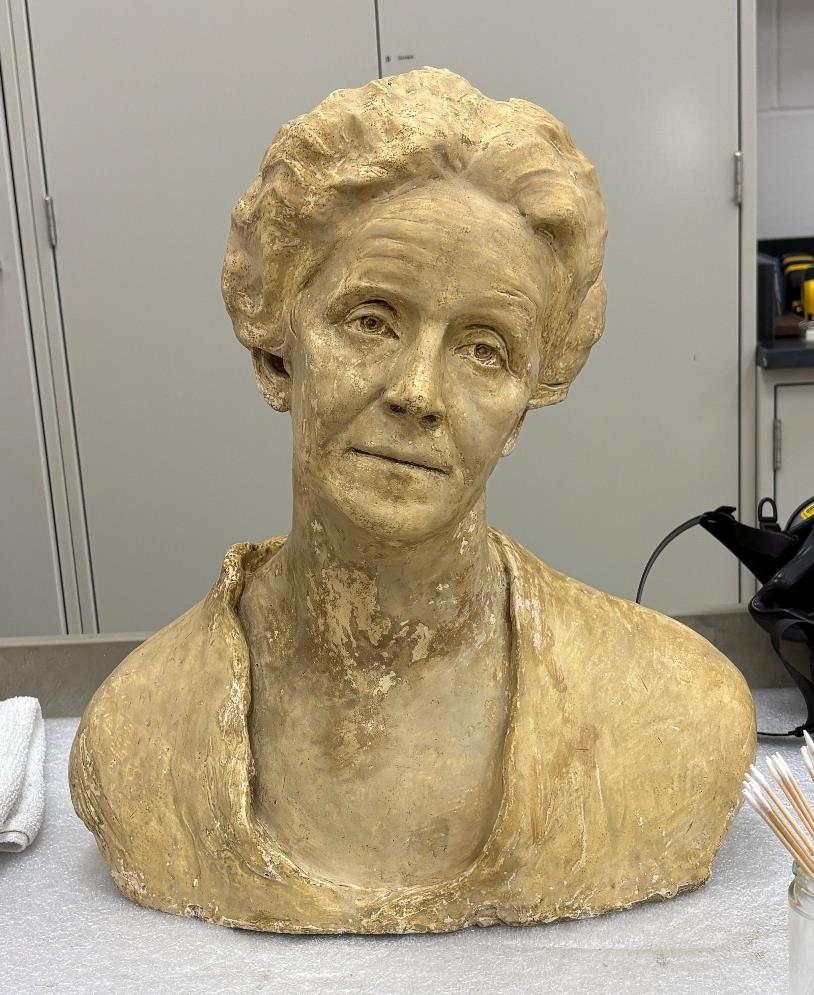
In this during-treatment image, the overpainting has been removed, revealing losses of the original paint on Alice’s face and neck. The losses were filled using reversible materials after a barrier layer was applied.
To finish treatment, a barrier layer was applied to isolate and protect the original surface. Then reversible materials were used to fill the losses and tone the fills so they resembled the original surface.
The sculpture, now clean and looking much more like Mona intended, is back at the Neihardt Center on exhibition. There, Alice will continue to greet visitors for years to come.
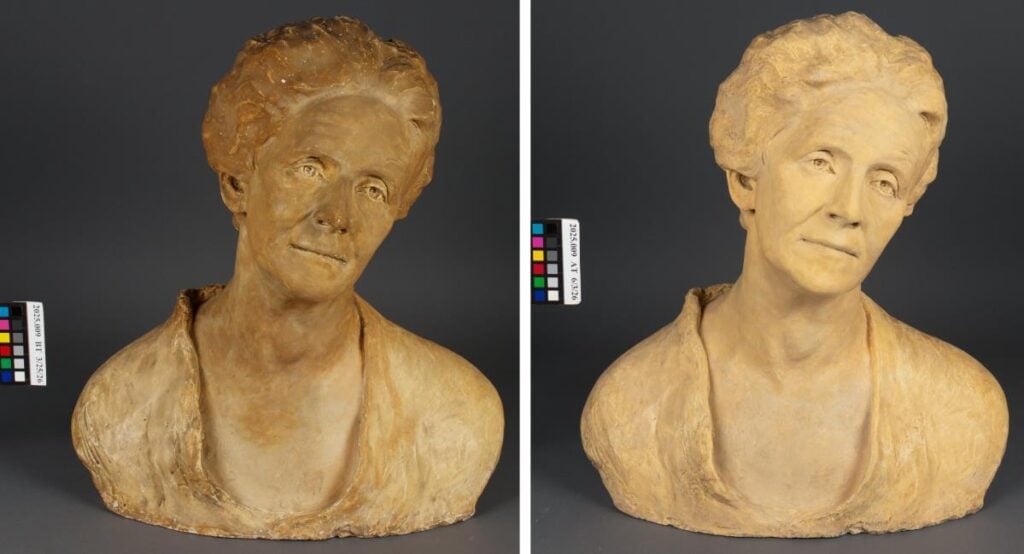
Before- and after-treatment images of the overall sculpture.
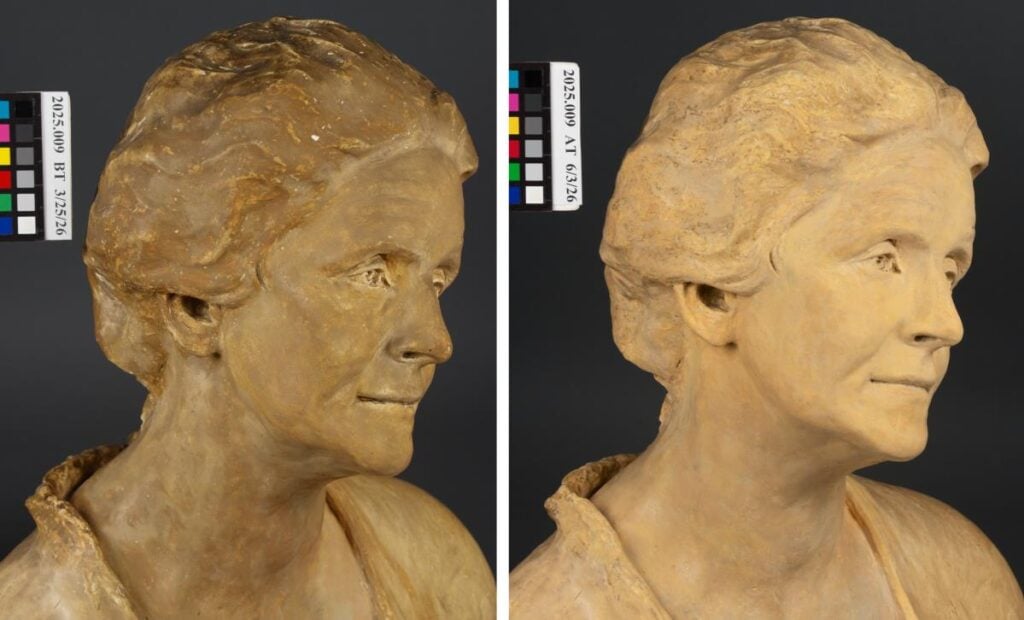
Before- and after-treatment images of Alice’s profile.
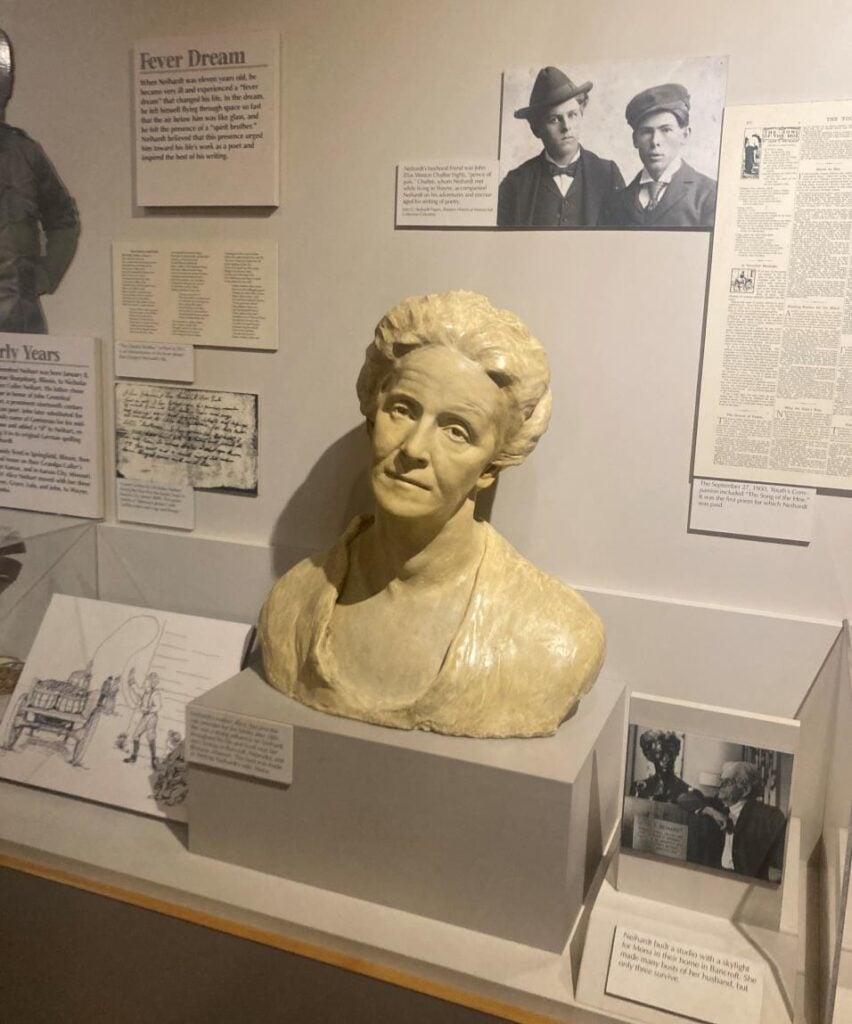
The bust, reinstalled at the Neihardt Center after treatment.