By William McLain
Death is a word that no parent ever wants to hear. During the winter of 1882-1883, death and heartbreak swept through many homes in Central City, Nebraska. The killer was diphtheria and the victims were children.
The dead included: Cora Flint (age 6), October 27; Charles Shaver (13), November 12; Joise Savory (3), November 20; Ruth Overholt (2), November 23; Lester Boyd (5), December 1; Mabel DaLee (2), December 2; Dolly Harmon (5), December 3; Inez Dykeman (7 months), December 4; Bertel Burroghs (13), December 23; Johnnie Joe (11), December 27.
The deaths continued in the early months of 1883: Willie Gardner (1 month and 26 days), January 4; Letitia Patterson (8), February 2; Mary Patterson (4), February 6; Carrie Patterson (2), February 11; Leonora Hutchings (5), March 11.
Central City, Nebraska, has been around since 1866. In its early days it was known as a fur trading post for the surrounding area. Its original name was Lone Tree, but it was officially changed in 1877. While it has more than three thousand residents today, in 1880 it had a population of only 648.
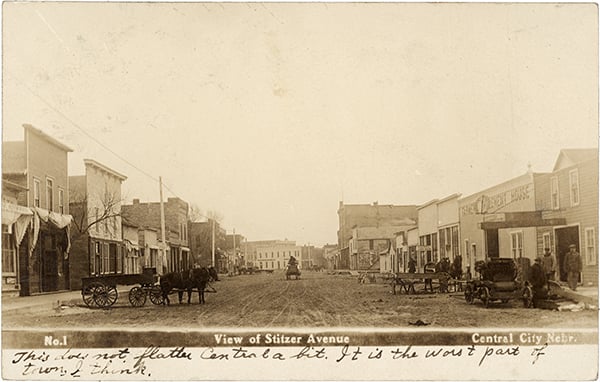
NSHS RG2241-1-6
Diphtheria is a serious bacterial infection that affects mucus membranes and the respiratory system. It is rare in today’s world but used to be a child killer. Only after 1920 did vaccinations become available; in 1920 alone, the disease is estimated to have caused 13,000-15,000 deaths in the United States.
Children are easily exposed to diphtheria, but the infection can be deadly for adults as well. It can spread through water droplets through coughing, or by the bacteria multiplying on the face or hands. The bacteria produce a toxin that damages tissue of the infected area, most commonly in the throat and nose. People living in crowded environments or unsanitary conditions can contribute to infection of this disease. Left untreated, victims can experience breathing difficulties, heart damage, and nerve damage. Diphtheria is most deadly to children from the ages of two months to six years old.
Diphtheria was not the only killer of the day. Town and cities contributed to the spread of disease by having crude sewer systems or outhouses that allowed human waste to seep into groundwater. Trash was burned or tossed onto the streets. Transportation was mostly by horse, and animal waste was often left where it fell.
Dysentery, typhoid fever, and tuberculosis were the heavy hitters of the day. On the Nebraska frontier doctors were few and often far away, and the care they provided was rudimentary. In Central City, the one saving grace during this time of suffering was Doc Gawne, who moved the town around 1875 and treated the people of Merrick County through the epidemic of 1882-1883.
In the Central City Cemetery, you can see a stone stump tree gravestone. Belonging to the Persons family, this gravestone has a somber story behind it. Harrison W. and Mary Persons moved from Vermont in 1871. They had three sons, Fred, Harry, and Harrison E. By 1880 Harrison E. had married Chrissie Jane Burk and had two children, Jesse and Frankie. The children were not older than three when in November 1880, a third child was born, Hattie.

Photo: Ann Berry, Find a Grave
Two months later little Hattie died from causes unknown or at least not mentioned in her obituary. The next blow to the family came the day after Christmas when two-year-old Frankie passed away due to diphtheria. Eleven days later, diphtheria struck again and took 10-month-old Percy. Three days after that it took five-year-old Jessie. This all happened two years before Central City’s deadliest diphtheria outbreak.
Having three of your children die within two weeks is something my mind can’t grasp. And the losses spread to their extended family—around this time Harrison’s brother, Fred, and Fred’s wife Jennie would grieve the loss of their two children, Bertha, age two, and George, age six.
While people suffered and toiled in their illness, others sought to exploit them:
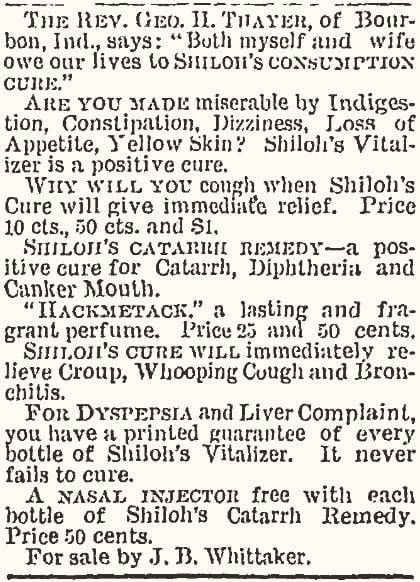
“Shiloh’s Consumption Cure, Are you made miserable by ingestion, dizziness, loss of appetite, or yellow skin? Shiloh’s vitalizer is a positive cure. Why will you cough when Shiloh’s cure will give you immediate relief. Price 10 cts., 50cts. and $1 a bottle. Shiloh’s Catarrh Remedy – a positive cure for catarrh, diphtheria and canker mouth. Shiloh’s cure will immediately relieve croup, whooping cough, and bronchitis. For dyspepsia and liver complaints, you have a printed guarantee on every bottle of Shiloh’s Vitalizer. It never fails to cure.”
Ads like this littered newspapers all over the U.S. in the late 1800s and into the early twentieth century. Various “patent medicines” claimed to cure almost any bodily illness. These so-called wonder tonics often contained ingredients of questionable effectiveness and safety. Shiloh’s tonic contained chloroform as a depressant, oil of tar as an additive, oil of peppermint as a flavor, terpin hydrate for decongestion, senna as a natural laxative, glycerine to sweeten the tonic, and prussic acid (hydrogen cyanide) to cut the tonic.
If you lived in the late nineteenth century and were unlucky enough to catch diphtheria, how would you have been treated? Diphtheria varied from person to person but no matter how severe the infliction, the patient was to be isolated for no less than forty days. It was common practice after the forty-day quarantine to have the infected person take a bath before they met anyone. The afflicted person’s clothes must be heated to to kill any bacteria.
An 1881 column in the Central City Courier gives instructions for what was said to be an instant cure for diphtheria: “A spoonful of flowers of Sulphur is well stirred in a wine glass of water. The mixture is to be used as a gargle, and afterwards to be swallowed.” Cure-alls or shared remedies usually did not work and at times made the patient experience more pain and suffering before succumbing.
The story of Central City’s diphtheria outbreak reminds us of the fragility of life in nineteenth century Nebraska and the perseverance of those who endured such tragedies. The grief of the Persons family, among others, is etched into gravestones that stand today as silent witnesses to their suffering.
Though medicine and sanitation have advanced far beyond what people of those times could have imagined, their experiences remain a powerful reminder of how far we’ve come and of the human cost paid along the way. The history of Central City is not only one of hardships, but also of endurance, community, and the unbreakable human spirit.
William McLain is a senior at Nebraska Wesleyan University, majoring in history with a minor in criminology. He completed this article as part of an internship with the Nebraska State Historical Society.
Sources:
Traci Rylands, “Nebraska’s Central City Cemetery: The ‘Dread Scourge’ of 1882, Part II,” Adventures in Cemetery Hopping, https://adventuresincemeteryhopping.com/2017/04/28/updated-nebraskas-central-city-cemetery-two-precious-gems-and-a-lone-tree-part-ii/
Central City Archives, online newspaper archive, Central City Courier, July 6, 1882.
Central City Archives, online newspaper archive, Central City Courier, July 13, 1882.
Central City Archives, online newspaper archive, Central City Courier, December 7, 1882.
Central City Archives, online newspaper archive, Central City Courier, January 11, 1883.
Central City Archives, online newspaper archive, Central City Republican, May 4, 1933.
(Posted 12/11/2025)