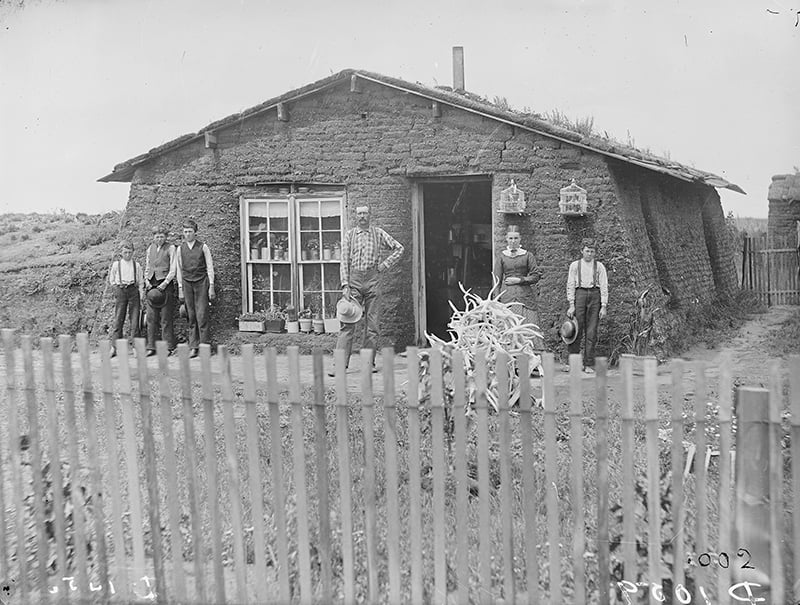
Wilbur Irvin Cram family at their sod house in Loup County, 1886. Cattle liked to rub against sod houses; a good fence kept them away. RG2608-0-1059
By David L. Bristow
It takes a good fence to keep livestock out of a farmer’s crops or garden. In the heavily wooded eastern United States, this was often done with split-rail fences. But how do you build a fence on the plains, where trees are scarce?
Nebraska historian Everett Dick wrote that pioneers used to hobble or tether horses to keep them from wandering, but controlling herds was a bigger problem. Until Nebraska’s 1870 herd law, it was your responsibility to fence your neighbor’s livestock out, and not the stockman’s responsibility to fence them in.
Osage orange hedgerows were once popular in southeastern Nebraska. Seedlings were planted close together and their branches carefully intertwined to grow into a hedge that was “hog tight, horse high, and bull strong.” Daniel Freeman’s circa-1875 hedgerow still remains at Homestead National Historical Park near Beatrice.
But hedgerows were too thirsty for much of Nebraska. The opening of lumberyards (and railroads to supply them) created more options, but a small landowner might have to pay more for fencing than for the land itself.
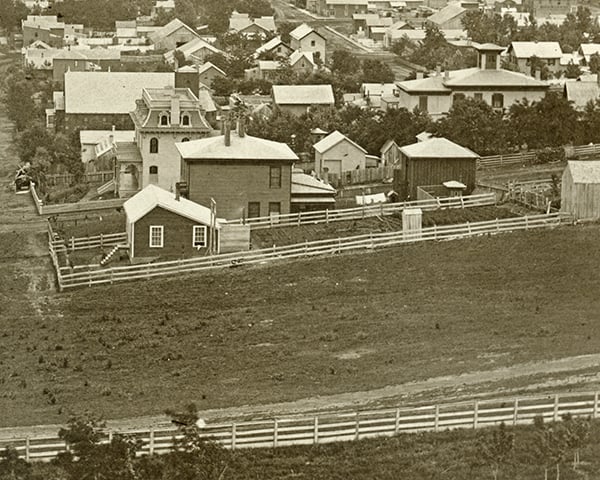
Omaha residents needed strong fencing to keep roaming hogs out of their gardens. The view is east from the old capitol grounds (present site of Central High School), 1868. RG2341-2-p06
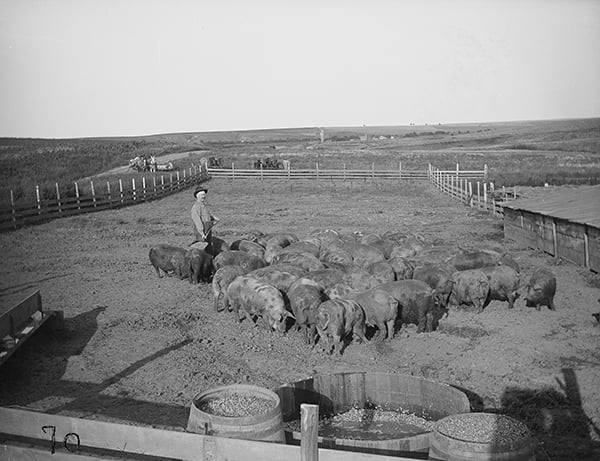
We’re guessing that the lumber for this hog pen is probably not local. Amherst, Buffalo County, 1903. RG2608-0-1862-a
Barbed wire transformed Nebraska. Invented in Illinois in the 1870s, it solved a huge problem for prairie farmers, but also sparked controversy. One manufacturer tried to establish a monopoly by claiming patent rights. Until the courts intervened, the company threatened to sue farmers who bought from its competitors unless they paid a license fee.
In cattle country, some big ranchers used barbed wire to illegally fence public land for their exclusive use. One night in 1885, Custer County settlers cut 15 miles of barbed wire fence around a local ranch.
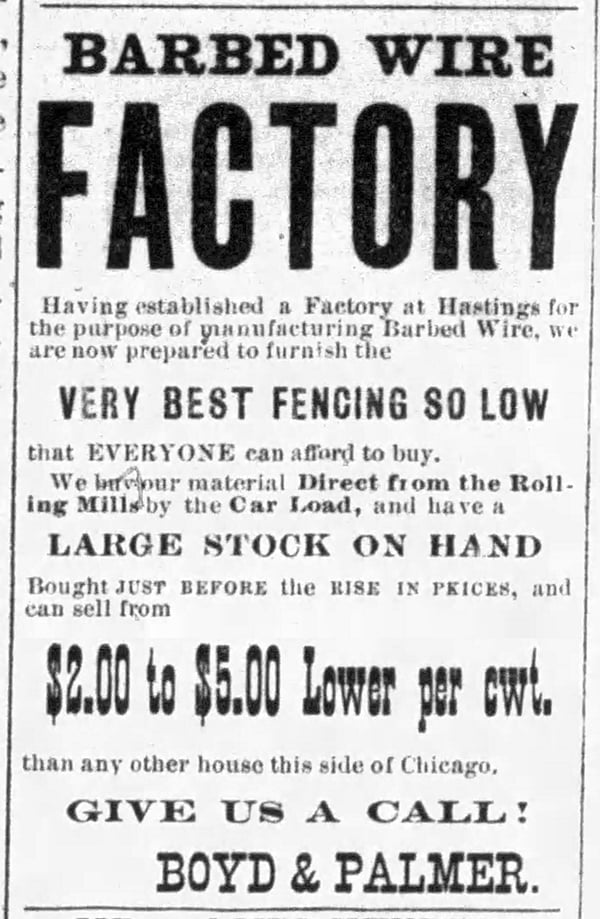
Hastings Journal, Feb. 19, 1880.
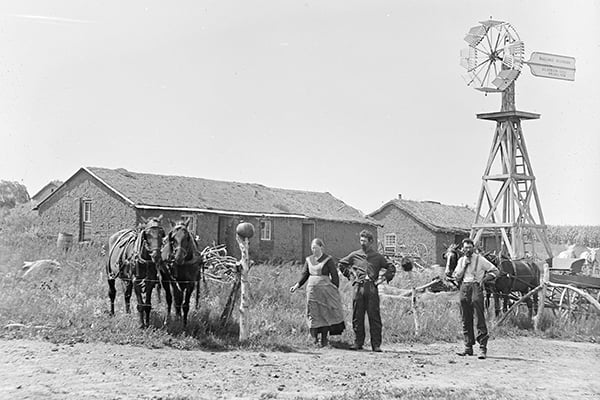
Barbed wire protects George and Harriet Ankeney’s soddie near Cummings Park, Custer County, circa 1885. RG2608-0-1078-a
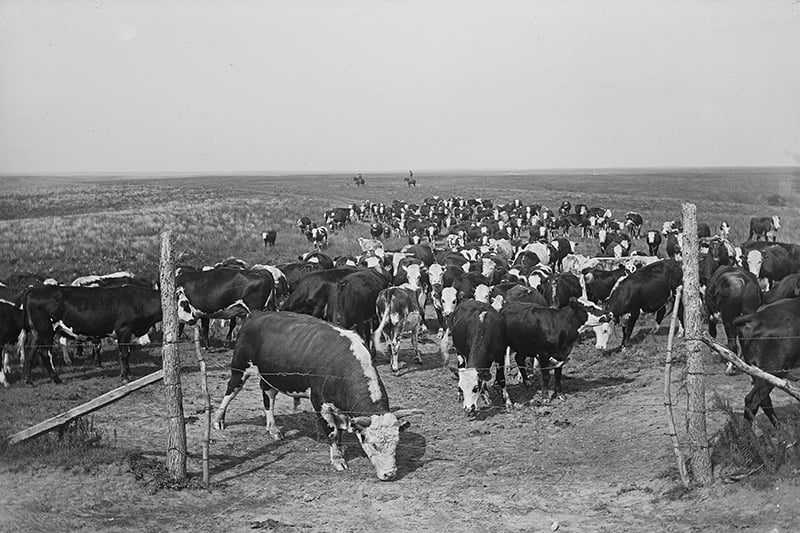
Barbed wire marked the end of the free-range cattle era. Undated Solomon Butcher photo, probably Custer County. RG2608-0-1756-b
Entrepreneurs, meanwhile, made barbed wire easier to use. “Any boy twelve years old can operate the machine,” boasted Josiah M. Robinson of Kenesaw, describing his patented wire reel. Robinson soon moved his manufacturing operation to Hastings and sold his product for several years in the 1890s. He is an example of a long Nebraska tradition: the farmer-inventor-entrepreneur.
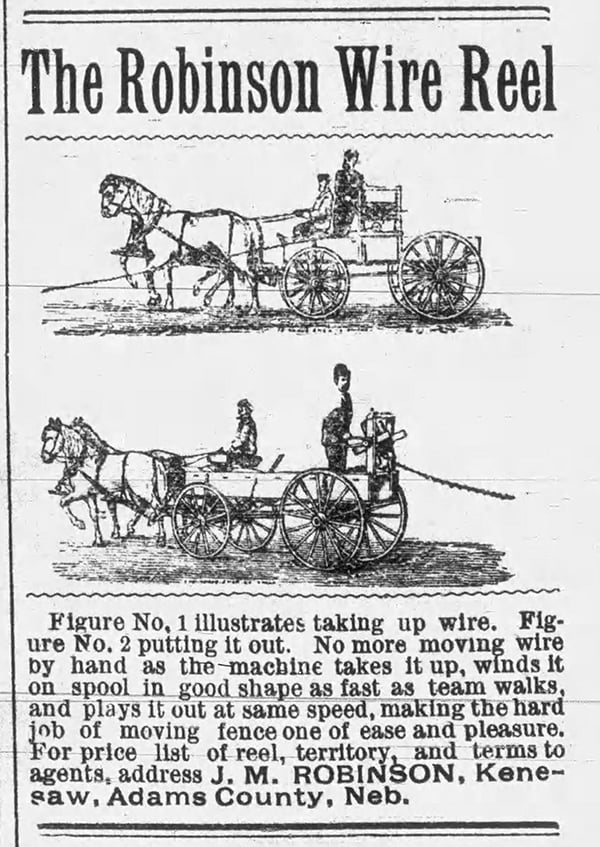
The Nebraska Farmer, Oct. 7, 1892.
Livestock-proof fences weren’t only for farms. They also protected property in Nebraska’s 19th century cities, where residents commonly kept chickens, milk cows, and even hogs.
“Has the University no rights that cows are bound to respect?” asked the University of Nebraska student newspaper in 1879. “A number of these quadrupeds may be seen every day watching around the corner of the building to pounce upon the first blade of grass that makes an appearance. Have ’em before the discipline committee!”
Groundskeepers planted a hedge and strung barbed wire, and in 1892 enclosed the campus with a wrought iron fence (which now lines O Street beside Wyuka cemetery). But by then the fence probably had more to do with controlling humans than cows.
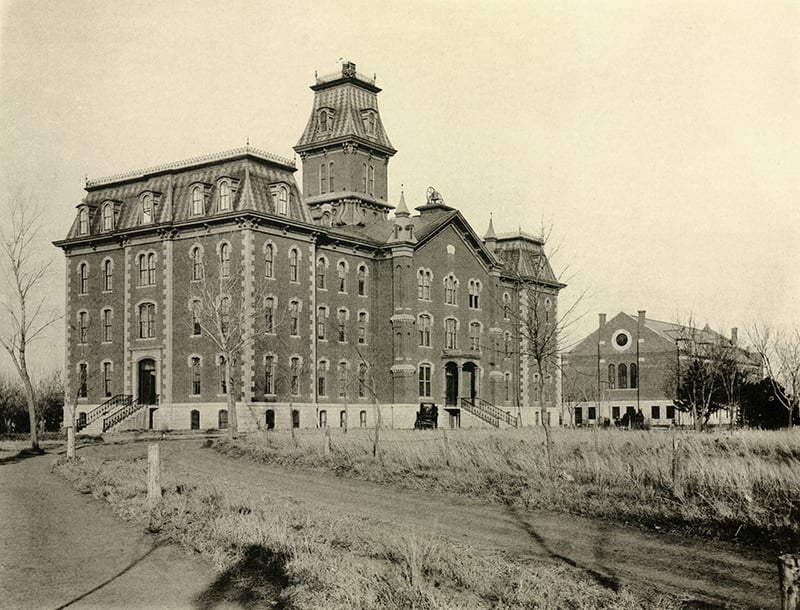
A strand of barbed wire protects University of Nebraska grounds in this photo taken between 1887 and 1900. University Hall, the original building on campus, was razed in 1948. RG2758-1-24
This article was first published in the August-September 2024 issue of NEBRASKAland magazine.
Sources:
Everett Dick, Conquering the Great American Desert, Chapter 4, especially pp. 70-74, 87-89.
David Bristow, “Barbed Wire Reel Ad, Kenesaw and Hastings, 1890s,” Nebraska History Moment (Nebraska State Historical Society), March 3, 2020.
Robert N. Manley, Centennial History of the University of Nebraska, Vol. 1: Frontier University, 1869-1919 (Lincoln: University of Nebraska Press, 1969), 250-251.
Date of campus photo: See building plans at An Architectural Tour of Historic UNL, University of Nebraska-Lincoln (2005), https://historicbuildings.unl.edu/plans.php?type=building&id=11. In the photo RG2758-1-24, Grant Memorial Hall stands to the right of University Hall; Grant Hall was built in 1887, and a 1900 addition changed its appearance, so this photo must date from 1887-1900.