Nebraska’s 1898 World’s Fair

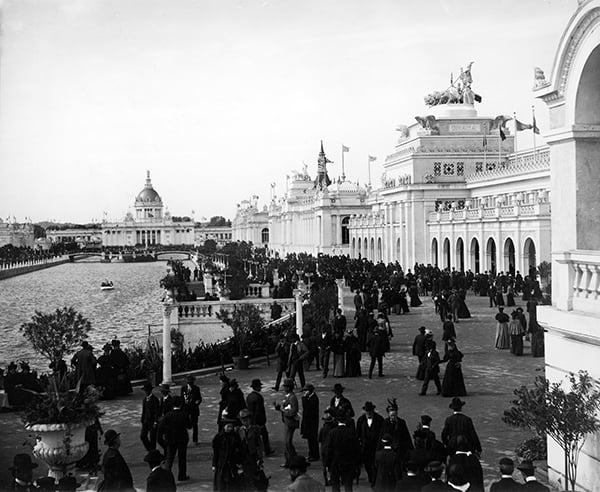
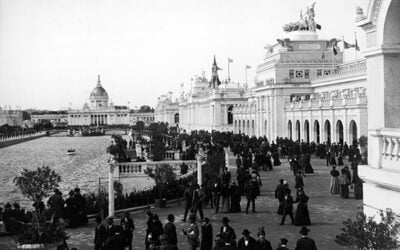
Crowds walk along a grand promenade beside a large reflecting pool with neoclassical buildings at the 1893 Chicago World’s Fair.

The Grand Court, looking west. RG2752AM


By David L. Bristow, Editor

More than 2.6 million people attended the Trans-Mississippi and International Exposition. Held from June through October 1898, it was the largest public event ever staged in Omaha.

Inspired by Chicago’s 1893 Columbian Exposition, the event was a huge financial gamble. Planning began a few years earlier during a severe economic depression, prolonged drought, and crop failures. Omaha businessmen prepared to risk large sums of money to lure tourists to a city in which some 5,000 houses stood empty.

Fortunately the economy recovered by the time the gates opened. Covering 184 acres, the Exposition grounds featured a Grand Court of white classical-style buildings housing displays of technology, commerce, agriculture, and the arts.

The Grand Court was built around a man-made lagoon nearly half a mile in length, its waters adorned with a large fountain encircling a statue of Neptune, and with Venetian gondolas that carried passengers. Nearby, the grounds also featured an Indian encampment, Buffalo Bill’s Wild West show, and two midways complete with rides, games, shows, restaurants, and various concessions.

It was even more impressive at night when the newfangled electric lights came on. Visitors were awed by the fair’s extensive use of outdoor incandescent lighting, with 14,000 light bulbs powered by a half-dozen steam generators. Historian Amanda Johnson has argued that electric lighting was as important to the Omaha fair as the Ferris wheel was to Chicago’s Columbian Exposition. Both drew visitors and were seen as symbols of modernity and technological prowess.
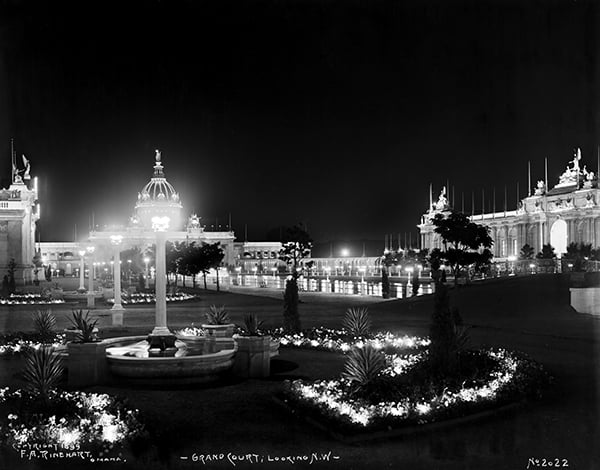
Night view of a grand illuminated courtyard with a central fountain, surrounded by manicured gardens and classical buildings.

Grand Court lit by incandescent bulbs, looking northwest. RG2752-1-1-1


Even the fair’s pretentious name sent a message. Boosters promoted it as a coming-of-age event not only for Omaha – now a regional hub city and no longer a frontier town – but also for the entire region west of the Mississippi River. And since the fair took place during the Spanish-American War, it coincided with America’s emergence as a rising international power.

The fair’s “Indian Congress,” meanwhile, was meant to represent the nation’s past. (It was a “congress” in the sense of a large gathering of multiple tribes, rather than a political body.) The Indian wars were all but over and the tribes were restricted to reservations. Most Americans assumed the Native population would continue its long decline, with the remainder assimilated. When President William McKinley visited the fair on October 12, the Omaha Bee commented that he led a nation that was “just commencing to play its great part upon the stage of the universe,” and that he was “rendered honor by a thousand representatives of a passing civilization that was in its way great.” Among the Native leaders greeting McKinley was the famous Apache warrior Geronimo.

In the end, Native peoples and cultures proved far more resilient than anticipated. The fairgrounds, on the other hand, were temporary by design. Made of plaster and lath, the fancy white buildings were torn down within a few years, and the former Grand Court became today’s Kountz Park.
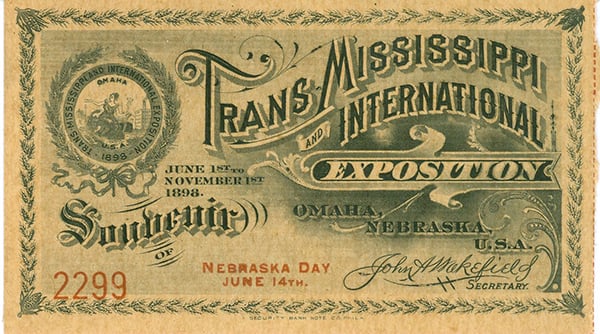
Ticket for the Trans-Mississippi and International Exposition in Omaha, Nebraska, dated June 1 to November 1, 1898, with “Nebraska Day June 14th” highlighted and serial number 2299.

Ticket for “Nebraska Day,” June 14, 1898. NSHS 7999-34-B
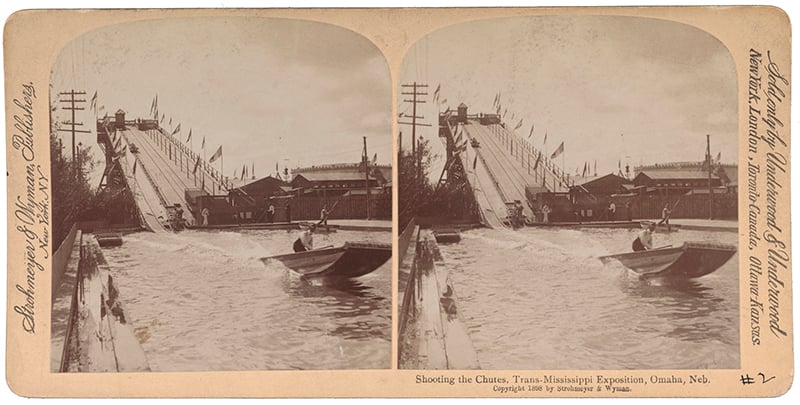
 

A boat descends a wooden chute into water at the Trans-Mississippi Exposition in Omaha, 1898, with people and flags visible on structures in the background.

Vendors sold souvenir 3-D stereoview cards of the Exposition. “Shooting the Chutes” was a popular ride on the Midway. Library of Congress
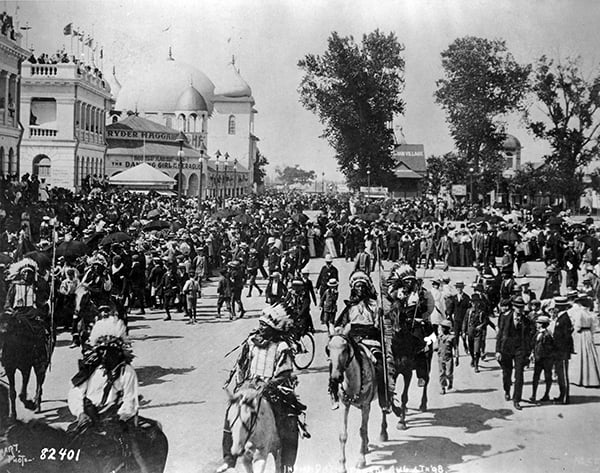
 

A historic black-and-white photo shows a crowded street parade with people on horseback and large crowds gathered by ornate buildings.

“Indian Day” parade, August 4, 1898. RG1739-0-3
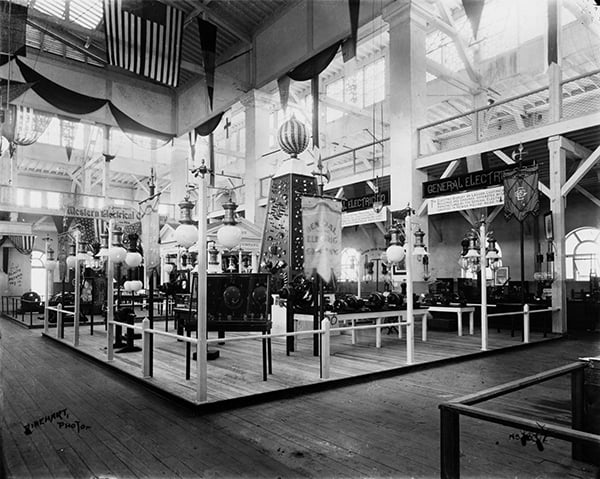
 

Black and white photo of an early 20th-century exhibition hall with General Electric displays, large lighting fixtures, and decorative banners hanging from the ceiling.

The Machinery and Electricity Building exhibited the latest technology. RG2752-01-10-1

This article first appeared in the October 2024 issue of NEBRASKAland magazine.
Become a Member!

Our members make history happen.

Join Now

You May Also Enjoy

Nebraska’s 1898 World’s Fair

Nebraska’s 1898 World’s Fair

Preserving the Albert Beguin Collection

Preserving the Albert Beguin Collection

Marker Monday: Antioch Potash Boom-Town

Marker Monday: Antioch Potash Boom-Town

No results found.

About NSHS

The Nebraska State Historical Society was founded in 1878 by citizens who recognized Nebraska was going through great changes and they sought to record the stories of both indigenous and immigrant peoples. It was designated a state institution and began receiving funds from the legislature in 1883. Legislation in 1994 changed NSHS from a state institution to a state agency. The division is headed by Director Daryl Bohac. They are assisted by an administrative staff responsible for financial and personnel functions, museum store services, security, and facilities maintenance for NSHS.

Explore Nebraska

Discover the real places and people of our past at these NSHS sites.

Upcoming Events

View our new and upcoming events to see how you can get involved.

Become a Member

The work we do to discover, preserve, and share Nebraska's history wouldn't be possible without the support of NSHS members.

NSHS Education

Learn more about the educational programs provided at our museums, sites, and online.

Education Digital Learning Resources

Find games, lists, and more to enhance your history education curriculum.

Latest Hall of Fame Inductee

The Nebraska Hall of Fame was established in 1961 to officially recognize prominent Nebraskans.

Listen to our Podcast

Listen to the articles and authors published in the Nebraska History Magazine with our new Nebraska History Podcast!

Nebraska Collections

NSHS's mission is to collect, preserve, and open our shared history to all Nebraskans.

Our YouTube Video Collection

Get a closer look at Nebraska's history through your own eyes, with our extensive video collections.

Additional Research Resources

NSHS's Research and Reference Services help connect you to the material we collect and preserve.

NSHS Services

Digital Resources

Find all of our digital resources, files, videos, and more, all in one easy-to-search page!

Support The Historical Society

Make a cash donation to help us acquire, preserve, and interpret Nebraska’s history. Gifts to the Nebraska State Historical Society help leave a legacy and may help your taxes, too! Support the work of NSHS.

Volunteers are the heroes of NSHS. So much history, so little time! Your work helps us share access to Nebraska’s stories at our museums and sites, the reference room, and online.