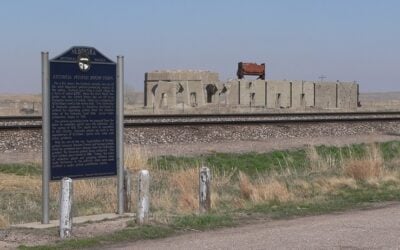
Among the most common questions professional archeologists receive is an important one: Why do you do archeology? This isn’t typically asked in the manner of “What drew you to become an archeologist,” though that is another common question we receive, and a fun one to answer! Rather, interested folks are asking “Why do you have to do archeology?” In short, most professional archeological work conducted in the U.S. today is mandated by state and federal legislation.
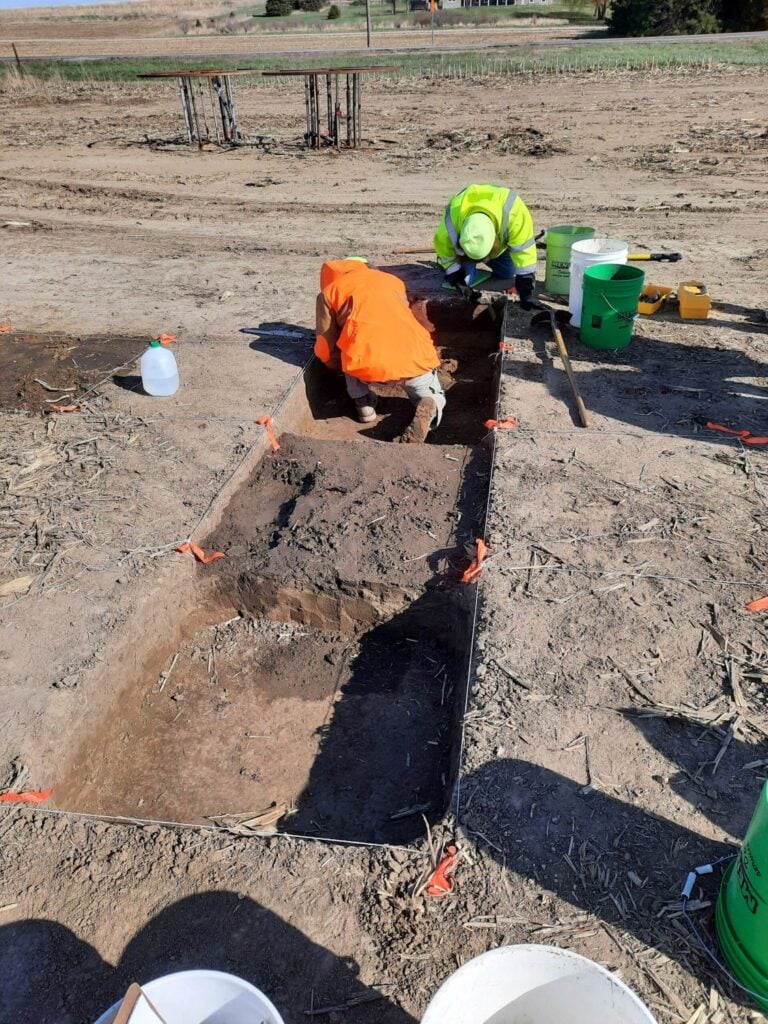
Archeologists excavating at the Sharp Homestead site.
Historic preservation laws, regulations, and federal orders like the National Historic Preservation Act (NHPA), Archaeological Resources Protection Act, Native American Graves Protection and Repatriation Act, Antiquities Act, and more stipulate when and how investigations of cultural resources must be conducted as a means of documenting, preserving, and returning our nation’s historical and cultural resources. In Nebraska, Revised Statutes 82-501 through 82-510, also known as the Nebraska Archeological Resources Preservation Act, provide guidelines and requirements for state undertakings—projects funded or overseen by state agencies or occurring on state lands. But the federal regulation that has the most impact on the State Archeology Office (SAO) is Section 106 of the NHPA.
Section 106 stipulates that a project–or undertaking–carried out under the direction or funding of a lead federal agency must undergo a review to identify any cultural resources (which include archeological sites) that could be impacted by the project, then determine the project’s potential to adversely affect those cultural resources. The Section 106 process is thoroughly defined with (relatively) clear steps guiding various entities and stakeholders through a complete review. Section 106 also offers these stakeholders opportunities to comment on projects at various stages of the process; the Advisory Council on Historic Preservation has produced a Citizen’s Guide to Section 106 describing the entire process, as well as how to get involved in the process as a member of the public.
Most SAO projects annually–typically numbering well over 100–are completed for the Nebraska Department of Transportation (NDOT) through a long-term cooperative agreement between NDOT and the Nebraska State Historical Society. Under this cooperative agreement, the SAO’s Highway Archeology Program (HAP) conducts cultural resources investigations for most NDOT projects statewide. We’ll learn more about the different steps of these investigations over the coming weeks. Because NDOT receives funding from the Federal Highway Administration (FHWA) to complete transportation projects across Nebraska, the Section 106 process is required. To facilitate the process, NDOT has been assigned lead federal agency authority to maintain responsibility for completing Section 106 activities on certain projects under a programmatic agreement with the FHWA and Nebraska State Historic Preservation Office. One such project involves a stretch of Highway 275 from east of Norfolk to Wisner, located in Cuming and Stanton counties in northeast Nebraska.
The Highway 275 project involves adding two highway lanes stretching over 15 miles between the intersection of Highway 275–Highway 57 and the intersection of Highway 275 and 16th Street in Wisner. Because funding for the highway expansion project came to NDOT from the FHWA, a complete review of the project’s footprint and its potential to adversely affect cultural resources was carried out to satisfy the Section 106 requirements.
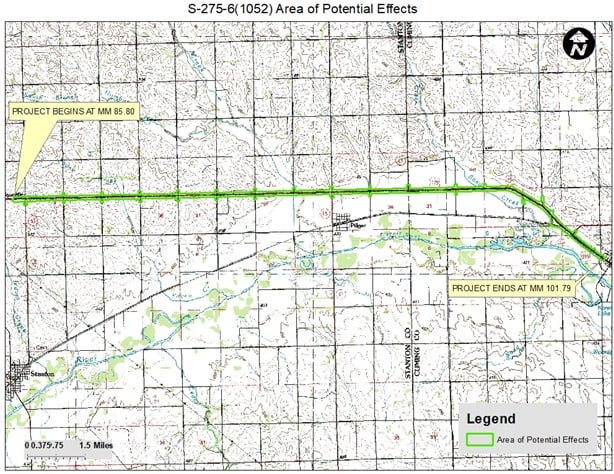
Highway 275 project location and area of potential effects in Cuming and Stanton Counties.
HAP archeologists were first notified of the Highway 275 project in 2016, kicking off the Section 106 process. Following the Section 106 process, the HAP team first reviewed available literature, databases, maps, aerial imagery, and other relevant materials regarding previously documented archaeological sites and other historic properties, such as standing structures, within the total project footprint, also known as the area of potential effects (APE). Using that background research, the team was able to identify specific areas of concern and further interest across the APE–places where known archeological sites would need to be more thoroughly investigated, and areas where an archeological survey would be needed to identify new archeological sites.
A further component of the Section 106 process entails documenting and evaluating a cultural resource located within the project APE for its historic significance at the local, state, or national level for consideration to be listed in the National Register of Historic Places (NRHP). When a resource is considered historically significant, alterations to a project must be completed to avoid or mitigate anticipated damage–adverse effects–to the site, structure, object, etc. In completing the project background research and survey work, one site located in the Highway 275 expansion APE was site number 25ST16¹, the Sharp Homestead.
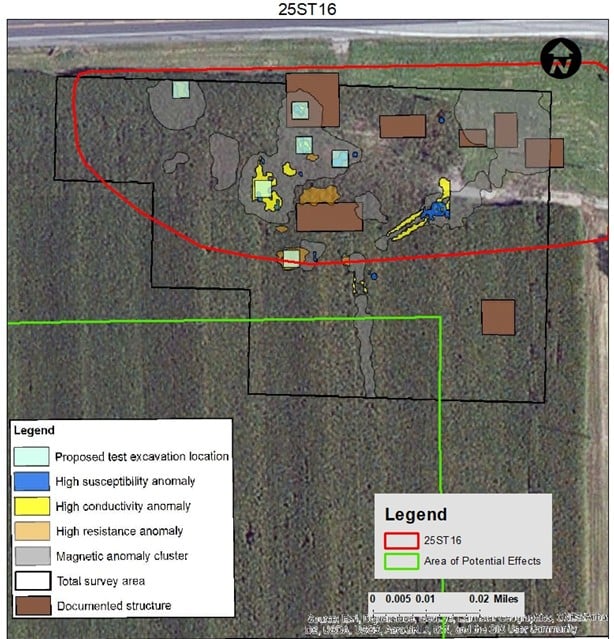
Results of geophysical survey at the Sharp Homestead (25ST16) showing locations of subsurface features.
Previous investigations and documentation dating back to 2012 indicated that the Sharp Homestead possessed attributes making it historically significant and Eligible for listing in the NRHP. Because the Highway 275 project ultimately could not avoid impacting the Sharp Homestead site area, extra mitigative steps were taken to comprehensively document the site before construction. These steps included conducting a geophysical survey using ground-penetrating radar, magnetometry, and other instruments over the site area to identify buried archeological features such as building foundations, outhouses, and cellars, as well as excavating large areas of the site to recover artifacts and other site data before it was removed. Completion of those mitigative efforts constitutes resolution of the adverse effects, and subsequently completion of the Section 106 process. These same steps are taken, with some slight variations depending on project scope, scale, and agreed-upon exceptions, for every federally funded or overseen project across the country.
With this foundation of why we do archeology, we hope you will come back for additional blog posts throughout the rest of the month that will provide further details about how the Sharp Homestead site was identified, what steps were taken to recover data from the site, and what happens after fieldwork is completed.
By State Archeologist Dave Williams, September 2025
Footnote: 1) Nebraska, like most other states, uses the Smithsonian Trinomial numbering system to label each archeological site found in the state. The trinomial starts with a 2-digit number based on the state’s position alphabetically–Nebraska is 25–and is followed by a 2-letter county designation—Stanton County is “ST.” Finally, a unique number is assigned to each new site documented in the county. Nebraska currently has over 11,000 documented archeological sites located in 92 of the state’s 93 counties.