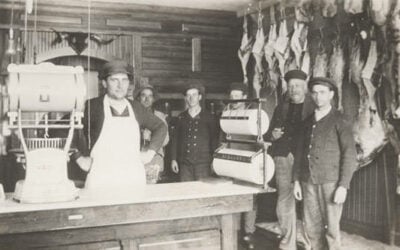

By 1910, one in five Nebraskans was a German immigrant or the child of one. Mostly they lived in rural areas, especially in northeast Nebraska. (Pierce County was 90 percent German in 1870!) Like many other immigrant groups, Germans tended to choose communities already settled by relatives and neighbors, or least others of the same ethnicity.
Nebraska was home to multiple German-language newspapers—67 were founded in the state at one time or another. Newspapers, churches, and cultural organizations helped connect people to their homeland.
Politically, Germans were known for opposing both Prohibition and women’s suffrage. During the world wars—especially during World War I—Germans faced stereotypes and suspicion of disloyalty. As late as the early 1940s Nebraska’s German newspapers often criticized pro-British US foreign policy.
However, “Germans were not at all as solid a block as native Americans perceived them to be” because of regional and religious differences, writes historian Fred Luebke.
A map in the 2013 Atlas of Nebraska shows almost every Nebraska county having at least 10 percent German ancestry, with several having more than 60 percent. These days, few of the descendants speak German—the most visible markers of culture are found in names, food, and traditions.
(Photo: German Lutheran Church, Thayer, NE. NSHS RG2856-7-1)
–David L. Bristow, 8/6/25
Sources:
- Archer et al, Atlas of Nebraska (2013), 86 (Pierce County), 90 (map of German ancestry).
- Paul Schach, “German-Language Newspapers in Nebraska, 1860-1890,” Nebraska History 65 (1984): 85.
- Robert W Cherny, “Isolationist Voting in 1940: A Statistical Analysis,” Nebraska History 52 (1971): 292-310.https://history.nebraska.gov/wp-content/uploads/2017/12/doc_publications_NH1971Isolat_Voting.pdf
- Frederick C Luebke, “The German-American Alliance in Nebraska, 1910-1917,” Nebraska History 49 (1968): 166. https://history.nebraska.gov/wp-content/uploads/2017/12/doc_publications_NH1968GermanAlliance.pdf