Some 10 million people visited the Centennial Exposition in Philadelphia in 1876. It was designed to wow the public with American progress in “Arts, Manufactures, and Products of the Soil and Mine.”
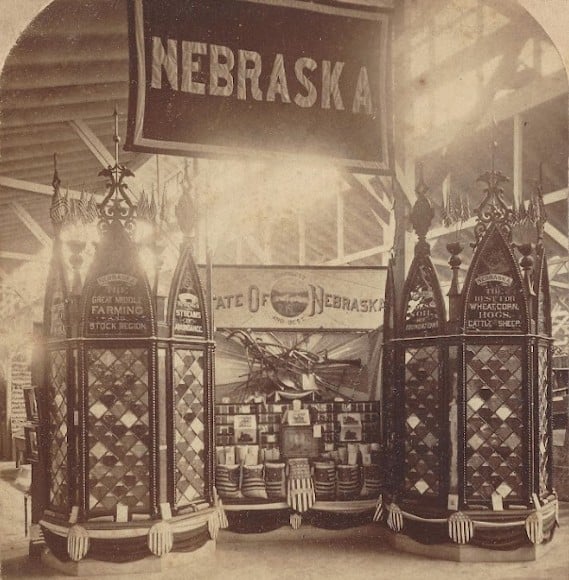
By necessity, Nebraska—still the newest state until Colorado joined the Union on August 1—focused its exhibit on the products of the soil. Diamond-shaped glass compartments contained samples of grain, seed, and soil, while gold lettering boasted of the state’s “corn, wheat, hogs, cattle and sheep.”
Aside from state boosterism, on July 3 the Omaha Evening Bee described the Exhibition’s big lesson:
“These are doubtless the most substantial evidences of the fruits of the first century of the Republic. They demonstrate beyond all doubt the capacity of a self-governed people to keep pace with other nations whose peoples have little or no part in their government.”
In 1876 American democracy had exclusions we would find unacceptable today. But even this limited democracy made the U.S. an outlier among nations. The vast majority of the world’s people were ruled by some form of monarchy and aristocracy, and not yet by what the Bee called “the noblest model of human government.”
(Photo courtesy of Matthew Hansen, Lincoln. Learn more about the photo.)
–David L. Bristow, Editor (posted 1/21/26)
Sources:
Anne P. Diffendal, “Nebraska in the Centennial Exhibition at Philadelphia, 1876,” Nebraska History 57 (1976): 69-81. https://history.nebraska.gov/wp-content/uploads/2017/12/doc_publications_NH1976Exh1876.pdf
“The First Century of the Republic,” Omaha Evening Bee, July 3, 1876: 2.