Here’s a trivia question sure to trip up most Husker football fans: Which was the first team from Nebraska to win a bowl game?
The obvious—but incorrect—answer is the 1962 Huskers. Bob Devaney’s first team defeated Miami in the short-lived Gotham Bowl, played in a chilly and mostly empty Yankee Stadium in New York City.
But the first team from the state of Nebraska to win a bowl game was the 1954 Omaha University Indians, who capped a perfect season at the Tangerine Bowl in Orlando, Florida, on January 1, 1955.
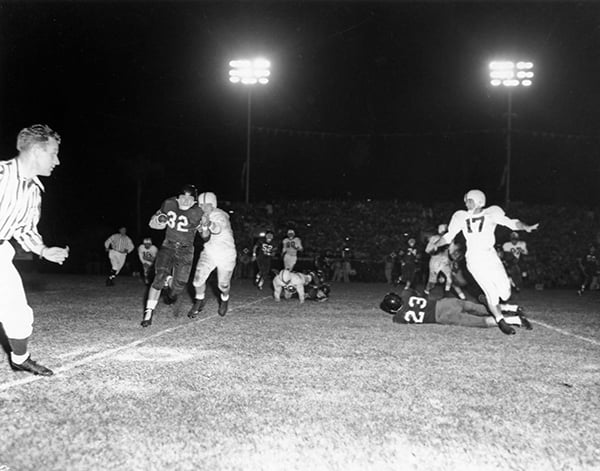
The Omaha Indians’ Emil Radik (#32) with the ball. Omaha’s WOW did a live radio broadcast. The game film was flown to Omaha and shown on WOW-TV on January 2. In 1971, in the wake of a growing Native American identity movement, the university changed its team name from the Indians to the Mavericks. The university dropped football after the 2010 season. All photos in this article are courtesy of the University of Nebraska-Omaha Libraries’ Archives & Special Collections.
The Tangerine Bowl called itself “The Little Bowl with the Big Heart.” It was a charity game to raise money for disabled children. Starting in 1947 bowl officials invited small but successful college teams to Orlando’s 16,000-seat stadium. The 1955 game paired Omaha against an unbeaten and once-tied Eastern Kentucky.
So it wasn’t a major bowl game by any means, but it was a big deal to Omaha University. “Tangerine Fever has swept the University,” reported the Gateway student newspaper on November 19, 1954. Bowl officials offered free room and board in private homes for 100 Omaha students, but many students who wanted to make the trip said they could not afford train or bus tickets. (Few fans flew.) Game tickets themselves ranged from $1.50 for end zone bleachers to $4.75 for a seat between the 40-yard lines.
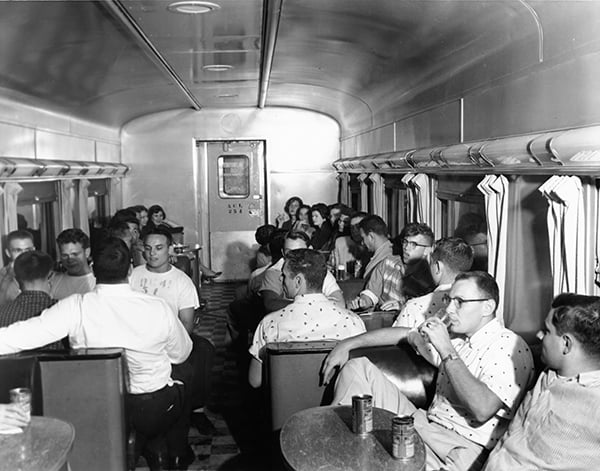
Gateway staff members felt that travel by automobile would be cheapest, but most student who made the trip preferred to travel by train. Prices ranged from $68 to $77 round trip, or $128 for a Pullman sleeper car. (In 2022 dollars: $755 to $856, or $1,423 for a Pullman berth). Others traveled by bus for $43 to $45 ($478 to $500 in 2022 dollars). Few traveled by air.
Omaha fans arrived in Orlando after 36 to 38 hours on a train or bus. Police escorted special buses carrying fans from the train station to the San Juan Hotel, where “winter coats, suitcases and band instruments” were piled in the lobby as hundreds of Omahans sweated in 80-degree weather.
For Omaha fans, perhaps the only irritation was having their team overshadowed yet again by the University of Nebraska Cornhuskers, who played on New Year’s Day in the Orange Bowl in Miami. But the 6-4 Huskers had received their bowl invitation only because of a Big 7 no-repeat rule that prevented conference champion Oklahoma—which had blown out the Huskers 55-7—from playing in the Orange Bowl two years in a row.
On New Year’s Day, No. 14 Duke dominated the unranked Huskers 34-7. But there was still time for some Nebraska fans to catch a plane to Orlando for the Omaha Indians’ night game.
Omaha scored their only touchdown in the first quarter. This was grind-it-out, mid-century football. A single Omaha possession consumed more than a quarter of the game—16 minutes, 45 seconds for a 94-yard drive that stalled at the one-foot line and resulted in no points. But Omaha held on for a 7-6 win.
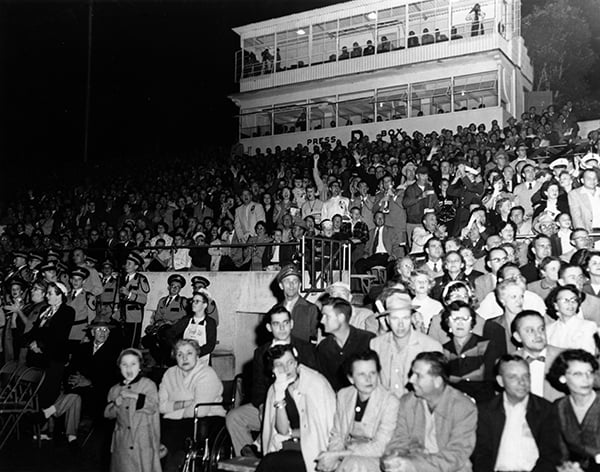
Omaha fans enjoyed the warm weather in Orlando, but after the game, a rumor circulated that a group of students had learned an important lesson about Florida wildlife. After asking locals about swimming holes, “The OU group… found the lake and went in for a swim,” the Gateway reported on January 14. “While in swimming they noticed some logs drifting toward them. A short time later they noticed the logs had eyes. In a much shorter time they were out of the lake.”
The Tangerine Bowl eventually grew into a major bowl game known variously as the Florida Citrus Bowl, the Capital One Bowl, and currently the Cheez-It Citrus Bowl. The Huskers have played in it three times, but have yet to win one.
Omaha’s bowl game sheds light on one other aspect of the university’s history. The following season, Hillsdale College turned down a Tangerine Bowl invitation after bowl officials said that Hillsdale’s four Black players could not play. University of Buffalo skipped the game in 1958 for similar reasons. But the 1954 Omaha Indians had no Black players, a situation that changed dramatically in the 1960s.
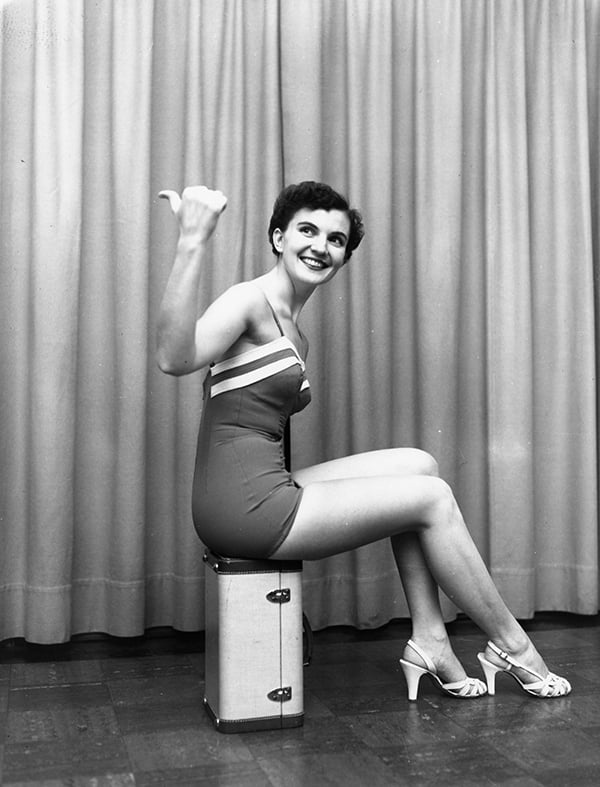
Jackie Pederson, Omaha University student and Tangerine Bowl Princess. A committee of judges from the university selected finalists from 34 applicants “on the basis of figure, beauty, poise and charm.” The committee tried to be “impartial,” one judge told The Gateway. “We judged on beauty only, from head to toes.” The football team then selected the winner based on three photos of each finalist, in “bathing suits, street clothes, and formal dresses.”
—David L. Bristow, Editor
This article first appeared in the Summer 2023 issue of Nebraska History magazine.