By David L. Bristow
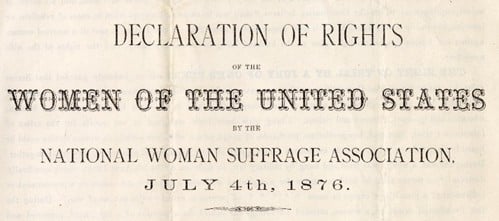
This is the headline of a pamphlet found in the papers of Erasmus Correll at the Nebraska State Historical Society. Erasmus and Lucy Correll were prominent suffragists in Hebron, Nebraska. Erasmus published the Hebron Journal, which openly supported women’s rights, and 1881-82 he published and edited Western Woman’s Journal, Nebraska’s first suffrage paper.
The Corrells were part of a statewide network of women and men supporting women’s rights and working with national suffrage leaders. While this pamphlet was not produced in Nebraska, it seems especially relevant in this Semiquincentennial year, and its main theme was soon echoed by Nebraska suffrage publications. It shows how women cited the principles of the Declaration of Independence to expand the scope of human rights
The “Declaration of Rights” was distributed at the Centennial Exposition in Philadelphia, a months-long celebration of American progress and technology. (Nebraska had a state exhibit there.) The authors open by acknowledging that their complaint “strike(s) the one discordant note” amid all the magnificence:
“Our faith is firm and unwavering in the broad principles of human rights, proclaimed in 1776, not only as abstract truths, but as the corner stones of a republic. Yet, we cannot forget, even in this glad hour, that while all men of every race, clime, and condition, have been invested with the full rights of citizenship, under our hospitable flag, all women still suffer the degradation of disfranchisement.”
Next, they list the “principles of just government, acknowledged by the United States at its foundation, which are:
“First. The natural rights of each individual.
Second. The exact equality of these rights.
Third. That these rights, when not delegated by the individual, are retained by the individual.
Fourth. That no person can exercise the rights of others without delegated authority.
Fifth. That the non-use of these rights does not destroy them.”
Readers would have heard the echoes of the famous passage in the Declaration of Independence:
“We hold these truths to be self-evident, that all men are created equal, that they are endowed by their Creator with certain unalienable Rights, that among these are Life, Liberty and the pursuit of Happiness.—That to secure these rights, Governments are instituted among Men, deriving their just powers from the consent of the governed….”
And the idea of the need to delegate authority is woven into the structure of the Constitution, such as in the Ninth Amendment (“The enumeration in the Constitution, of certain rights, shall not be construed to deny or disparage others retained by the people”) and the Tenth (“The powers not delegated to the United States by the Constitution, nor prohibited by it to the States, are reserved to the States respectively, or to the people”).
Having rooted its argument in the nation’s founding principles, the rest of the pamphlet takes the form of “Articles of Impeachment,” indicting the nation for failing to live up to its stated values.
In Nebraska in 1881, the premier issue of the Corrells’ Western Woman’s Journal echoed Jefferson’s “unalienable rights”:
“By reason of the mere fact of existence, every human being possesses certain inherent personal rights. Among these are the right to live, the right to think and act, and the right of enjoyment. In addition to these, certain other rights belong to every human being not incapacitated by infancy, insanity, idiocy, or crime. Among these rights are the right to acquire and control property, the right to have and express opinions, and the right of a voice” in government.
Such rights do not depend upon one’s sex, but are “birthrights founded upon the broad magna charta of humanity….”
While no one thought that the Founders intended to give voting rights or property rights to women, once one accepts their principles, it is difficult to apply those principles unevenly without appearing hypocritical. In the words of Dr. Martin Luther King Jr. in his “I Have a Dream” speech, these founding principles became a “promissory note” for later generations of Americans.
Read more about the Corrells and other Nebraska suffragists in “‘Striving for Equal Rights for All’: Woman Suffrage in Nebraska, 1855-1882” (PDF)
(posted 2/4/26)