The Gerald R. Ford Conservation Center recently completed treatment on a 395-year-old Bible celebrated for its detailed printing.
The Bible, published in 1630, features a German translation by Martin Luther and hundreds of copper plate engravings by Swiss artist Matthäus Merian. Known as a Merian Bible, the book includes intricate maps and religious scenes that are considered among the finest examples of copper plate printing.
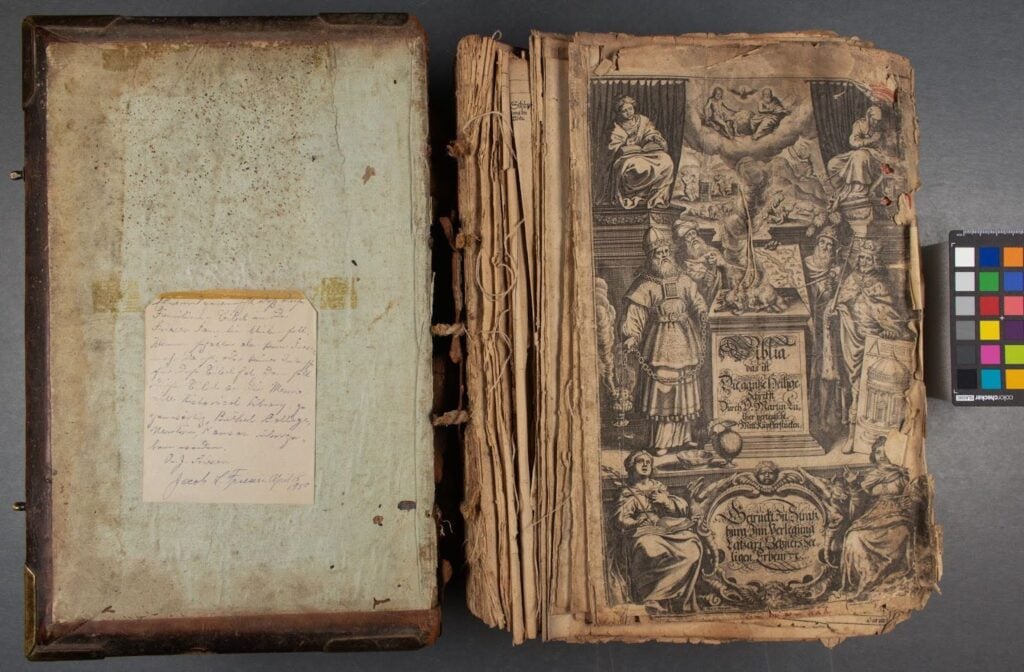
In this before-treatment image, the nearly detached upper cover board is visible, along with many loose leaves at the front of the book.
The Gothic binding came to the Ford Center’s Paper Lab in poor condition. Its heavy wooden cover boards were nearly detached. The wood itself was broken in one corner and split vertically in several places, likely the result of stress where the book’s metal hardware was nailed into the wood. The leather on the spine also had cracks and large losses, exposing some of the fragile folds of the text block and the raised cords it was sewn on.
Inside, the thick paper text block was damaged throughout. From the beginning of the Bible to midway through the Book of Exodus, all of the leaves had come loose. Many pages were curled, creased, and tattered, and plenty had tears and losses. The gutters were also heavily soiled, with hundreds of years of accumulated dirt, insect carcasses, and insect frass.
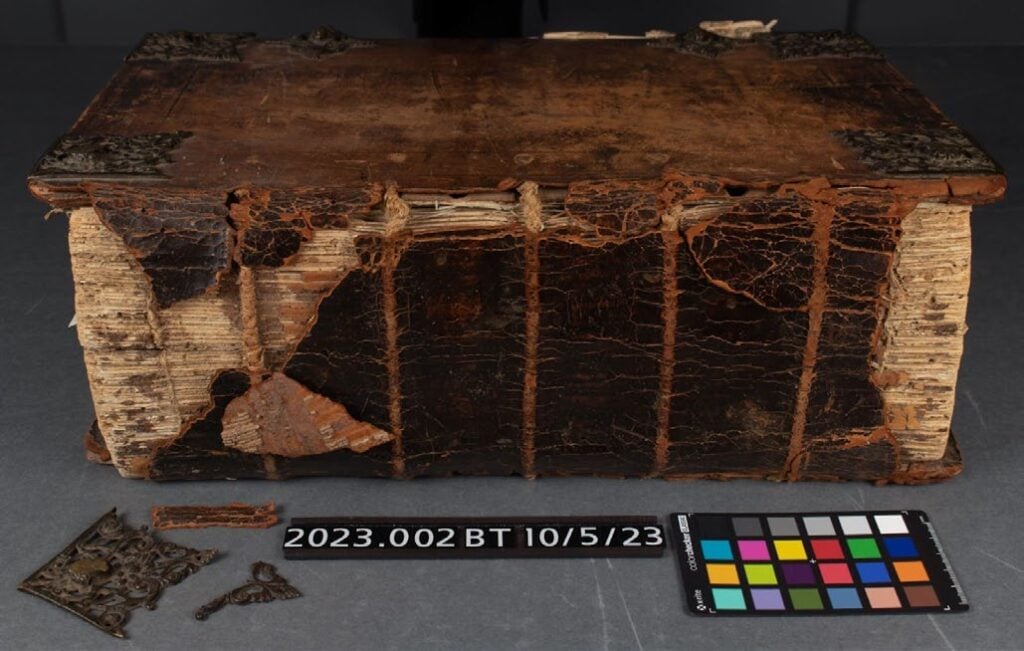
The covering leather is attached directly to the Bible’s spine in a tightback construction, so centuries of opening and flexing contributed to the damage visible in this before-treatment image.
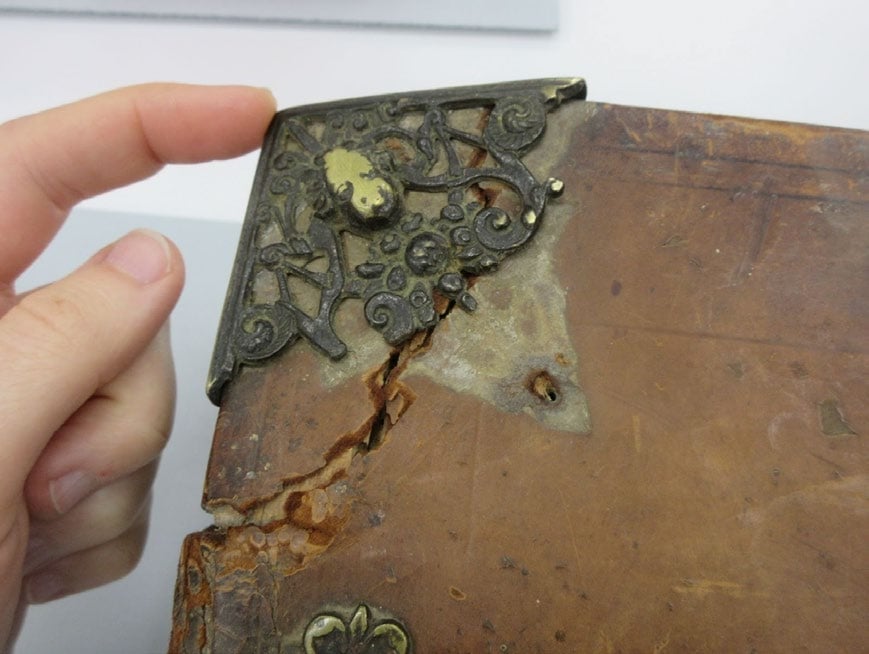
A break in the lower board is also visible.
Our treatment goal was to structurally stabilize the Bible, which belongs to the rare books collection at Bethel College in North Newton, Kansas. The college’s Mennonite Library and Archives wanted to ensure the long-term preservation of the book while making it safer to handle.
First, the boards and leather spine piece were fully detached and surface cleaned. The breaks and splits in the wooden boards were repaired using an animal hide adhesive and strong Japanese paper. The metal corner pieces were also treated with a dilute detergent to remove grime, and one loose piece of hardware was reattached with a resin solution.
For the text block, we originally hoped to reattach the loose leaves without resewing the large portion of the book that remained intact. Unfortunately, as the pages were turned and the spine was flexed during surface cleaning, the cord sewing supports revealed the full extent of their brittleness and began to disintegrate. We made the necessary decision to remove the sewing thread and cords, take the block apart, and resew it using strong new materials.
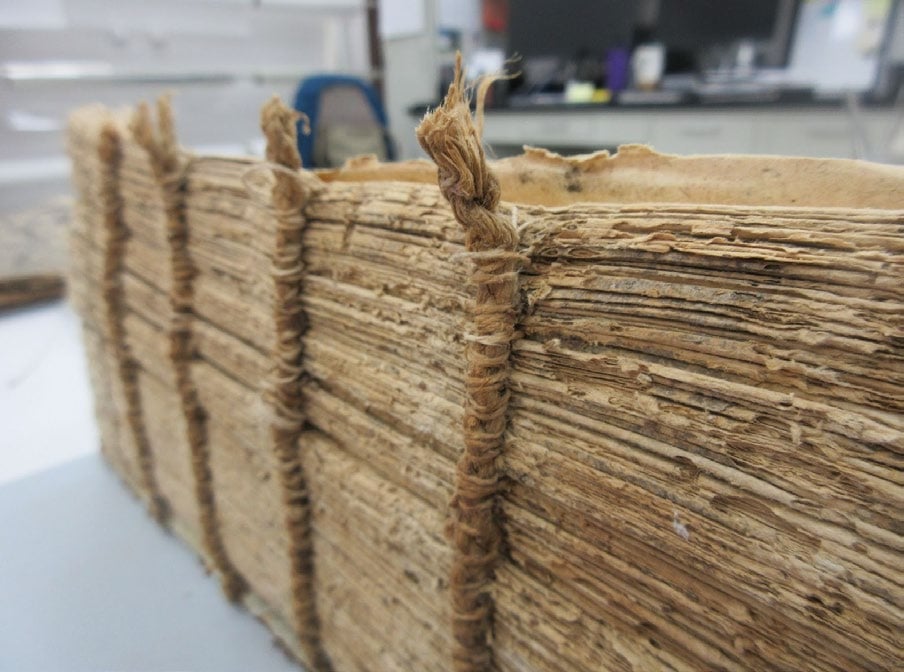
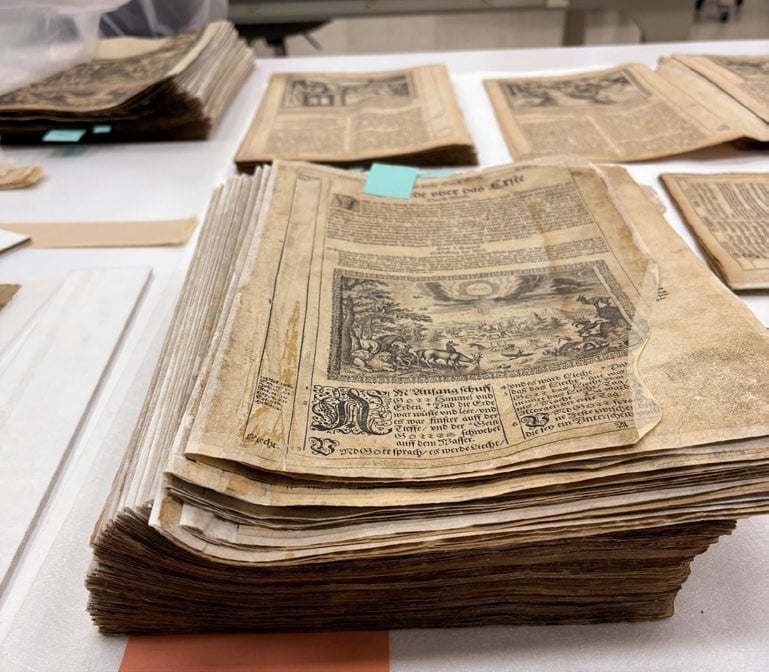
The original cord sewing supports, seen in the during-treatment image on the left, broke down while the text block was being cleaned. The disbound sections, on the right, were humidified, flattened, and repaired before they were sewn together again.
Before resewing, while the text block was still disbound and in sections, we mechanically removed old tape and paper that had been adhered in past repair attempts but were causing additional damage. To realign tears and reduce creasing, we humidified and flattened the folded sheets that are nestled together to form the text block’s sections. Then we reinforced torn folds and mended tattered edges, tears, and losses using lightweight Japanese paper and a reversible adhesive.
The title page and frontispiece, which were more extensively damaged and fragile, were also washed in pH-controlled deionized water and lined onto Japanese paper for overall support.
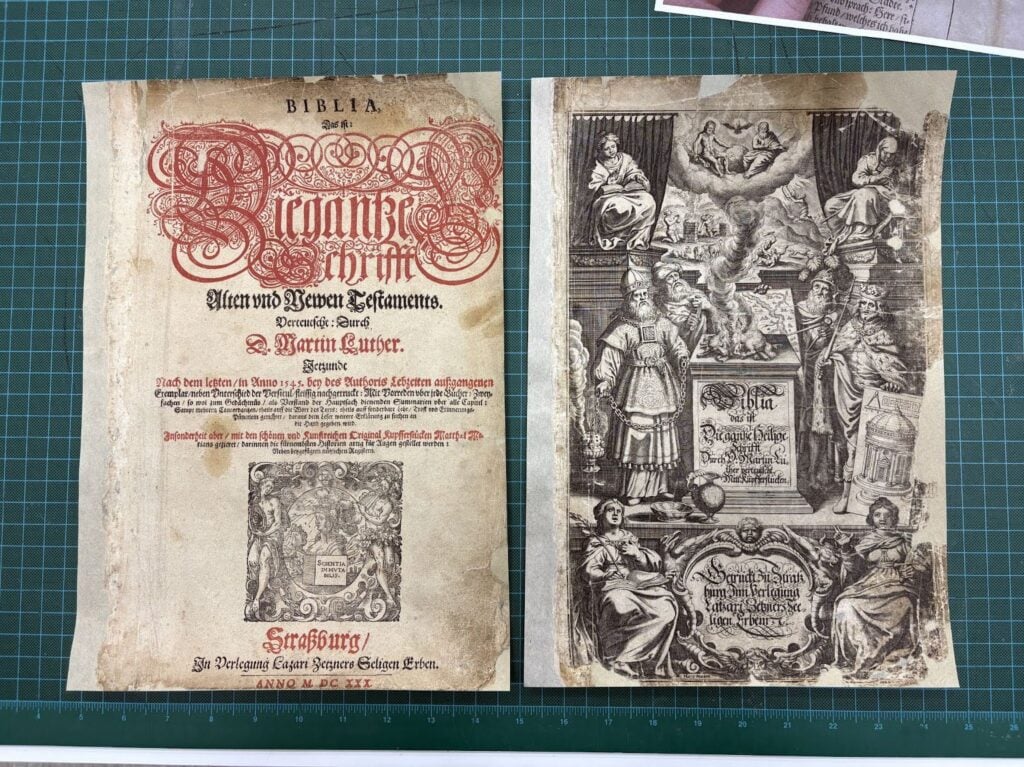
The Bible’s title page and frontispiece were washed in pH controlled deionized water and lined onto Japanese paper for greater support. Due to the larger number of paper damages through the text block, tears and losses were only repaired if they were likely to become more damaged with continued use.
With paper repairs complete, we punched sewing holes through the sections’ folds and resewed the book on five raised cords, following the original construction. The new sewing was done in an abbreviated pattern, in which the thread does not pass through every hole of every section.
This technique was chosen in an effort to minimize the swell at the book’s spine, which adds up based on the amount and thickness of the sewing thread. For the Bible, it was important to maintain a reasonable amount of swell in order to match its original size and shape as closely as possible, especially given the new bulk already added by so many necessary paper repairs.
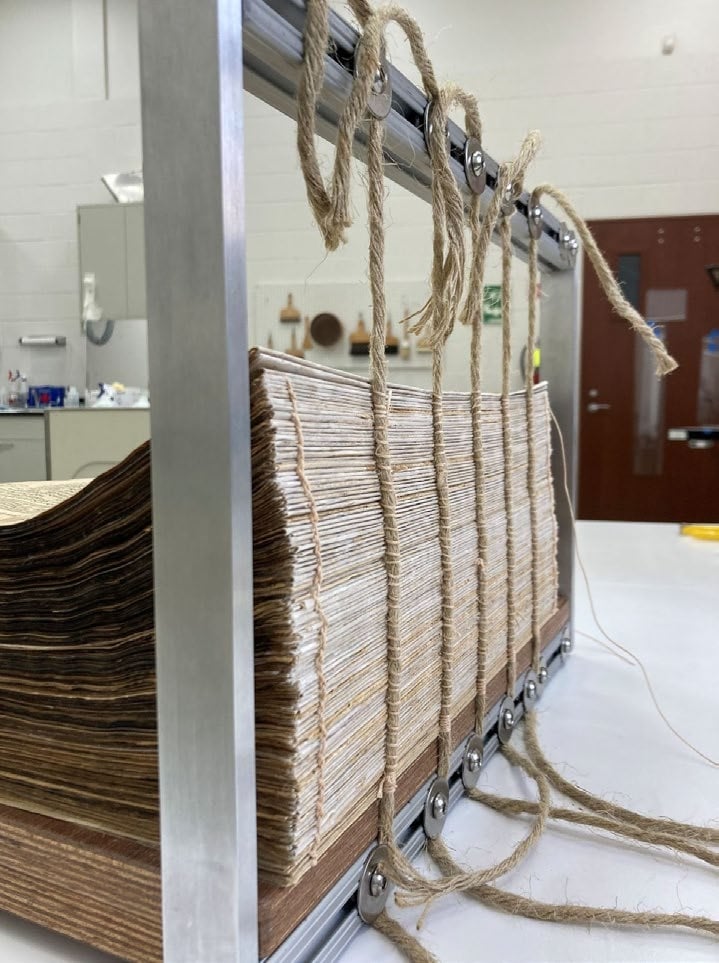

The Bible was resewn on five raised cords using abbreviated sewing to minimize swell at the spine while still providing strength and flexibility. The linen thread used for the resewing was toned with acrylics to better match the color of the original.
We encouraged the resewn Bible to resettle into its original rounded shape. Then the spine was lined using layers of Japanese papers and a strong cotton, which provide support for the book and help control the way it opens.
The next step was board reattachment. While the cover boards were originally attached to the text block by lacing the cords through a series of holes and channels, we wanted to avoid placing undue stress on the wood and potentially causing new breaks.
So instead of relacing, we reattached the boards using the portions of the spine linings that extended beyond the width of the spine. Some were fed underneath the covering leather on the outer board faces and then adhered to the wood. Others went underneath the paper on the inner faces. This way, the boards were securely connected to the text block, sandwiched between several points of attachment.

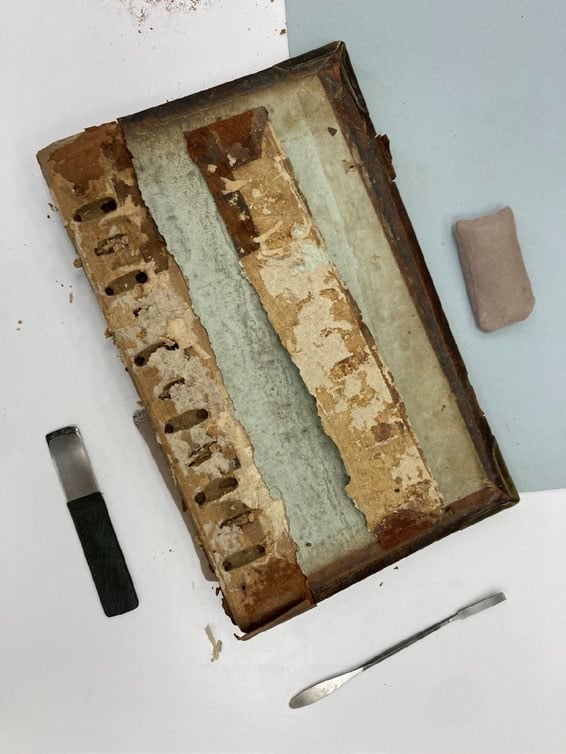
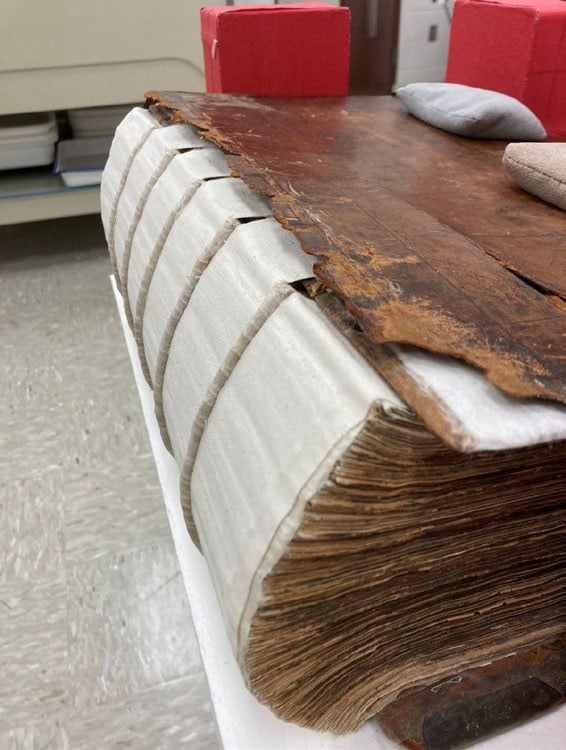
The Bible’s heavy wooden boards were originally attached to the text block by lacing the cord sewing supports through a series of holes and channels, visible in the during-treatment images at the left and center. The boards were reattached using extended paper and cotton linings, as seen on the right, to avoid straining the wood and potentially causing new splits.
Finally, a new spine piece was made out of linen and Japanese paper and toned with acrylics to match the colors of the covering leather. This piece was attached directly to the spine of the book, following its original tightback construction, and adhered onto the boards, providing additional attachment and support.
Then the original leather spine piece was reattached on top, and all of the leather was treated with a consolidant to protect it from future wear.
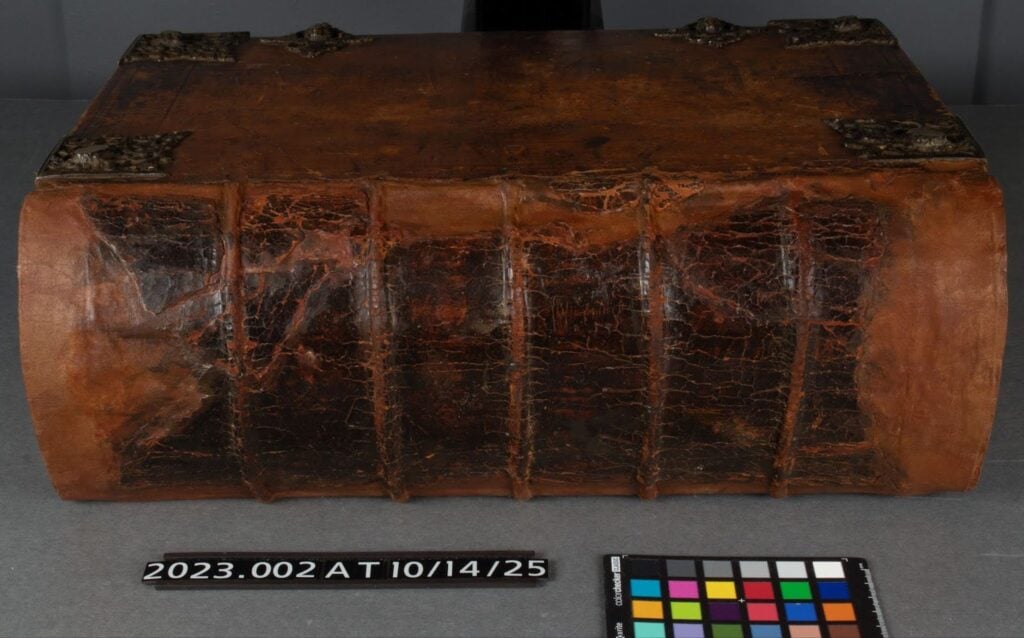
An after-treatment image of the Bible’s spine.
With the treatment complete, the Bible is now fully intact and structurally sound. The Kauffman Museum will display the book before it takes its place back in the Bethel College archives, where it will be housed in a sturdy double-walled clamshell box and available for viewing with careful handling.
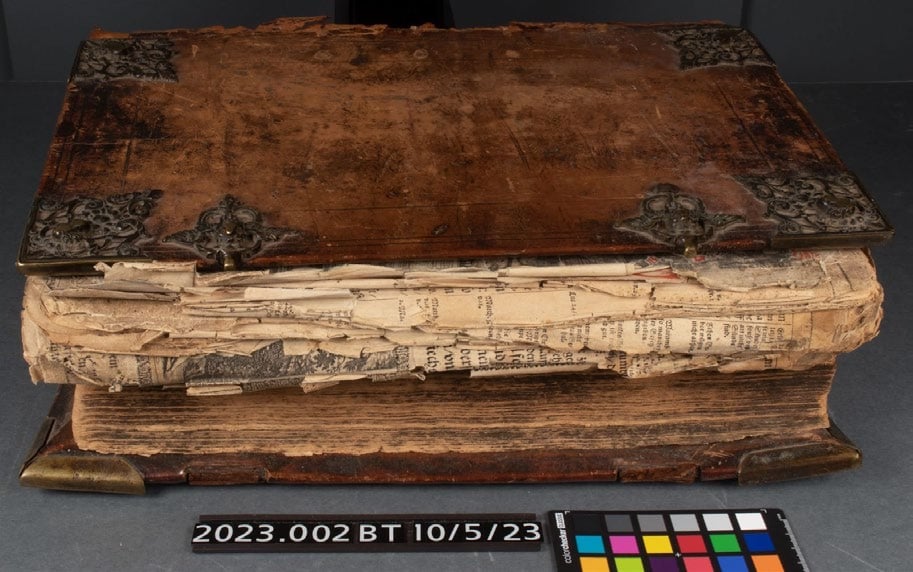

Before- and after-treatment images of the Bible’s fore edge.