By David L. Bristow
In 1909 Ulrick Sorensen faced a decision that would determine his future. It was potentially a life-or-death choice.
This is a story about the early days of aviation in Nebraska. The state’s first powered airplane flights happened in 1910, but a year earlier Sorensen made what I believe to be the first manned glider flight in Nebraska.
Sorensen launched his glider near Berwyn in Custer County. A farmer by background, in the early 1900s “Professor” Sorenson earned money by making parachute jumps at county fairs and events in central Nebraska.
This is where the story gets a little confusing to the modern reader. How did he do parachute jumps before there were airplanes?
You are correct if you guessed jumping from a balloon. But consider that the modern hot air balloon, with its onboard propane tanks, wasn’t invented until 1960. What were balloons like before then?
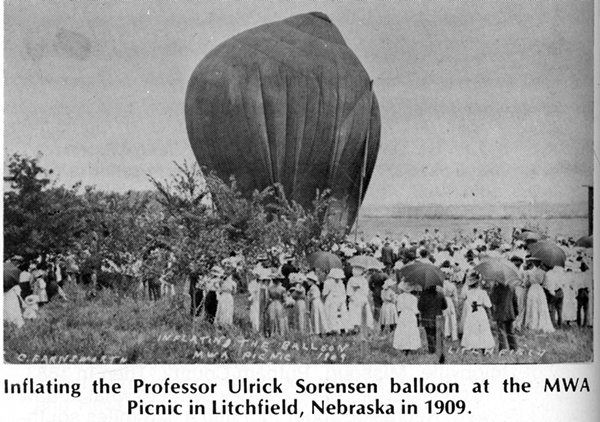
Starting in 1783, there were two kinds of balloons. Gas balloons were filled with hydrogen. Smoke balloons were essentially big cloth bags heated over a bonfire. Smoke balloons didn’t stay up long. They came back down as the hot air inside them cooled off.
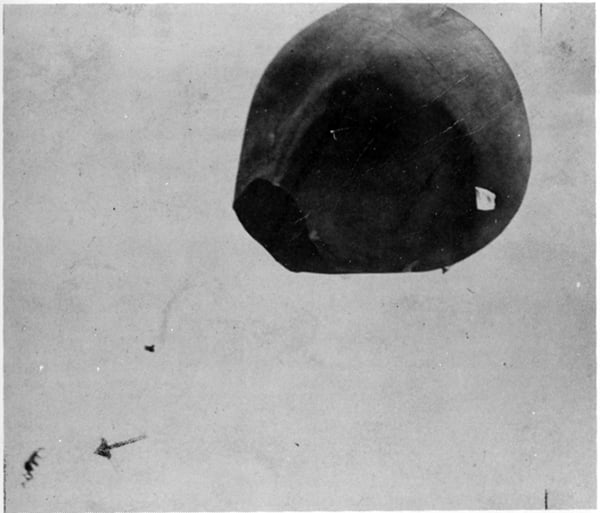
Sorensen used a smoke balloon. He didn’t use a basket. In this photo he’s sitting on an iron bar:
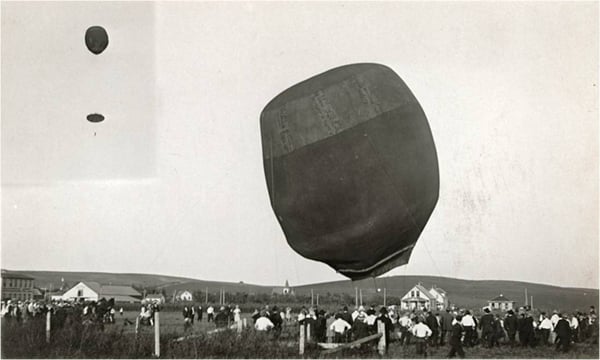
An unlabeled photo from Spalding, Nebraska, shows a balloon and parachute that are probably Sorensen’s:
The first parachutes were demonstrated in the 1790s, more than a century before airplanes, but the earliest knapsack parachutes and harnesses weren’t invented until several years after this photo. What were parachutes like before that?
The parachute is hanging from the balloon, and a trapeze bar hangs from the parachute. Many parachutists would hang from the trapeze bar while straddling a bit of netting that served as a kind of safety harness. Sorenson appears to be sitting on the trapeze bar. He used no safety harness, only his hands and the seat of his pants. He pulled a release cord to detach the parachute.
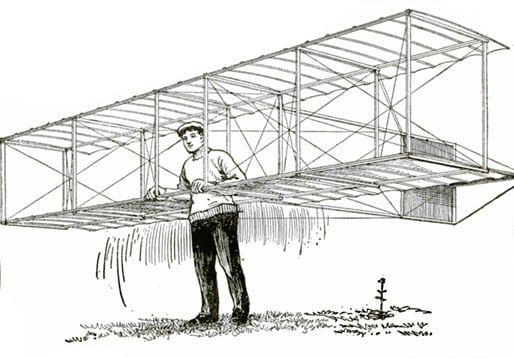
By now you may have guessed how Sorensen planned to launch his glider, which he based on a Wright Brothers design. The illustration at the top of this page appeared in the April 1909 issue of Popular Mechanics, which included plans for building such a glider.
On June 13, 1909, Sorensen attached his glider to his balloon, and a crowd watched him go up. It was reported that the balloon rose so quickly that the glider’s tail was damaged as it left the ground. But Sorensen didn’t notice it.
Sorensen pulled the release cord at about 3,500 feet, and the damaged glider tumbled through the air for the first 500 feet before finally righting itself and pulling into a tight spin. Witnesses said he hit the ground within about a minute to a minute-and-a-half—fast enough to knock him out, but not fast enough to kill him.
Ulrick Sorensen had survived Nebraska’s first plane crash. Reports appeared in newspapers around the country.
He promised to try to again. He was sure he’d get it right this time. But the 27-year-old Sorensen had a problem. His 17-year-old girlfriend, Cora, told him he could fly again if he wanted. And she said they could get married. But she made it clear that one of those two things was not going to happen.
And that was the big decision that Ulrick Sorensen faced in the summer of 1909. We don’t know if he agonized over it or if it was easy. But we do know that in 1969, Ulrick and Cora celebrated their sixtieth wedding anniversary, still living on their farm near Berwyn.
This article was first published in the June 2020 issue of NEBRASKAland magazine.
Sources:
“Gliding Machine Falls 4000 Feet,” Custer County Republican, June 17, 1909.
“Fourth Will Be Big Day for Air at Broken Bow / Rev. C. W. Savidge Will Pull the Eagle’s Tail and Prof. Sorenson Go Up in Balloon,” Omaha Daily Bee, June 24, 1909.
“Amateur Aviator Tumbles Over Three Thousand Feet,” Omaha Daily Bee, June 16, 1909.
“Hard Jolt for Aviator at Berwyn,” Omaha World-Herald, June 15, 1909, p. 1.
“Fell Plump for 3500 Feet,” Pacific Commercial advertiser (Honolulu, HI), July 3, 1909.
“Fell 3,500 Feet and Lives,” The Sun (New York, NY), June 27, 1909.