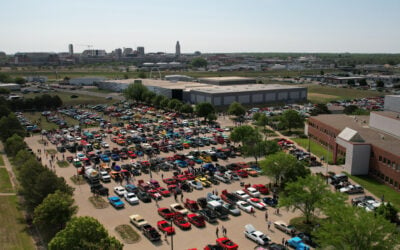

Hord feedlot near Neligh, Antelope County. NSHS RG4232-2-20
By David L. Bristow
Today we take for granted that the livestock business involves large feedlots, management based on nutritional science, and use of the latest technology. A Nebraskan named Thomas Benton Hord was an innovator who helped create the modern livestock industry. From his beginnings in the open-range era, Hord became, arguably, Nebraska’s first modern cattleman.
Hord started out during the western cattle boom of the 1880s. He worked with partners and Eastern investors to build large herds on the unfenced ranges of Wyoming and Nebraska. Survival was a challenge. A severe winter in 1886-87 decimated herds, and a financial panic in 1893 led to years of economic depression and low livestock prices.
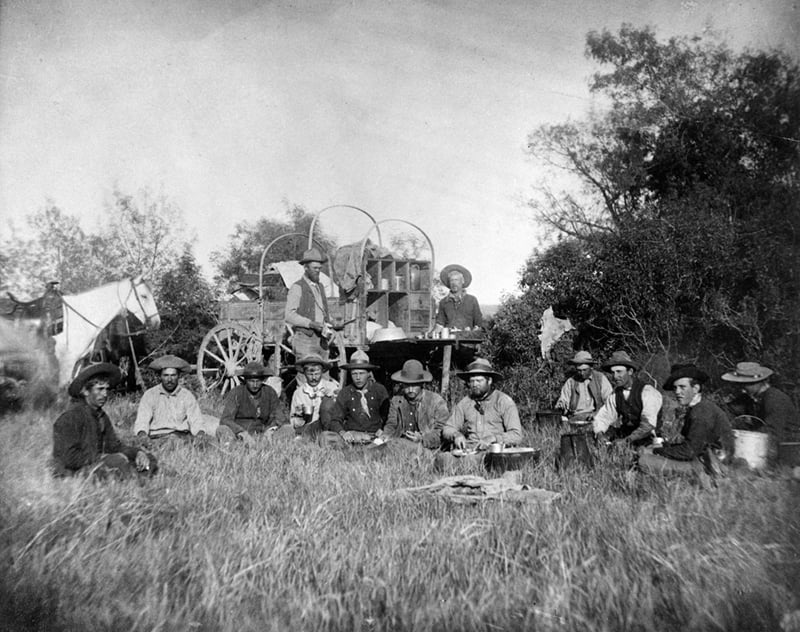
Hord cowboys at dinner at the 77 Ranch in Wyoming. NSHS RG4232-1-10
Meanwhile, relations between cattlemen and homesteaders became violent in parts of Wyoming. During the “Johnson County War” of 1892, cattle barons hired gunmen to go after alleged rustlers. One of Hord’s foremen, Mike Shonsey, was involved in the killing of two men; the following year Shonsey shot to death another man who came seeking revenge. Shonsey then fled to Nebraska and spent the rest of his life working at Hord operations in Central City and Clarks.

With the end of the open range, cattlemen began to think of ways to raise large numbers of animals within limited boundaries. Based in Central City, Hord began operating ever-larger feedlots for cattle and sheep. By 1903 his operation had thirteen feed yards and 18,000 acres of crops. In a typical year, Hord finished 10,000 cattle, 10,000 sheep, and 7,000 hogs, feeding them 8,000 tons of hay and a million bushels of corn. He was said to have the nation’s largest cattle feeding operation.
Historian Jim Potter researched Hord’s business records and uncovered not only the operation’s large scale, but also its innovativeness. Potter writes that Hord used “practices that seem modern even today. Each feedlot encompassed from ten to fifteen acres and had its own windmill to water the livestock. The cattle were fed a specific ration, largely shelled corn, in an amount that they ‘will eat up clean, leaving nothing to be used for the next meal that has been slobbered over and made unpalatable.’
“Hord also took advantage of available technology. Each separate feeding facility was connected by telephone to the main office at Central City so Hord could keep in touch with his foremen. His key employees participated in a company profit-sharing plan in addition to receiving a salary. Purchase of grain used in the operation, only part of which was grown on Hord land, injected an average of $300,000 per year into the regional economy. In 1905 Hord reported shipping a thousand carloads of cattle to market by rail, most going to Chicago.”
At a time when factory production was growing rapidly, Hord applied an industrial mindset to the livestock business. He has had many imitators. When he died in 1910 he was hailed as Nebraska’s most successful livestock entrepreneur.

The Hord family at their home near Central City. NSHS RG4232-2-10
This article first appeared in the November 2020 issue of NEBRASKAland magazine.
Read Potter’s entire article (PDF): James E. Potter, “Thomas B Hord: From the Open Range to ‘The Largest Live Stock Feeding Enterprise in the United States,’” Nebraska History 96 (2015): 122-135