Japan has long had a passion for baseball. The game was first played there in 1871. It spread first among elite private schools and became the nation’s most popular sport by the early twentieth century. But while Japanese people embraced the American game, traditional Japanese culture frowned upon professional sports. The first professional Japanese baseball teams formed in the 1920s, but professional baseball wasn’t fully established in Japan until 1936, a few years after Babe Ruth and his All-American team created a sensation with their visit to the country.
That’s the back story to a surprising discovery by baseball historian Robert K. Fitts, author of Issei Baseball: The Story of the First Japanese American Ballplayers (University of Nebraska Press). Fitts learned that the world’s first Japanese professional team was organized in Lincoln, Nebraska, and played its first game in Frankfort, Kansas, on April 17, 1906.
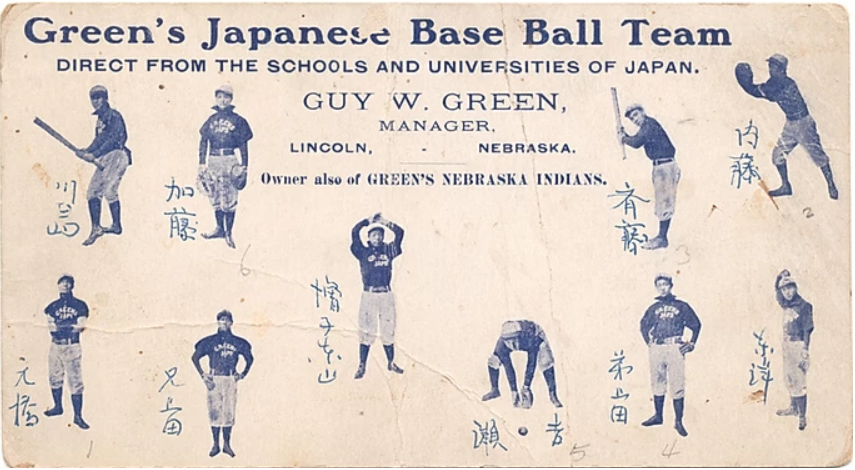
The team was the brainchild of Lincoln resident Guy W. Green, whose Nebraska Indians baseball team was featured in our Spring 2022 issue. Green instructed the Indians’ captain, Dan Tobey, to recruit Japanese immigrants from California. Tobey brought the players to Havelock (now part of Lincoln) for two weeks of practice before going on the road. Like the Indians, “Green’s Japanese Base Ball Team” was a barnstorming outfit, traveling the country and playing local teams wherever games could be arranged.
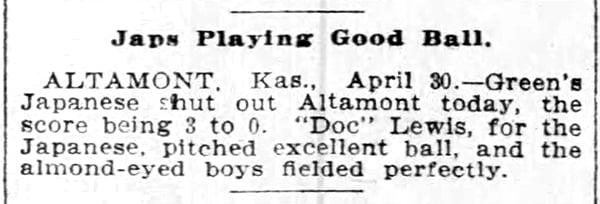
Nebraska State Journal (Lincoln), May 1, 1906. As with the Nebraska Indians team, press coverage often include racial tropes and stereotypes.
Although the players had all played high school ball in Japanese schools, Green and Tobey didn’t think all of them were good enough to play as an independent team, so they added several Native American players to the roster, “hoping that most spectators would not be able to tell the difference,” Fitts writes.
Even so, Tobey started a Japanese lineup against a surprisingly good Frankfort High School team. But when “Greens Japs” (as their jerseys read) fell behind 4-1 after three innings, Tobey began making substitutions. The Japanese came back to win the game, but only with the help of five Native American players.
Green’s Japanese went on to win most of their games that season, but never with an all-Japanese lineup. The team disbanded after the season and was soon forgotten, but within a few years Japanese teams from Denver and Los Angeles began making names for themselves.
—David L. Bristow, Editor
This article was first published in the Winter 2022 issue of Nebraska History magazine.