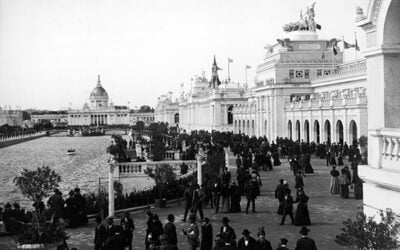
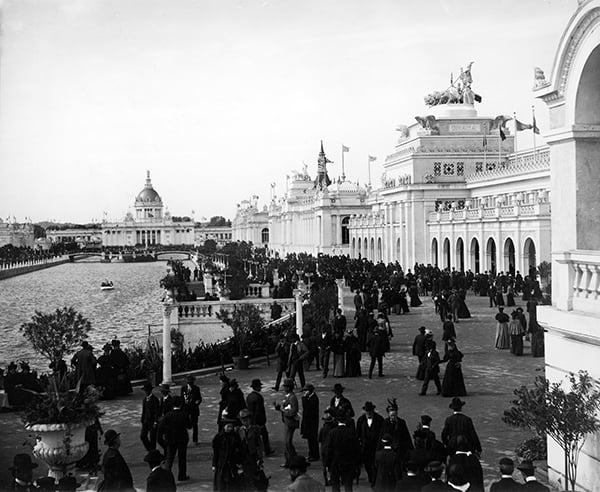
The Grand Court, looking west. RG2752AM
By David L. Bristow, Editor
More than 2.6 million people attended the Trans-Mississippi and International Exposition. Held from June through October 1898, it was the largest public event ever staged in Omaha.
Inspired by Chicago’s 1893 Columbian Exposition, the event was a huge financial gamble. Planning began a few years earlier during a severe economic depression, prolonged drought, and crop failures. Omaha businessmen prepared to risk large sums of money to lure tourists to a city in which some 5,000 houses stood empty.
Fortunately the economy recovered by the time the gates opened. Covering 184 acres, the Exposition grounds featured a Grand Court of white classical-style buildings housing displays of technology, commerce, agriculture, and the arts.
The Grand Court was built around a man-made lagoon nearly half a mile in length, its waters adorned with a large fountain encircling a statue of Neptune, and with Venetian gondolas that carried passengers. Nearby, the grounds also featured an Indian encampment, Buffalo Bill’s Wild West show, and two midways complete with rides, games, shows, restaurants, and various concessions.
It was even more impressive at night when the newfangled electric lights came on. Visitors were awed by the fair’s extensive use of outdoor incandescent lighting, with 14,000 light bulbs powered by a half-dozen steam generators. Historian Amanda Johnson has argued that electric lighting was as important to the Omaha fair as the Ferris wheel was to Chicago’s Columbian Exposition. Both drew visitors and were seen as symbols of modernity and technological prowess.
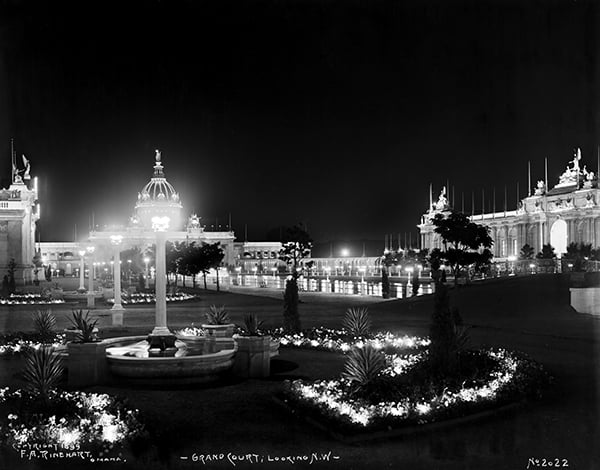
Grand Court lit by incandescent bulbs, looking northwest. RG2752-1-1-1
Even the fair’s pretentious name sent a message. Boosters promoted it as a coming-of-age event not only for Omaha – now a regional hub city and no longer a frontier town – but also for the entire region west of the Mississippi River. And since the fair took place during the Spanish-American War, it coincided with America’s emergence as a rising international power.
The fair’s “Indian Congress,” meanwhile, was meant to represent the nation’s past. (It was a “congress” in the sense of a large gathering of multiple tribes, rather than a political body.) The Indian wars were all but over and the tribes were restricted to reservations. Most Americans assumed the Native population would continue its long decline, with the remainder assimilated. When President William McKinley visited the fair on October 12, the Omaha Bee commented that he led a nation that was “just commencing to play its great part upon the stage of the universe,” and that he was “rendered honor by a thousand representatives of a passing civilization that was in its way great.” Among the Native leaders greeting McKinley was the famous Apache warrior Geronimo.
In the end, Native peoples and cultures proved far more resilient than anticipated. The fairgrounds, on the other hand, were temporary by design. Made of plaster and lath, the fancy white buildings were torn down within a few years, and the former Grand Court became today’s Kountz Park.
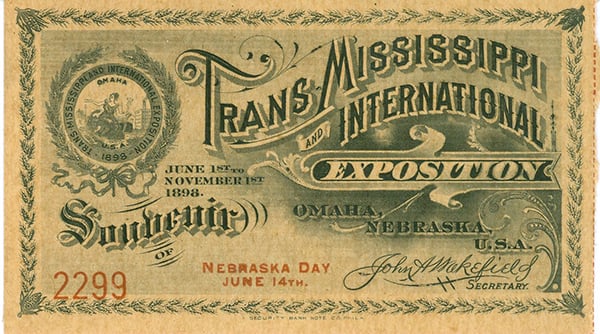
Ticket for “Nebraska Day,” June 14, 1898. NSHS 7999-34-B
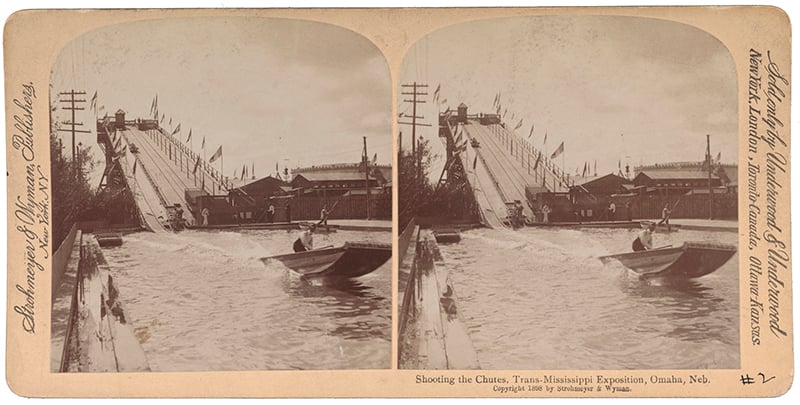
Vendors sold souvenir 3-D stereoview cards of the Exposition. “Shooting the Chutes” was a popular ride on the Midway. Library of Congress
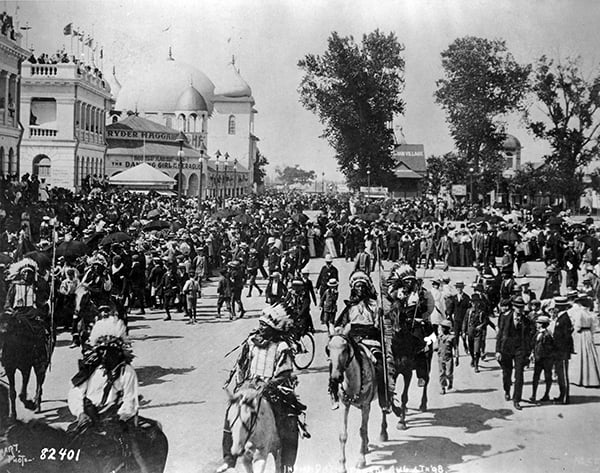
“Indian Day” parade, August 4, 1898. RG1739-0-3
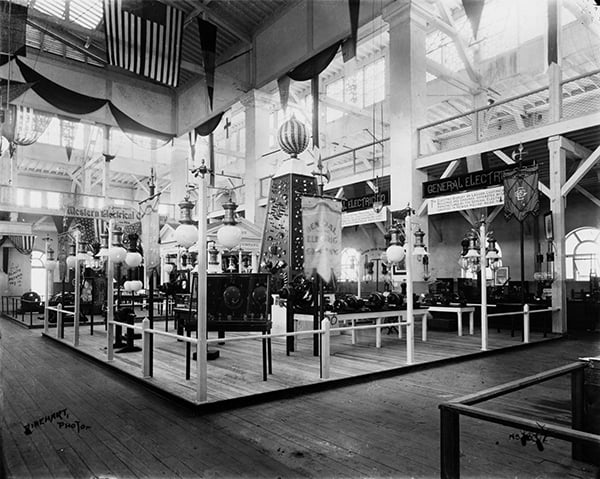
The Machinery and Electricity Building exhibited the latest technology. RG2752-01-10-1
This article first appeared in the October 2024 issue of NEBRASKAland magazine.