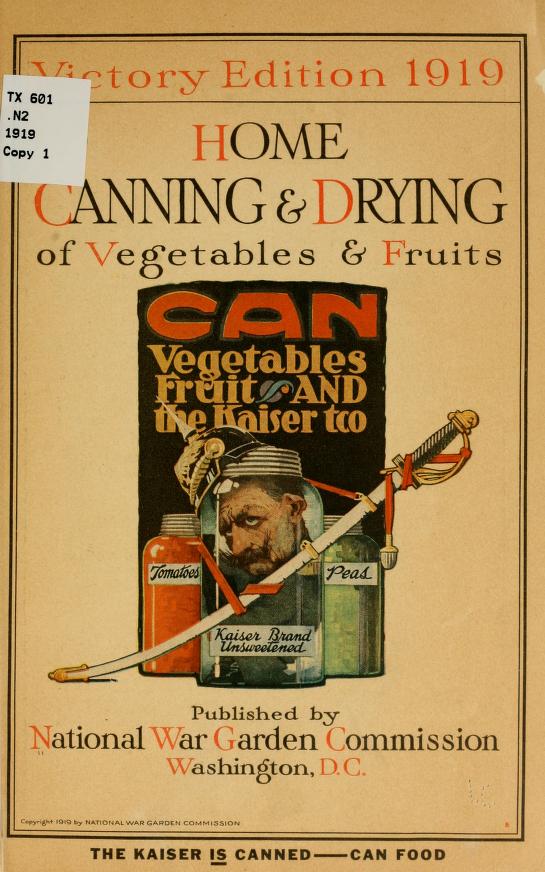
Housewives were urged to “can Vegetables Fruit & the Kaiser too” in this 1919 publication by the National War Garden Commission.
During American participation in World War I the U.S. Food Administration, under the direction of Herbert Hoover, launched a massive campaign to persuade Americans to economize on food and to grow gardens in their backyards. Housewives were urged to “can Vegetables Fruit & the Kaiser too” and to “Back Up the Cannon by Use of the Canner.” When sugar became in short supply, Food Administration officials recommended new methods of home canning and food preservation, relying on the resourcefulness of the American housewife to put into practice their new slogan: ”Maximum canning with minimum sugar.”
The Lincoln Daily Star on July 17, 1918, said: “Despite the severe sugar shortage and the limited supplies for canning and preserving purposes, housewives are urged to ‘put up’ enough fruits and vegetables to carry them through the winter. Two great advantages will come from such practices—food stores will be assured and transportation will be greatly relieved so that fundamental foods and other necessities can be transported.”
National War Garden Commission poster depicting a young gardener marching with personified potatoes, carrots, and pumpkins carrying American flags. NSHS 4733-11
The Commoner (Lincoln) on August 1, 1918, described the resourceful housewife as “bending all efforts to learn the best ways of using less sugar in her cooking and preserving and of canning without it; or with sugar substitutes.” Americans’ obsessive love of sugar was also criticized by Food Administration officials, who urged housewives to cut down on even the small amount of sugar used to sweeten tea and coffee by enforcing the rule of “one teaspoonful to the cupful or none at all.”
Read more about how housewives were urged to preserve food during a sugar shortage in a Publication column on the Nebraska State Historical Society website.
— Patricia C. Gaster, Assistant Editor/Publications
(Updated 8/18/2023)