In late 1990, Smithsonian magazine published a story on gifts given to U.S. presidents. The cover of the issue highlighted a gift once bestowed on Harry S. Truman: a coconut carved and decorated to resemble Truman’s own head.
The caption described it as “a beaming example” of presidential presents.
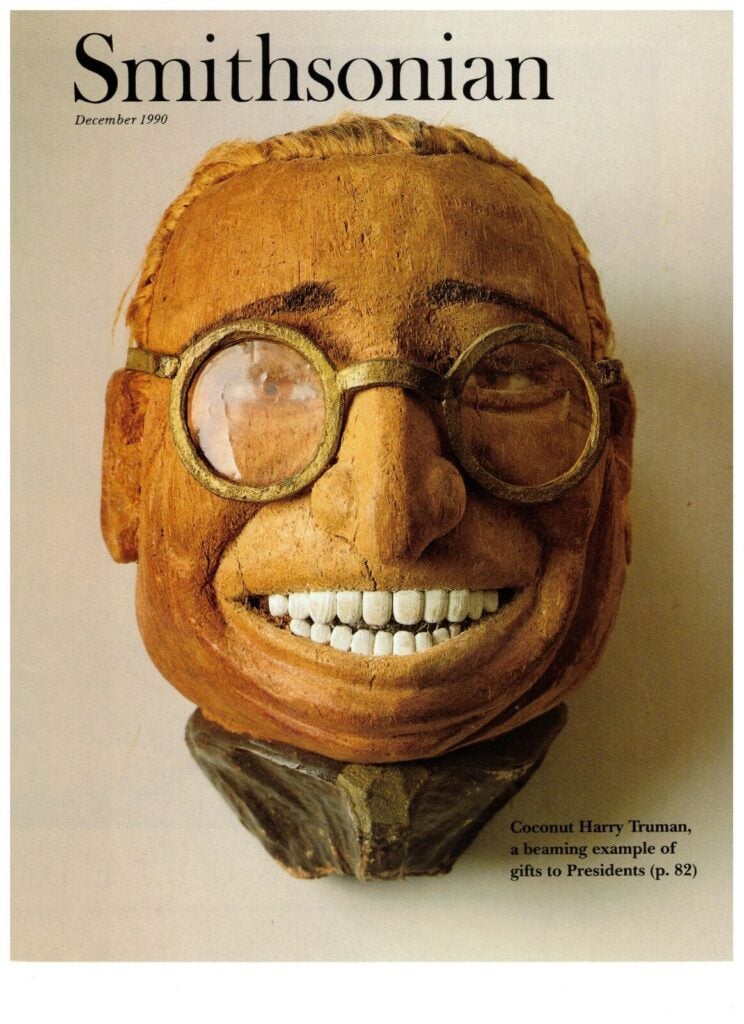
Smithsonian magazine featured the coconut head on the cover of its December 1990 issue. Today, the object belongs to the Harry S. Truman Presidential Library and Museum in Independence, Missouri.
The coconut head in question recently came to the Ford Center for conservation. Composed of a variety of materials, the object was structurally sound overall, but several of its decorative elements had become areas of concern.
Two of the carved teeth were loose. Much of the “hair” — long plant fibers adhered to the back of the coconut — was breaking away or already lost.
The adhesive used to assemble the “glasses” was also failing, and the plastic lenses were separating from the painted paperboard frames as a result.
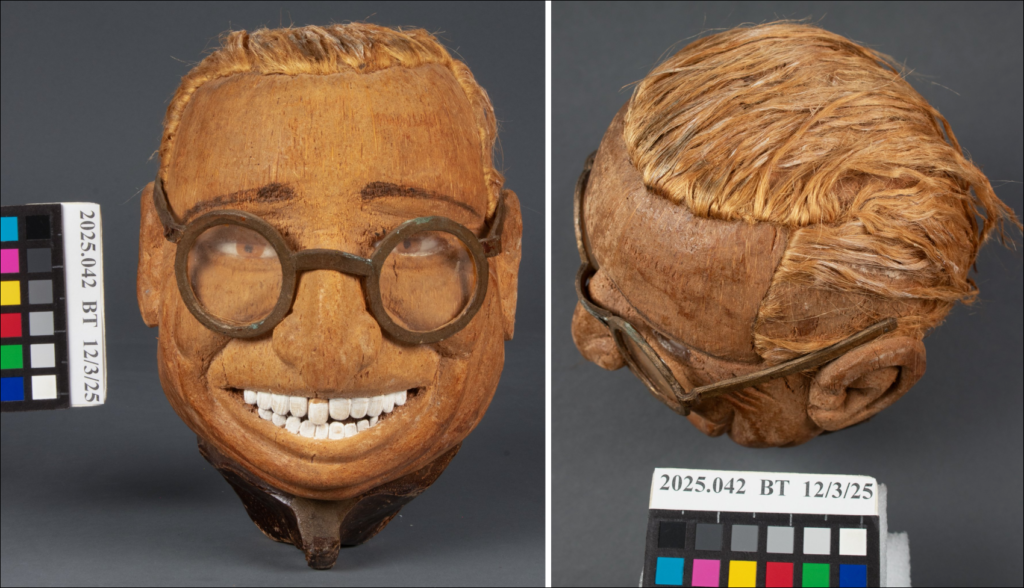
A loose tooth and damaged “hair” fibers are among the concerns visible in these before-treatment images of the Truman coconut head. Discolored adhesive is also evident on the hair in the form of a white residue.
The Objects Lab developed a treatment plan to secure the loose and detaching elements while bringing the Truman coconut head closer to its original appearance. But first, we had to address its stability.
The carved base at the bottom of the coconut head is narrow, which puts the object at risk of tipping over and crushing its own fragile hair fibers. To keep it balanced and upright during treatment, we built an inconspicuous brace by covering the base with a barrier layer of wax film and molding epoxy putty into the unsupported areas.
Once the putty had cured, the wax film was removed, and the newly created support was painted and lined with felt.
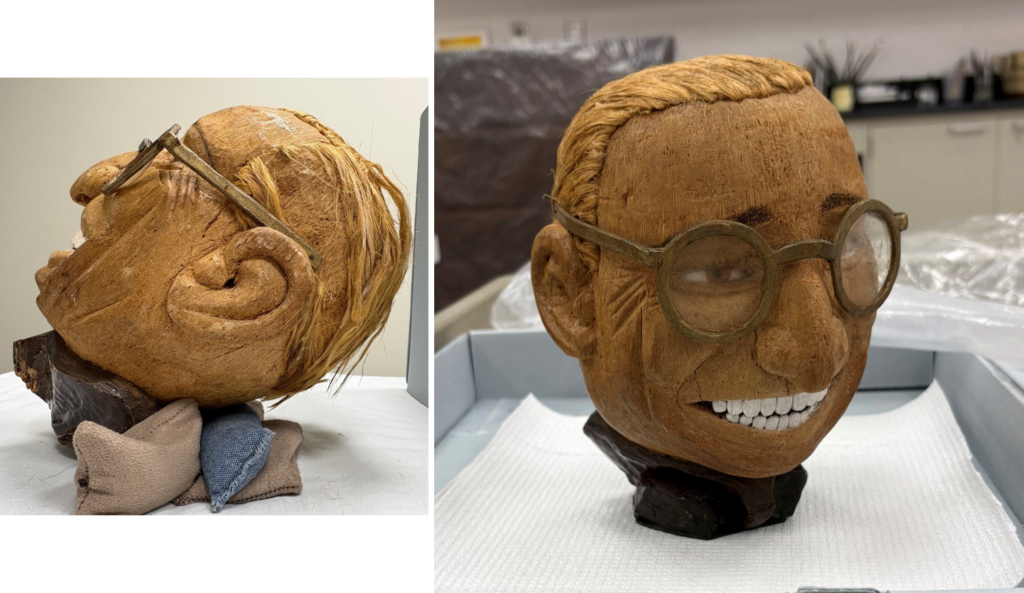
Soft weights were used temporarily to keep the coconut head from tipping over, as seen in the before-treatment image on the left. For longer-term stability, an inconspicuous support was created and painted to match the base, as seen in the during-treatment image on the right.
Resting safely on its support, the coconut head was vacuumed overall to remove loose dirt. Grime was reduced even further using erasers, and a few minor cracks in the coconut’s surface were consolidated using an adhesive.
The hair was then stabilized as much as possible. We carefully arranged the fragile fibers so the lost strands are less obvious and helped secure them in place with two rounds of adhesive. The first was an adhesive film slipped below the fibers and activated with a warm tacking iron; the second was a liquid adhesive brushed lightly across the strands.
We were able to remove some of an old adhesive that left a white residue on the hair, but other portions couldn’t be removed without causing further breakage to the fibers. Those discolored areas were toned using paint or a mixture of inpainting medium and dry pigments to minimize the appearance of distracting damage.
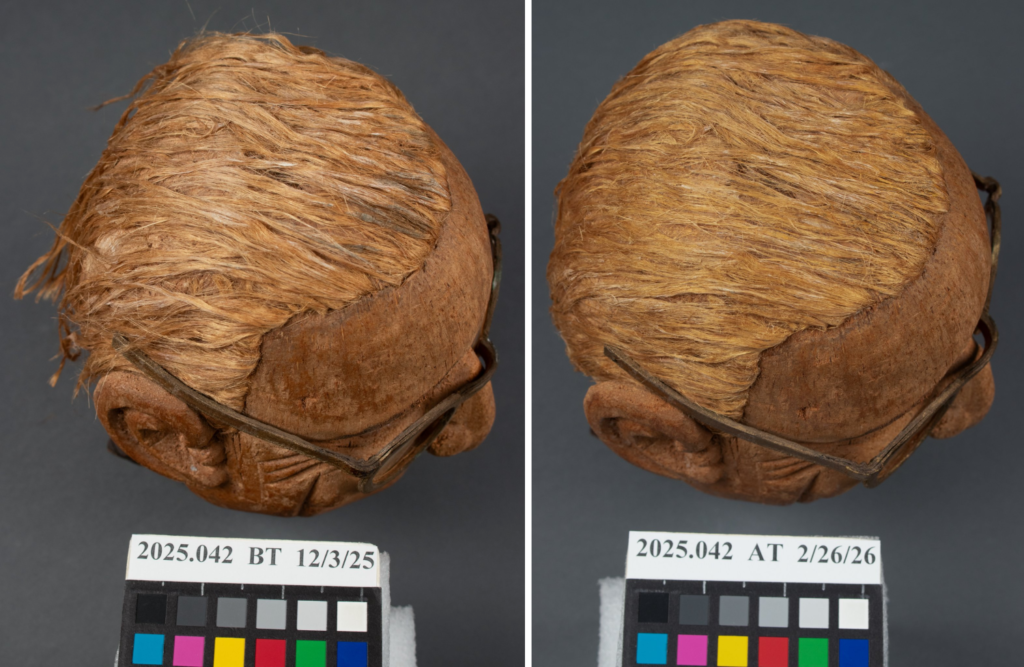
Before- and after-treatment images of the coconut head’s hair.
Finally, the loose teeth were stabilized and toned, and the glasses lenses were cleaned and readhered to the frames.
With treatment complete, we built an enclosure to protect the coconut head in transit and storage. The box has a drop-down wall, slide-out tray, and a series of foam supports to help its handlers move and access the object safely.
Our testing also revealed that the plastic in the glasses is likely cellulose acetate, which off-gasses harmful chemicals that degrade the plastic as it ages. So, we cut vents in the box’s lid and lined the interior with a pollutant-absorbing paper. That way, the enclosure will allow continuous air circulation and trap damaging off-gassing.
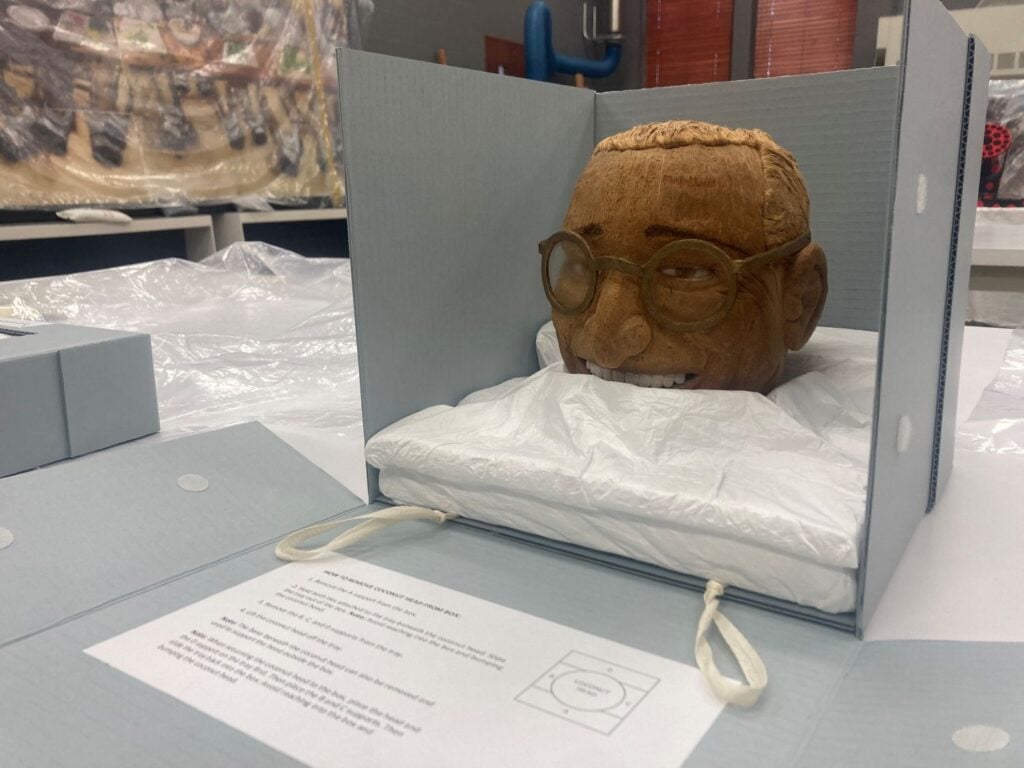
This after-treatment image shows the construction of the protective enclosure in progress. In addition to foam supports, the box has a drop-down wall and slide-out tray, so handlers don’t have to reach in from above and risk jostling the coconut head.
The coconut head and its custom support have now returned to the collection of the Harry S. Truman Presidential Library and Museum in Independence, Missouri. Stable and safely housed, the object should be ready if it’s ever called upon for another magazine photo shoot.
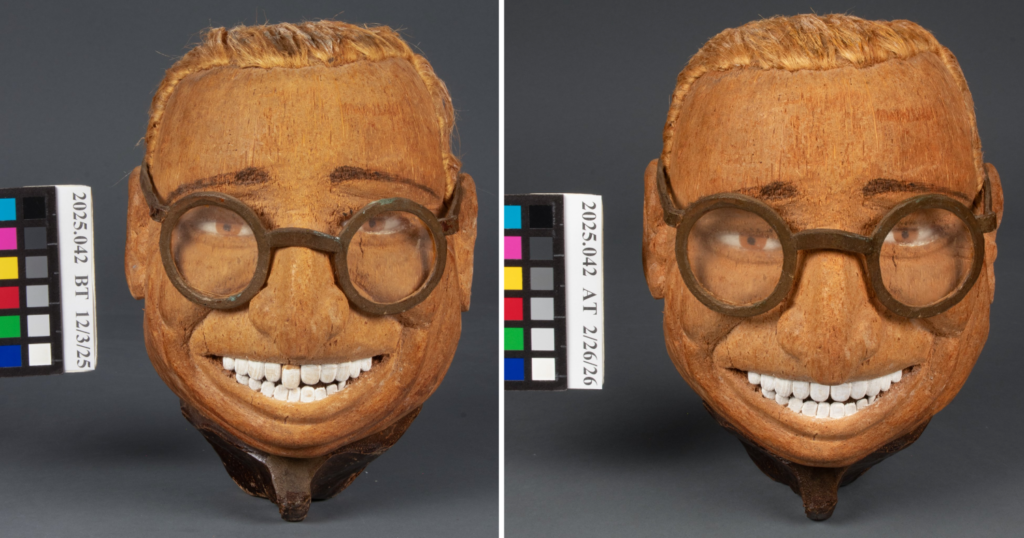
Before- and after-treatment images of the front of the coconut head.
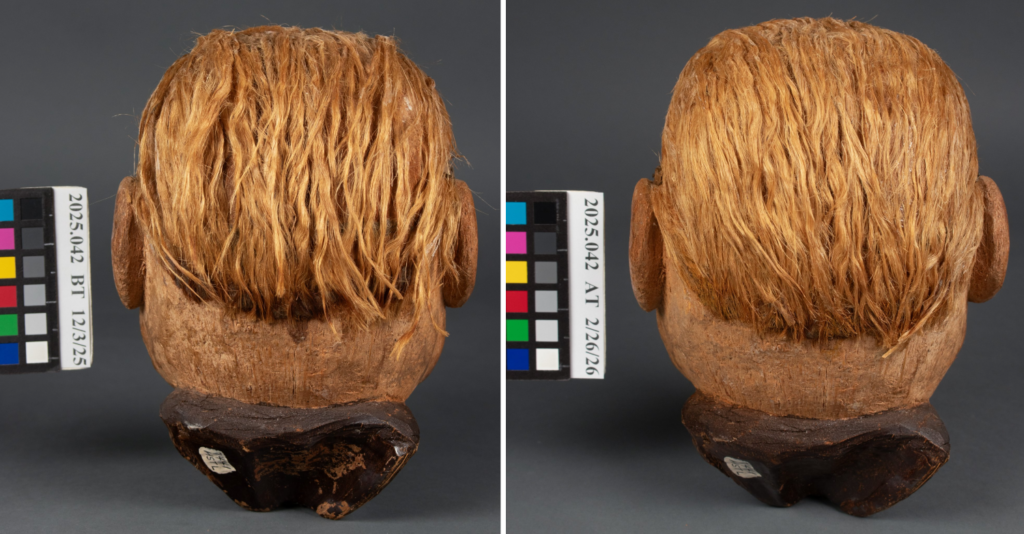
Before- and after-treatment images of the back of the coconut head.
(Published May 2026)