Marker Monday: Salem Swedish Methodist Episcopal Church

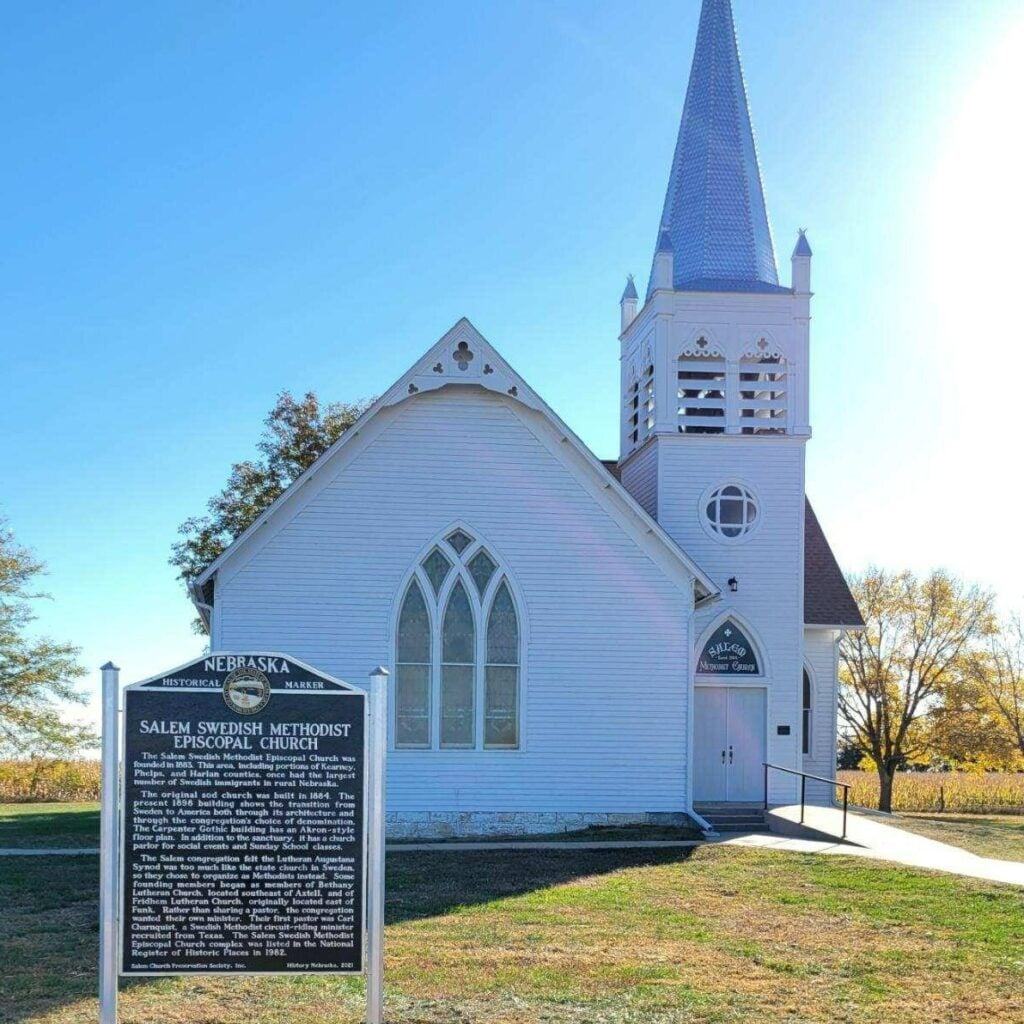
A white, wooden church with a tall steeple stands next to a historical marker sign that reads “Salem Swedish Methodist Episcopal Church” in Nebraska.


Marker Text

The Salem Swedish Methodist Episcopal Church was founded in 1883. This area, including portions of Kearney, Phelps, and Harlan counties, once had the largest number of Swedish immigrants in rural Nebraska.


The original sod church was built in 1884. The present 1898 building shows the transition from Sweden to America both through its architecture and through the congregation’s choice of denomination. The Carpenter Gothic building has an Akron-style floor plan. In addition to the sanctuary, it has a church parlor for social events and Sunday School classes.


The Salem congregation felt the Lutheran Augustana Synod was too much like the state church in Sweden, so they chose to organize as Methodists instead. Some founding members began as members of Bethany Lutheran Church, located southeast of Axtell, and of Fridhem Lutheran Church, originally located east of Funk. Rather than sharing a pastor, the congregation wanted their own minister. Their first pastor was Carl Charnquist, a Swedish Methodist circuit-riding minister recruited from Texas. The Salem Swedish Methodist Episcopal Church complex was listed in the National Register of Historic Places in 1982.


Location

Intersection of Roads 20 and H near southwest of Axtell, Nebraska. View the marker’s location HERE.
 

You May Also Enjoy

Marker Monday: The Sage Brothers

Marker Monday: The Sage Brothers

Nebraska History Spotlight: the Clarkson Historical Society

Nebraska History Spotlight: the Clarkson Historical Society

Nebraska’s Celebration of America’s 250th Birthday

Nebraska’s Celebration of America’s 250th Birthday

No results found.

About NSHS

The Nebraska State Historical Society was founded in 1878 by citizens who recognized Nebraska was going through great changes and they sought to record the stories of both indigenous and immigrant peoples. It was designated a state institution and began receiving funds from the legislature in 1883. Legislation in 1994 changed NSHS from a state institution to a state agency. The division is headed by Director Daryl Bohac. They are assisted by an administrative staff responsible for financial and personnel functions, museum store services, security, and facilities maintenance for NSHS.

Explore Nebraska

Discover the real places and people of our past at these NSHS sites.

Upcoming Events

View our new and upcoming events to see how you can get involved.

Become a Member

The work we do to discover, preserve, and share Nebraska's history wouldn't be possible without the support of NSHS members.

NSHS Education

Learn more about the educational programs provided at our museums, sites, and online.

Education Digital Learning Resources

Find games, lists, and more to enhance your history education curriculum.

Latest Hall of Fame Inductee

The Nebraska Hall of Fame was established in 1961 to officially recognize prominent Nebraskans.

Listen to our Podcast

Listen to the articles and authors published in the Nebraska History Magazine with our new Nebraska History Podcast!

Nebraska Collections

NSHS's mission is to collect, preserve, and open our shared history to all Nebraskans.

Our YouTube Video Collection

Get a closer look at Nebraska's history through your own eyes, with our extensive video collections.

Additional Research Resources

NSHS's Research and Reference Services help connect you to the material we collect and preserve.

NSHS Services

Digital Resources

Find all of our digital resources, files, videos, and more, all in one easy-to-search page!

Support The Historical Society

Make a cash donation to help us acquire, preserve, and interpret Nebraska’s history. Gifts to the Nebraska State Historical Society help leave a legacy and may help your taxes, too! Support the work of NSHS.

Volunteers are the heroes of NSHS. So much history, so little time! Your work helps us share access to Nebraska’s stories at our museums and sites, the reference room, and online.