Marker Monday: The O.K. Store

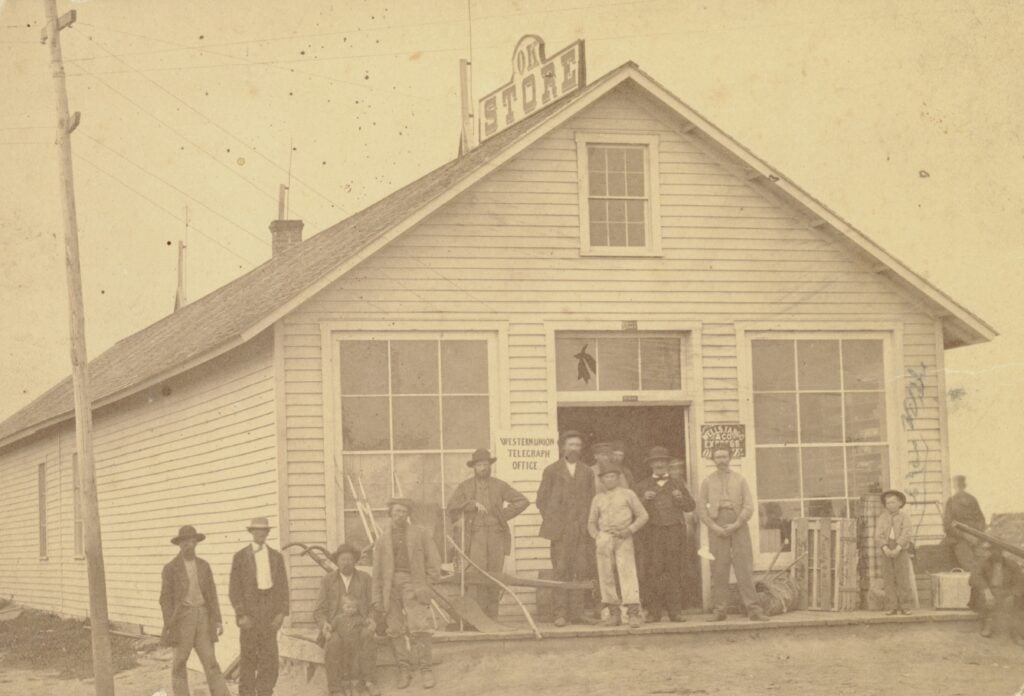
A sepia photo of people standing outside a wooden general store with large windows and a sign reading "Store" above the entrance. A “Western Union Telegraph Office” sign is posted on the building.

O.K. Store, c. 1890. NSHS RG3451-3-100

Marker Text

The first settlers of Hall County, Nebraska, nearly all of whom were German immigrants, arrived on July 5, 1857. They platted Grand Island City and established farms. The O.K. Store of Henry A. Koenig and Fred Wiebe, located near the Mormon Trail, was opened near this site in 1862. It was the first store in the settlement and it also served as the first telegraph station. During the Indian uprising of 1864 and 1865 many Platte Valley settlers fled but the Grand Island settlers remained. They fortified the O.K. Store with a sod stockade which sheltered 68 men and 100 women. To give shelter to 35 more persons, William Stolley built “Fort Independence” about two miles west. On August 22, 1865, General S. R. Curtis and his troops visited “Fort O.K.” Impressed by the settlers’ preparations for defense Curtis left a six-pounder cannon, which is still preserved in Hall County. Because of the fortifications “Fort O.K.” and Grand Island escaped Indian attacks. In 1858, a short distance northeast of this marker, the first post office for Grand Island was located in John D. Schuller’s cabin, which now stands on the county museum grounds.


Location

Fonner Park, 700 E Stolley Park Road, Grand Island.
Become a Member!

Our members make history happen.

Join Now

You May Also Enjoy

Marker Monday: The O.K. Store

Marker Monday: The O.K. Store

Nebraska History Spotlight: Lincoln County Historical Museum

Nebraska History Spotlight: Lincoln County Historical Museum

Marker Monday: Prisoners of War in Dundy County

Marker Monday: Prisoners of War in Dundy County

No results found.

About NSHS

The Nebraska State Historical Society was founded in 1878 by citizens who recognized Nebraska was going through great changes and they sought to record the stories of both indigenous and immigrant peoples. It was designated a state institution and began receiving funds from the legislature in 1883. Legislation in 1994 changed NSHS from a state institution to a state agency. The division is headed by Director Daryl Bohac. They are assisted by an administrative staff responsible for financial and personnel functions, museum store services, security, and facilities maintenance for NSHS.

Explore Nebraska

Discover the real places and people of our past at these NSHS sites.

Upcoming Events

View our new and upcoming events to see how you can get involved.

Become a Member

The work we do to discover, preserve, and share Nebraska's history wouldn't be possible without the support of NSHS members.

NSHS Education

Learn more about the educational programs provided at our museums, sites, and online.

Education Digital Learning Resources

Find games, lists, and more to enhance your history education curriculum.

Latest Hall of Fame Inductee

The Nebraska Hall of Fame was established in 1961 to officially recognize prominent Nebraskans.

Listen to our Podcast

Listen to the articles and authors published in the Nebraska History Magazine with our new Nebraska History Podcast!

Nebraska Collections

NSHS's mission is to collect, preserve, and open our shared history to all Nebraskans.

Our YouTube Video Collection

Get a closer look at Nebraska's history through your own eyes, with our extensive video collections.

Additional Research Resources

NSHS's Research and Reference Services help connect you to the material we collect and preserve.

NSHS Services

Digital Resources

Find all of our digital resources, files, videos, and more, all in one easy-to-search page!

Support The Historical Society

Make a cash donation to help us acquire, preserve, and interpret Nebraska’s history. Gifts to the Nebraska State Historical Society help leave a legacy and may help your taxes, too! Support the work of NSHS.

Volunteers are the heroes of NSHS. So much history, so little time! Your work helps us share access to Nebraska’s stories at our museums and sites, the reference room, and online.