The Bicentennial year of 1976 marked the beginning of the Lincoln County Historical Museum. Planning for the museum began years earlier and culminated in a July 4th opening to the public. It was a grassroots effort led by a dedicated group of volunteers who saw a center for Western history as an essential way to preserve the region’s cultural and historical resources. The result would become an eleven-acre museum complex housing artifacts and buildings that tell the story of west-central Nebraska.
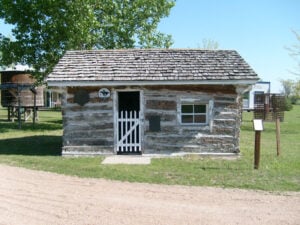
Pony Express Cabin at the Lincoln County Historical Museum.
The museum revolves around three major themes: the Pioneer Period, Agriculture, and the North Platte Canteen. The story of our pioneers is told through numerous artifacts within the main museum building and in the historic structures that make up part of the eight-acre village. There is an exhibit on Fort McPherson, and the Frank & Fred Leu Memorial Wing features artifacts from our ranching history. Outside, there are four log cabins and a depot that represent this period. They are Emil Ericsson’s homestead cabin (1868), an original Fort McPherson cabin (1860s or 1870s), a Pony Express cabin (ca. 1861), and a freighter’s cabin (1866) that was moved to North Platte the year after the town was platted by the Union Pacific. The depot came from Brady and was built in 1885.
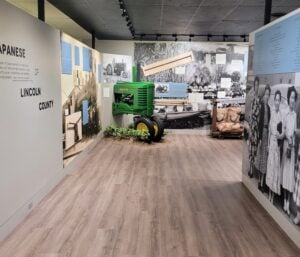
“Japanese of Lincoln County” Exhibit at the Lincoln County Museum.
Agriculture also makes up a significant portion of the history preserved in the museum. This is partly represented in our “Japanese of Lincoln County” exhibit. This unique piece of history centers on the Japanese immigrants (issei) who arrived to work for the railroad and then stayed to farm, ranch, and open businesses, as well as their children (nisei), who fought in World War II.
In the village, two exhibit buildings are dedicated to the tractors and equipment that helped make the U.S. the breadbasket of the world. It is also where one of the only remaining ditch plows in the country is located. Costing up to $1,000 per mile and pulled by approximately forty-eight head of oxen or, at times, three capstans, it dug ditches three feet deep and eight feet wide at the top. The “bull ditches” it created drained marshy ground caused by irrigation ditches and improved hay meadows and fields.
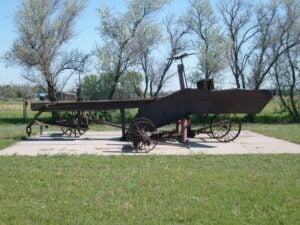
A ditch plow that was used to drain the Platte River Valley. Now displayed at the Lincoln County Historical Museum.
By the 1920s, the days of animal-powered equipment were coming to an end, and the owners left the plow northwest of North Platte when it was no longer profitable to operate. The grove of trees that grew around it saved the plow from the scrap drives of World War II.
The North Platte Canteen is one of those rare historical events that was both locally and nationally significant. Its impact on the lives of millions of people was profound enough that the United States Congress is considering giving its volunteers the Congressional Gold Medal. Naturally, preserving and telling the Canteen’s story is a major part of the museum’s job. Within the exhibit, visitors learn how North Platte’s first canteen, founded during World War I, influenced Rae Wilson to start the Canteen in World War II. The exhibit explains the volunteer effort that eventually involved 55,000 people from 125 communities in Nebraska and surrounding states through visual media and artifacts.
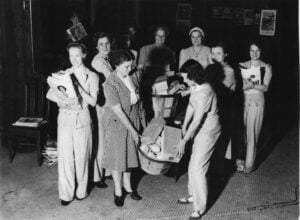
Canteen volunteers bringing in donated items, circa 1942. Photo courtesy of the Lincoln County Historical Museum.
From a simple oven used by a volunteer to make angel food cakes every day for the entire war, to the popcorn ball romance, to one of the original famous coffee pots, and to live film footage shot by the U.S. Army in 1945, the exhibit is designed to convey the love, sacrifice, and patriotism of a group of women who served both the cause of liberty and the soldiers who walked through their doors. Because of one woman’s idea and the efforts of thousands of volunteers, a stop in the middle of Nebraska became a little piece of home for 6 million servicemen and women. It is truly an American story and one we love to tell.
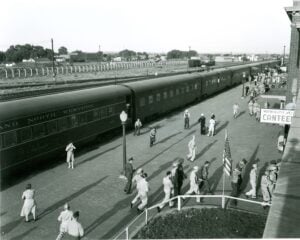
The North Platte Canteen. Photo courtesy of the Lincoln County Historical Museum.
To learn more about the Lincoln County Historical Museum, you can visit their website at www.lincolncountymuseum.org or follow them on Facebook. Their social media is not just a place where events are posted but also serves as a changing exhibit space for images and artifacts that would otherwise be stored away in the archive. Located in North Platte, NE, the museum is open May 1– September 30, Monday–Saturday from 9:00 a.m. to 5:00 p.m., and Sunday from 1:00 p.m. to 5:00 p.m. The museum is also open during Crane Season each year and by appointment during the winter months. They can be contacted by phone at 308-534-5640 or by email at lincomuseum@gmail.com. Address: 2403 N Buffalo Bill Ave, North Platte, NE 69101
-Lincoln County Historical Museum, July 2026