With outstretched wings carved from ivory, a large eagle sculpture became the focus of a detailed conservation treatment at the Gerald R. Ford Conservation Center.
The eagle was once owned by U.S. Senator William Purnell Jackson, who represented Maryland from 1912 to 1914, according to the clients who brought it in for treatment. The clients don’t know exactly how the sculpture first made its way from Meiji-era Japan to the United States. But they inherited it from a relative and displayed it in their home until a box was accidentally dropped on top of it.
The eagle, which is mounted on a root-wood stand, sustained numerous losses and breaks in the accident. The wing and tail feathers were especially damaged. The ivory surfaces had also discolored over time, and so had an adhesive used in earlier repair efforts.
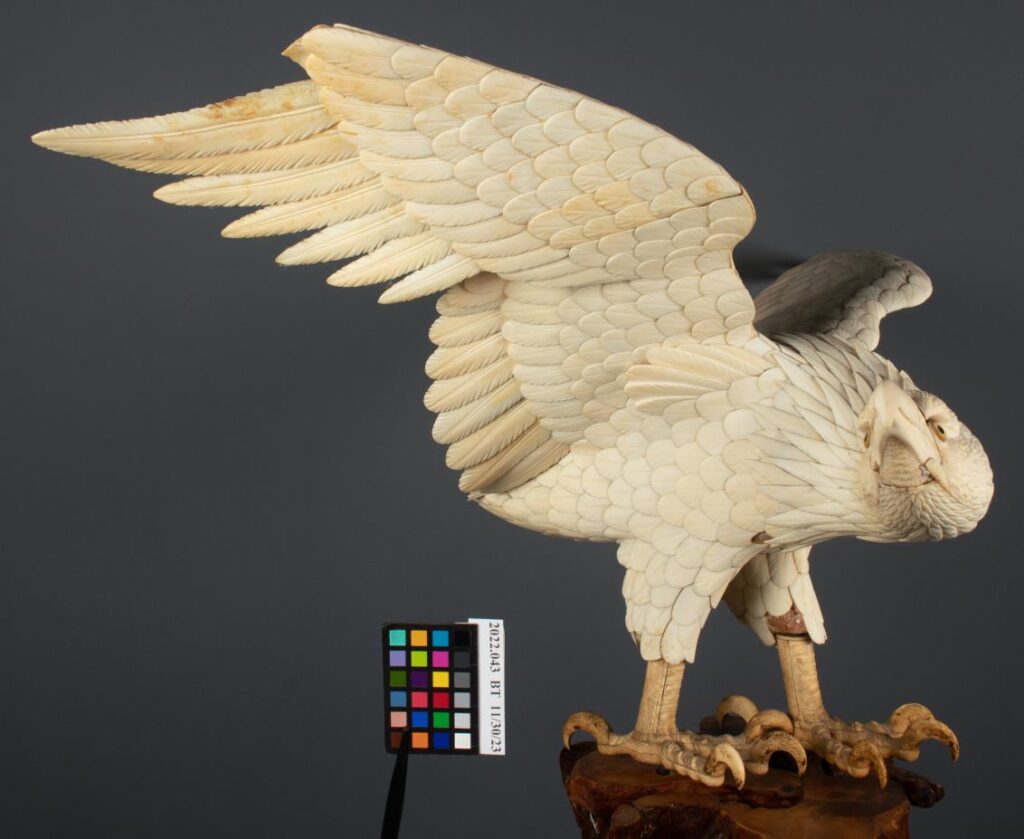
The eagle sculpture suffered numerous losses and breaks, as seen in these before-treatment images. Discoloration is also visible on the carved ivory surfaces.
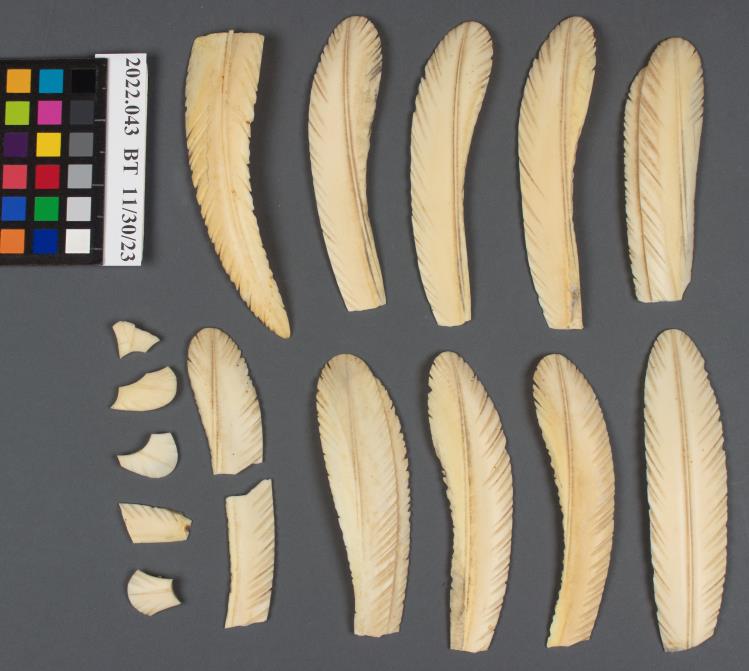
Structurally, the eagle has an underlying wood core, which is overlaid with ivory pieces carved to resemble feathers and other body parts. These carved pieces were attached to the wood using adhesive, iron alloy screws, and copper alloy pins.
Examination of the ivory’s grain under a microscope in the Objects Lab indicated that it doesn’t have the characteristic crosshatch pattern typical of elephant ivory. Instead, the grain is composed of relatively even, curved lines, suggesting the pieces were carved from the tooth or tusk of a mammal other than an elephant.
With all of this information in mind, we designed a treatment plan to stabilize the sculpture’s loose and detached pieces, recreate lost elements, protect the original materials from further loss, and bring it closer to its original appearance.
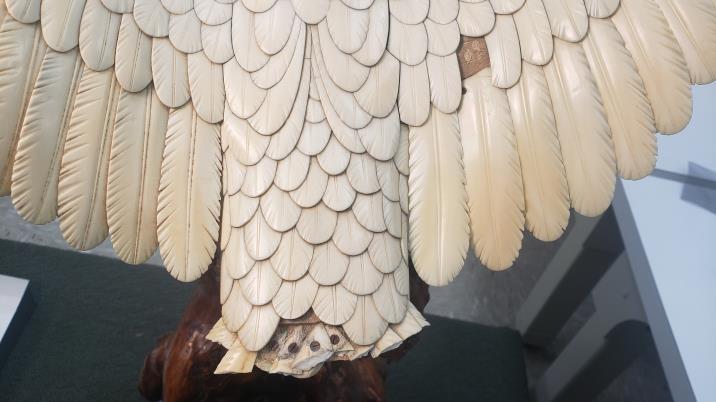
The sculpture has a wood core, which is overlaid with pieces of carved ivory. In this during-treatment image, the underlying wood is visible where feathers are broken or lost.
We began treatment by disassembling the sculpture to the extent possible, so each component could be thoroughly cleaned.
We removed heavy layers of dust and grime with a vacuum, soft-bristle brush, and a customized cleaning solution. We used scalpels and sharpened pieces of bamboo to mechanically scrape away old, discolored adhesive. And for the most stubborn stains and residues, we deployed a number of solvents chosen after careful testing.
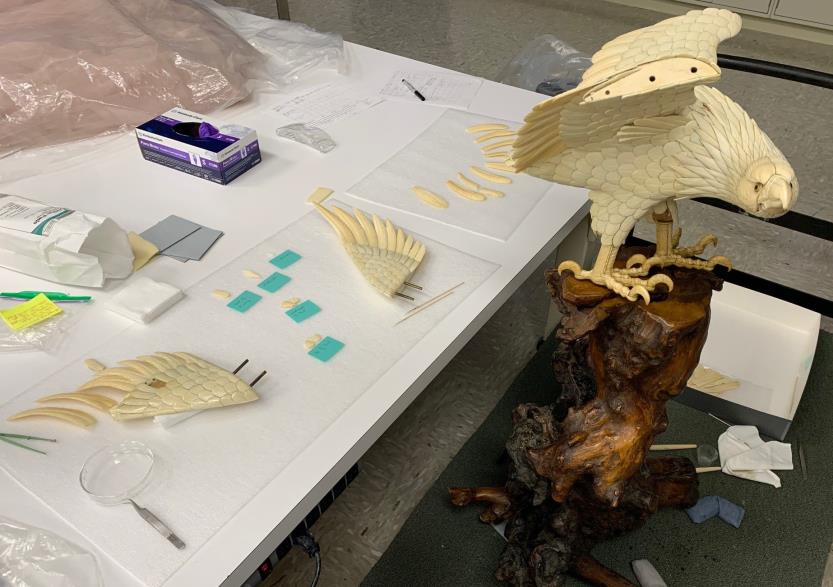
The carved ivory pieces are attached to the sculpture using adhesive, screws, and pins, so we disassembled the eagle to clean each element. This during-treatment image documents part of the cleaning process and shows how the wingtip is attached to the rest of the body using pins.
Once all of the components were cleaned, a barrier layer was applied to the edges of the broken pieces to protect and isolate the original material. Then the pieces were reattached using adhesives.
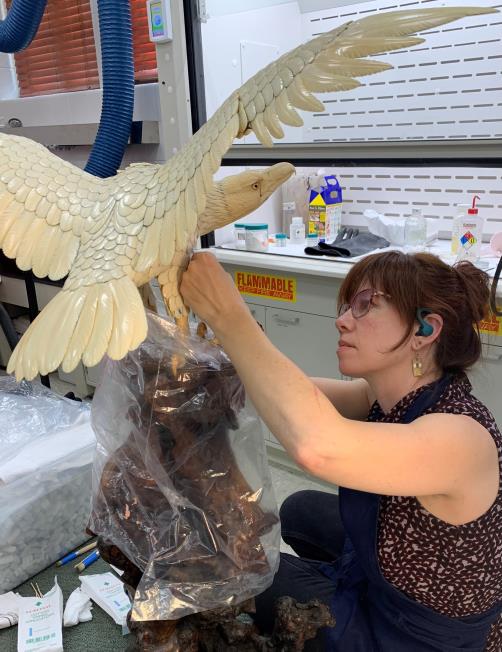
In this during-treatment image, Objects Conservator Rebecca Cashman reattaches broken pieces to the sculpture.
There was no real ivory available that would’ve been suitable to replace the sculpture’s numerous lost feathers, so we created faux feathers. These fills were shaped with scalpels and Dremel bits to blend in with the original carvings as closely as possible. Then they were attached using a reversible adhesive and toned with a mixture of resin and dry pigment to match the color and gloss of the original ivory.
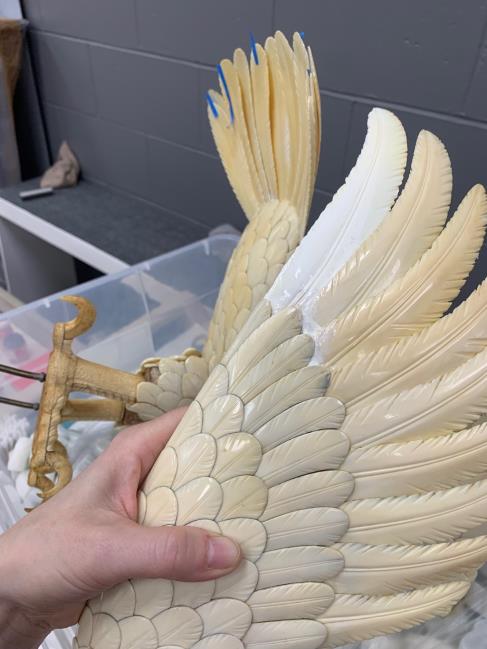
Faux ivory fills, like the one on the left in this during-treatment image, were made to replace the sculpture’s lost feathers. After the fills were attached, they were toned to match the color and gloss of the original ivory as much as possible.
With the eagle’s repairs complete, we turned to the root-wood stand for the final steps of the treatment. We hammered a loose leg on the stand back into place so it wouldn’t wobble, and we applied and buffed a mixture of paste wax and dry pigment to its surface to give it a protective coating.
The eagle sculpture has now been returned to its owners in stable condition. We’ve recommended the object be displayed away from direct sunlight and bright areas to avoid light damage, which could discolor both the original and repair materials.
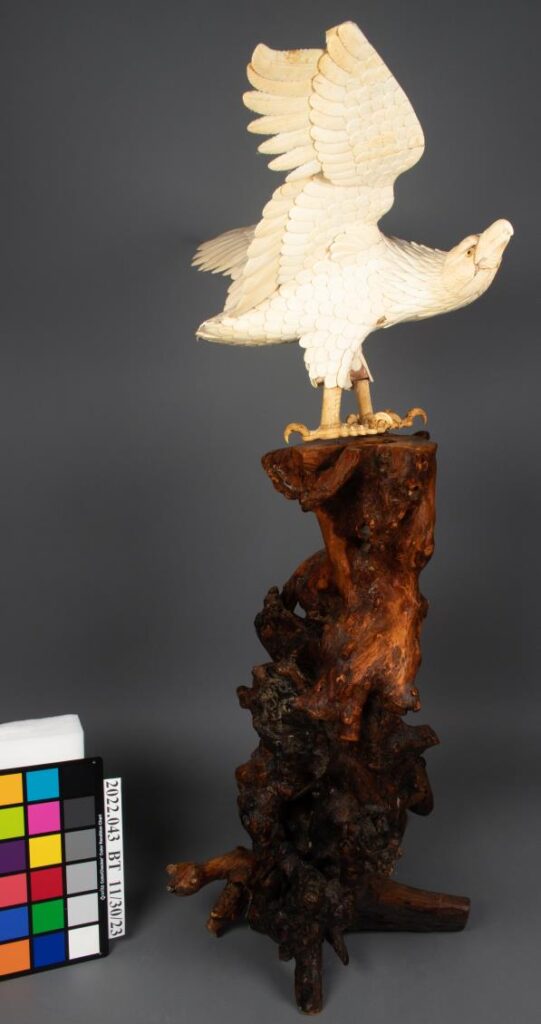
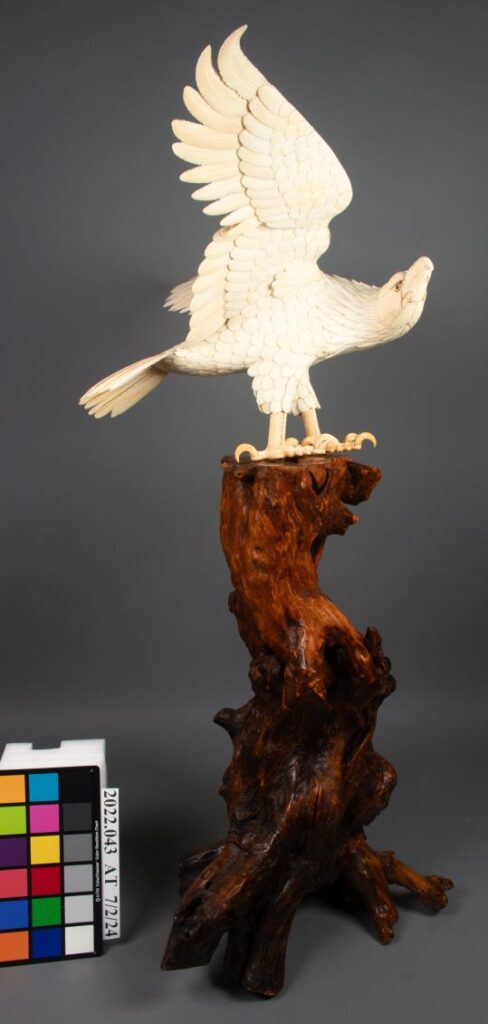
Before- and after-treatment images of the overall eagle sculpture and stand.
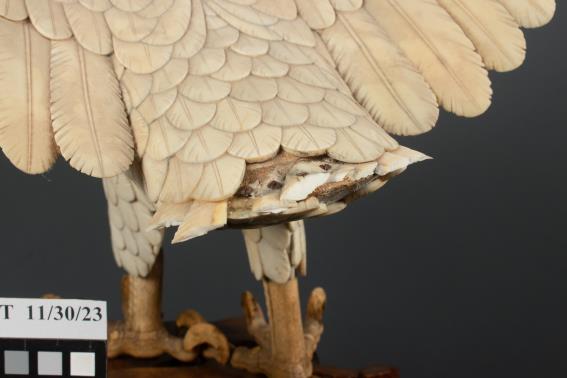
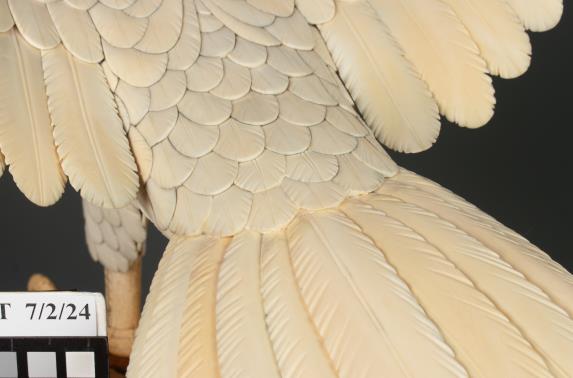
Before- and after-treatment images of the eagle’s tail.