By David L. Bristow
Imagine that you are in a bar in the early 1900s—a glass of cold beer in your hand, a spittoon within easy spitting distance on the hardwood floor, and a racy painting of some unclothed beauty hanging on the wall.
You turn at the sound of a woman’s voice singing hymns, and in walks a mature woman in a long black dress. Standing nearly six feet tall, she wields a hatchet and has fire in her spectacled eyes.
And then she starts smashing the place up until she is tackled and hauled away by police.
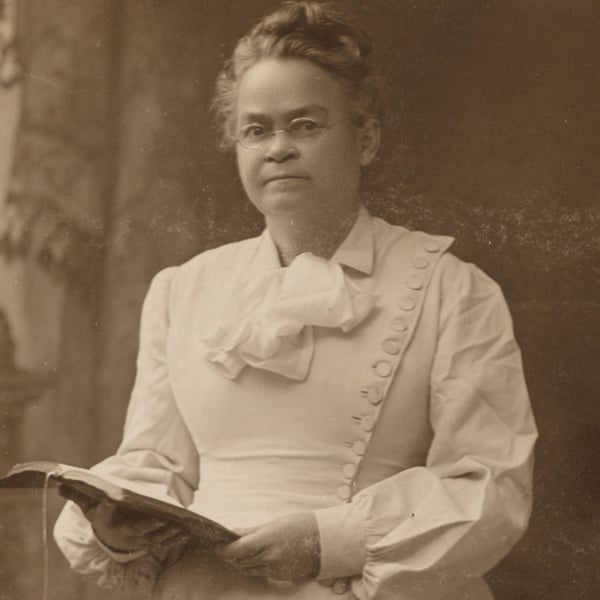
Carrie Nation in 1903. National Portrait Gallery
Starting in 1900, Carrie Nation became a household name for her fanatical (she agreed with that word) opposition to alcohol. The 55-year-old Kansan spent much of early 1902 crusading in Nebraska.
In March, some saloons in Fullerton and Hastings locked their doors as soon as Nation arrived in their town.[1] One Hastings bar owner probably wished he had done likewise after Nation “grabbed a chunk of ice from a dish of olives” and “slammed it through” a “breezy picture” she didn’t like, in the words of the Lincoln Courier.[2]
Days later, the mayor of Blair refused to let the Kansan speak at the city opera house, saying, “We have enough trouble of our own, without importing any more.”[3] But Nation spoke at Boyd’s Opera House in Omaha, a city she called a “Hell-hole of iniquity.” Sipping from a “pitcher of light-brown Missouri River water,” Nation “shot ragged holes in the social system, upset theology, ripped politics up the back, and with a well-primed charge of verbal dynamite blew up the government in Washington,” according to the Omaha Bee.[4]
“You business men here that want saloons are nursing the adder in your bosoms that will sting you,” she said. “You men can vote it out and you women can smash it out.”[5]
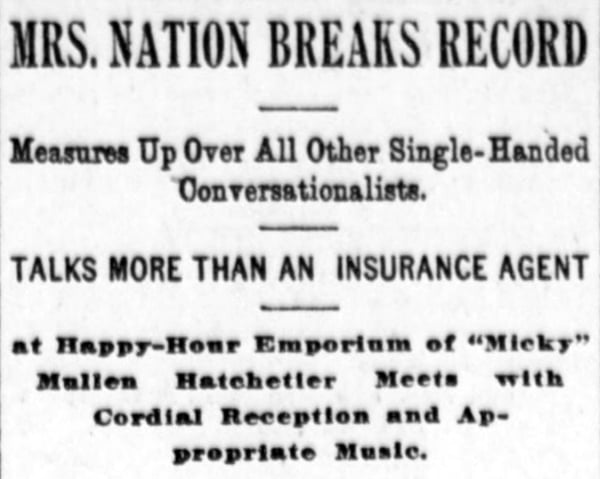
Nation toured Omaha’s vice district accompanied by reporters. Omaha Bee, March 30, 1902
The City of Lincoln, meanwhile, was seriously considering a local prohibition ordinance, and Nation went there to campaign for it. When it failed in a close vote, she blamed local resident William Jennings Bryan—recent presidential nominee and the country’s most prominent Democrat—for not speaking up enough in its favor. Never tolerant of half-heartedness or political calculation, Nation wrote in her autobiography, “From that time forth I knew Bryan was for Bryan and what Bryan could get for Bryan.”[6]
Nation’s followers shared her uncompromising fervor. While she was in Lincoln, news broke that a woman had horsewhipped the mayor of Topeka, Kansas, for failing to shut down the city’s saloons. Nation applauded the attack.[7] On April 1, newspapers reported that a dozen veiled women had entered a saloon in Eddyville, Nebraska, smashing furniture and emptying out liquor bottles.[8]
Nation herself never did anything veiled. She was soon back in Omaha touring the city’s notorious Third Ward in the company of several newspaper reporters. A crowd followed her to Goldsmith’s saloon at Ninth and Capitol, “possibly the toughest joint in town,” according to the Omaha Bee. “With wild peals of laughter the women raised their glasses of beer, blew the foam from the amber fluid so that it almost fell upon the ‘smasher’s’ dress and drank to her health.”[9]
She received a harsher welcome at a Nebraska City saloon a few days later when she tried to get behind the bar—presumably to break things—and in the ensuing scuffle was reportedly slapped by a bartender. Nation took it in stride.[10] In her autobiography she boasted, “I reeled and fell and while I knew he struck me with his clenched fists as hard as he could, so it seemed to me, I did not have a bruise.”[11] Ejected from the saloon, she came back later and was arrested and jailed.
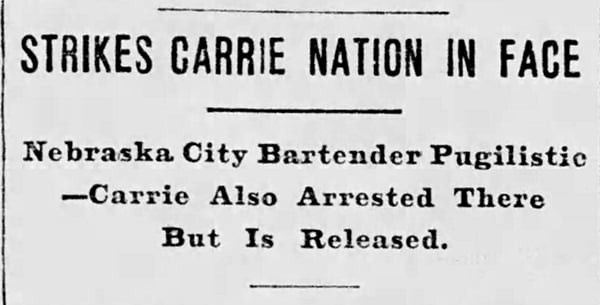
Omaha World-Herald, April 6, 1902
But opposing alcohol wasn’t Nation’s only crusade. She was also an ardent supporter of women’s suffrage. For her, and for many women of her generation, the two causes were related. In one of her public debates on suffrage, Nation took on a county judge in Seward. According to the Blue Valley Blade, the pair spent the evening quoting the Bible at each other.
“She seems to have a very poor opinion of the stronger sex,” the Blade commented. “Mrs. Nation contends that men are to blame for all the evil in the land and that things will not go right until women are allowed to vote.”[12]
Dying in 1911, Nation did not live to see the country embrace both Prohibition and women’s suffrage in the wake of World War I. For Nebraskans, her 1902 tour showed both the growing power—and firm resistance to—her causes.
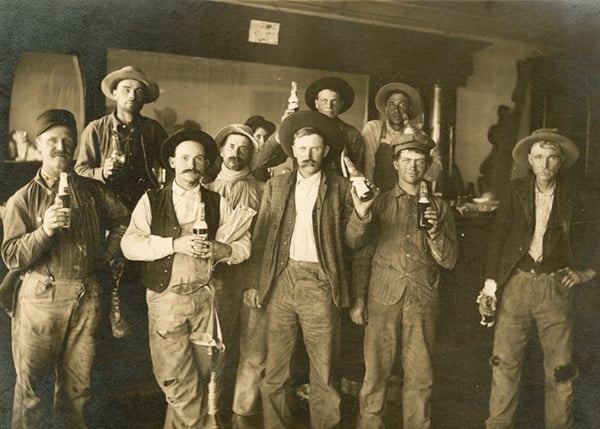
Saloon in Wheeler County, Nebraska, circa 1900. NSHS RG3542-7-5
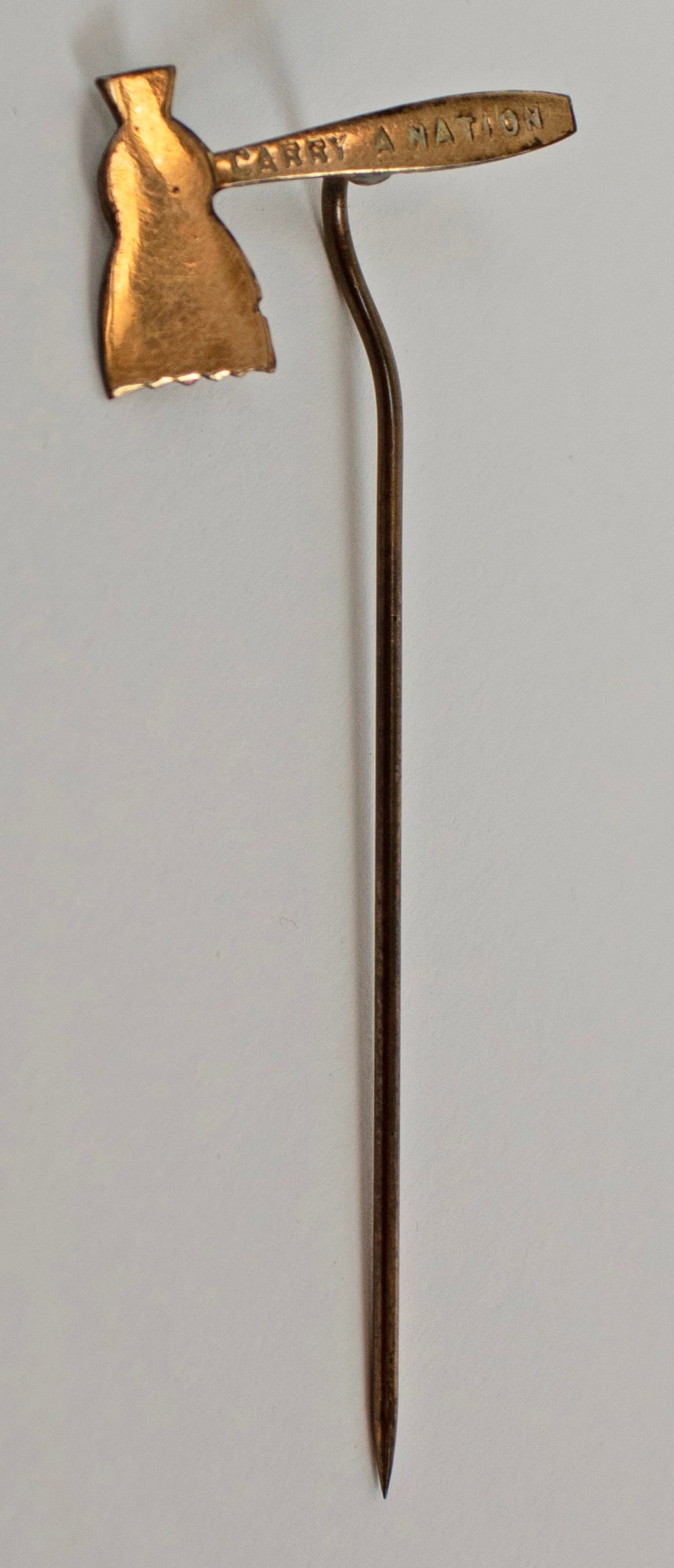
Stickpin engraved with the words, “Carry A. Nation Hatchet.” Nation, who in her later years began spelling her name this way, sold these for a dime as a fundraiser. She gave this one to a railroad station agent at a telegraph office in Exeter, Nebraska. NSHS 10376-1
A version of this article first appeared (without endnotes) in the January-February 2024 issue of NEBRASKAland magazine.
References:
[1] North Platte Semi-Weekly Tribune, March 14, 1902: 1;
[2] The Courier (Lincoln, NE), April 5, 1902: 9. See also “Carrie Nation Throws Ice,” Omaha Bee, March 18, 1902: 3.
[3] “Repulses Carrie Nation,” Omaha Bee, March 23, 1902: 4.
[4] “Carrie Nation and Omaha,” Omaha Bee, March 29, 1902: 5.
[5] Ibid.
[6] Carry A. Nation, The Use and Need of the Life of Carry A. Nation (1905), 119. (In her later years she often spelled her name this way.)
[7] “Horsewhips Mayor of City,” Omaha Bee, March 25, 1902: 1; “Carrie Nation and Omaha.”
[8] North Platte Semi-Weekly Tribune, April 1, 1902: 3; “Eddyville Women Smash,” Omaha Bee, April 3, 1902: 3.
[9] Seward Independent-Democrat, April 3, 1902. Quoted in “Carry Nation Tours Omaha,” NSHS Blog, https://history.nebraska.gov/publications_section/carry-nation-tours-omaha/
[10] Nebraska City Daily Tribune, April 5, 1902. Quoted in, “Nation, Carrie, in Nebraska City, 1902,” NSHS Blog, https://history.nebraska.gov/publications_section/nation-carry-in-nebraska-city-1902/
[11] Nation, Use and Need of the Life of Carry A. Nation, 148.
[12] Blue Valley Blade (Seward, NE), April 16, 1902. Quoted in, “Carry Nation Debated Woman Suffrage at Seward,” NSHS Blog, https://history.nebraska.gov/publications_section/carry-nation-debated-woman-suffrage-at-seward/