(Published April 2026)
Freemasons have long shared their values and traditions with new members through artwork, including visual aids known as master’s charts or Masonic “carpets.”
Three such lithographs, owned by King David Lodge #407 in Altoona, Iowa, came to the Gerald R. Ford Conservation Center recently for treatment. Engraved by the artist John Sherer in 1855 and 1856, the plates depict Masonic vignettes in architectural settings, surrounded by symbols including globes, gavels, and books.
Each lithograph was printed in black ink on heavyweight paper, installed in a handmade wooden frame, and backed with wooden slats.
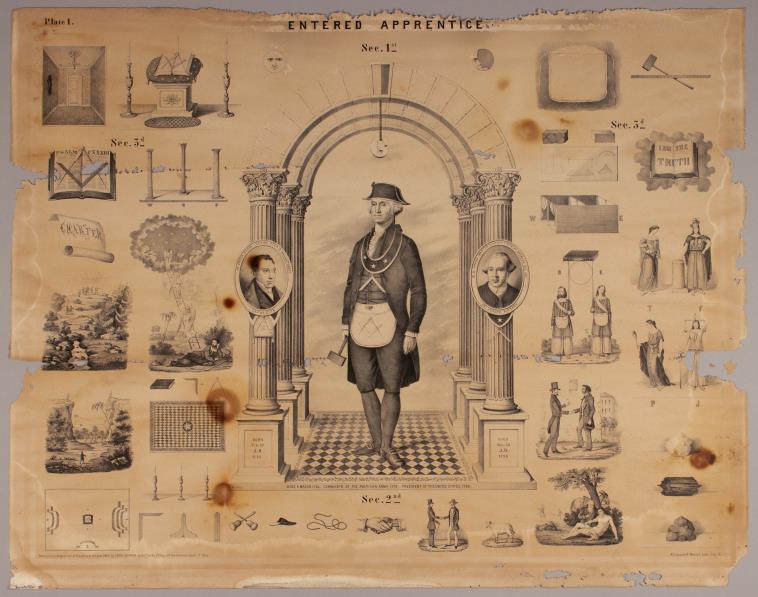
The “Entered Apprentice” print depicts George Washington standing under a colonnade and wearing a Masonic apron. Emblematic visuals like this one were common in Masonic lodges in the nineteenth century.
The prints arrived at the Paper Lab in poor condition, and the frame’s backing slats were among the culprits.
Insects had entered the frames through gaps in the slats and eaten away at the paper. Water had seeped in too, perhaps on multiple occasions. The result was significant damage in the form of holes, jagged losses, and large stains called tidelines.
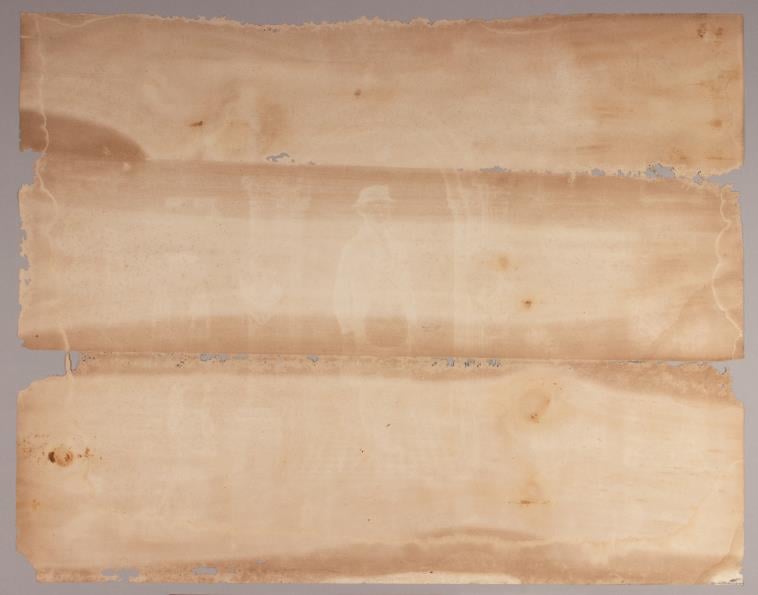
Insect damage is evident along the edges and in horizontal lines across the paper, as seen in these before-treatment images of the back of the print and the frame. The horizontal loss lines match up with gaps between the frame’s backing slats, indicating these were easy entry points for pests.
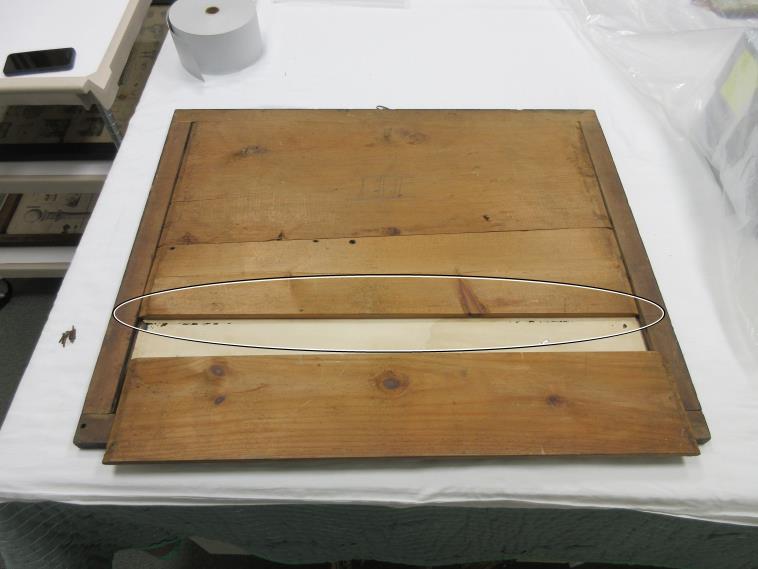
Direct and prolonged contact between the prints and the wooden slats had also caused acidic degradation that manifested as dark spots on the paper. These areas of discoloration matched the locations of knots in the wood.
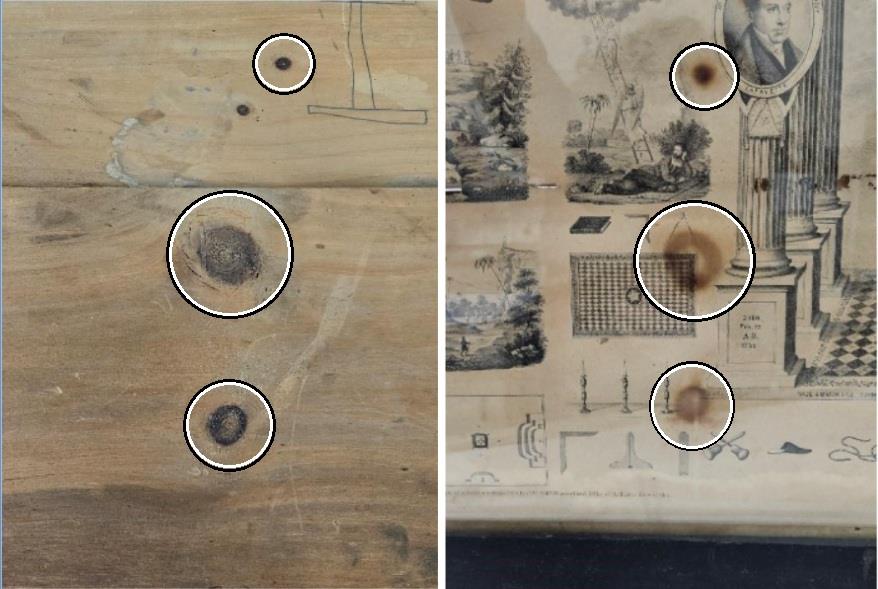
Knots in the frame’s wooden backing slats correspond to dark spots in the “Entered Apprentice” print, as seen in these before-treatment images. Water exposure may have contributed to the darkness of the spots.
Our priorities for treatment were to structurally stabilize the three prints and bring them closer to their original appearances. The first step: deep cleaning.
The surfaces of the prints were carefully vacuumed using a soft brush attachment and cleaned using sponges to remove loose dirt, debris, and insect casings.
The prints were also washed to help swell the paper fibers and allow them to release additional dirt that had permeated the paper over time. This process visibly lightened the prints and minimized the appearance of the tidelines and dark spots.
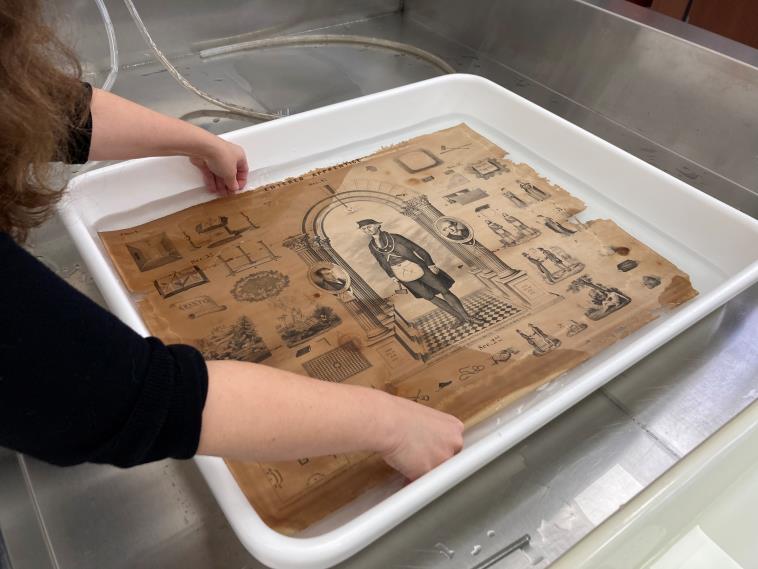
The prints were washed up to three times in pH-controlled water to improve the strength of the paper and its overall appearance. As seen in these during-treatment images, the prints released dirt and particulate matter, leaving the paper visibly lighter.
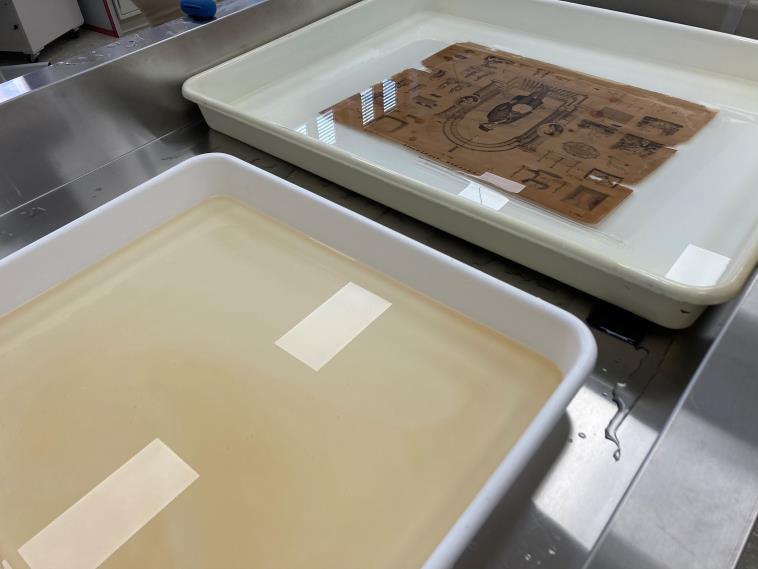
Next, the two most fragile prints were lined onto, or adhered to, medium-weight paper for additional overall support.
All three prints received paper fills to repair the areas where insects had eaten the original material.
We created the paper fills by laying clear film over the prints and tracing the edges of the losses. We used those traced shapes as templates to prepare new pieces of paper to match losses in the original.
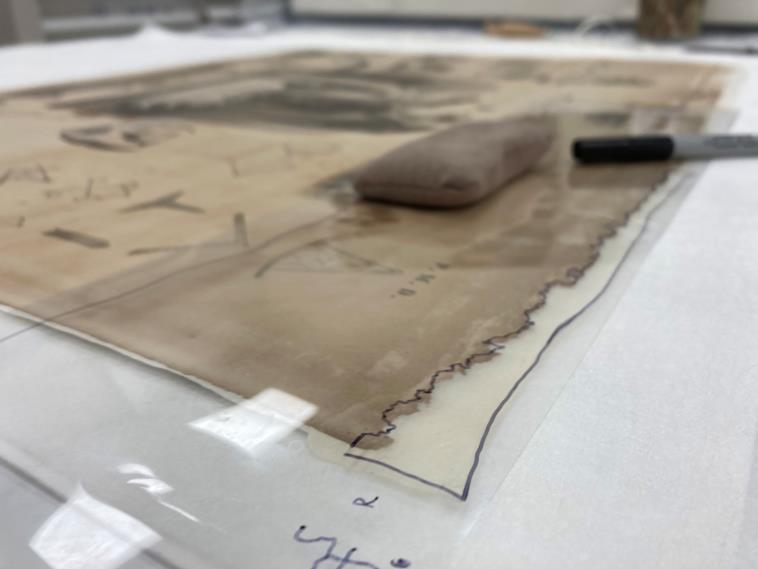
As seen in this during-treatment image, we mapped damaged areas by laying clear film over the prints and tracing the edges. The tracings were used as templates to help shape new pieces of paper to fill losses in the original.
The fills were attached using a reversible adhesive to protect the original paper, then toned using paints and pastels to help them blend into the original color as much as possible.
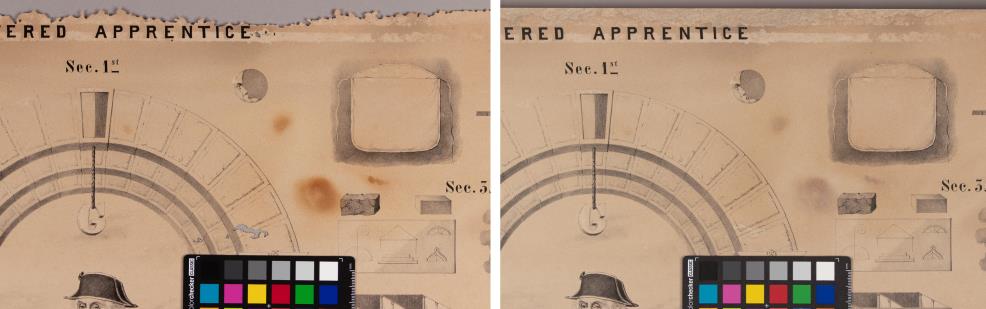
Paper fills applied along the top edge of the print helped to stabilize the insect damage, as seen in these before- and after-treatment images. Improvements to the dark spots are also visible, with washing and toning having minimized the discoloration.
Finally, the prints were reinstalled in the original frames without the original backing slats, which would have continued discoloring the paper and providing access points for insects and moisture.
The wooden slats were replaced with sheets of paper-based board that can serve as rigid barriers without introducing harmful materials.
With treatment complete, the clean, stable prints have been returned to their lodge in Iowa, preserved for future generations of Masons to study, appreciate, and carry forward their shared history.
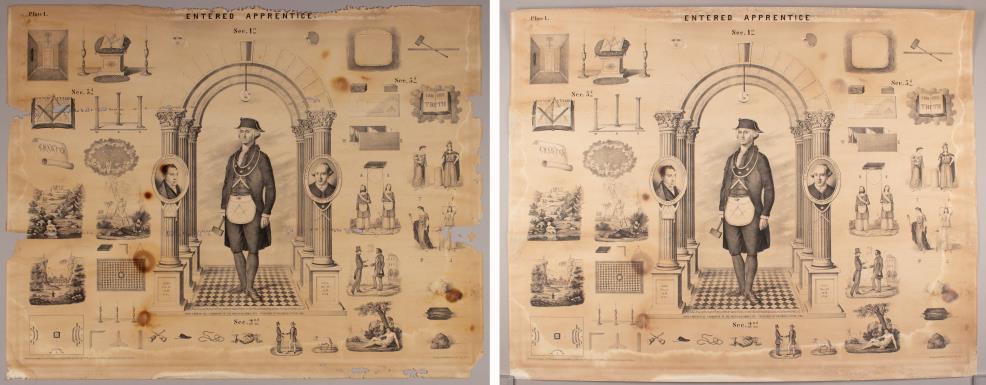
Before- and after-treatment images of the “Entered Apprentice” print.
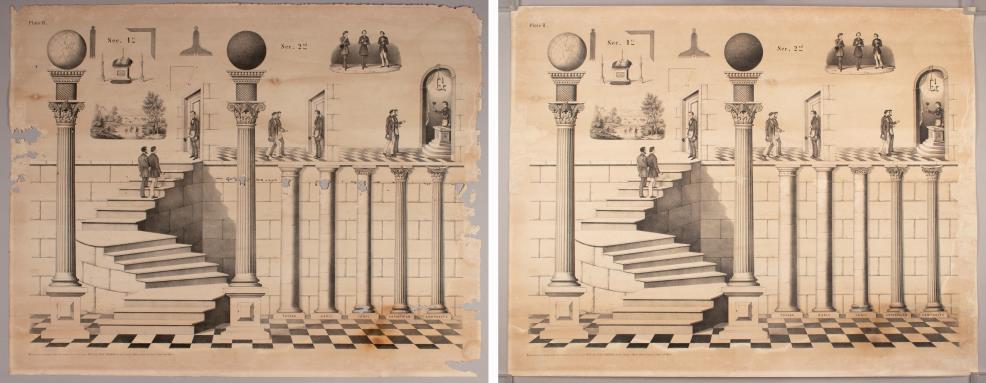
Before- and after-treatment images of the untitled second print.
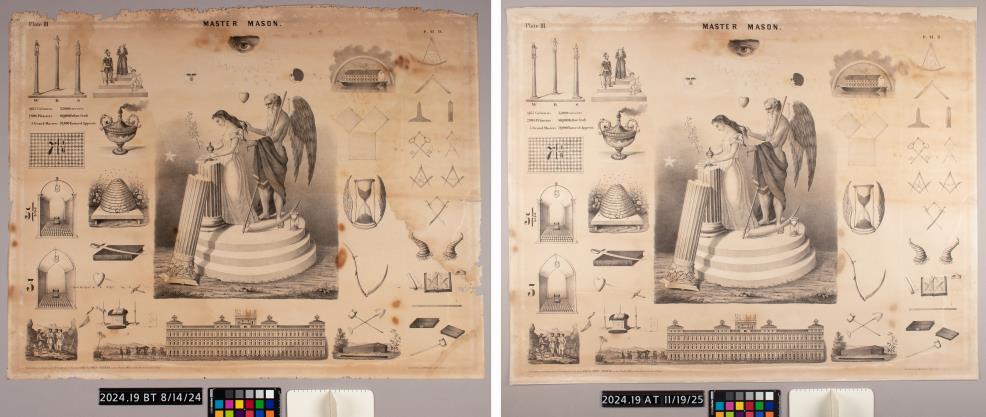
Before- and after-treatment images of the “Master Mason” print.