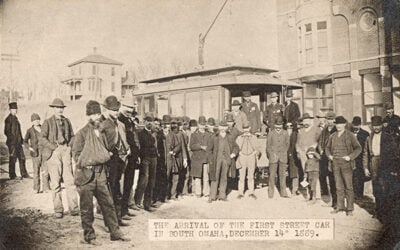
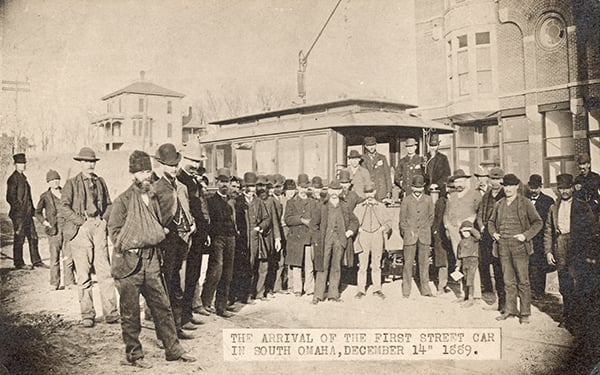
Photo: NSHS RG2341-0-420
By the 1890s South Omaha had a reputation as a rough, violent place. But Omaha World-Herald columnist Elia Peattie saw something else:
“South Omaha is indeed a rim around the stock yards. Every one in that town, with a very few exceptions, is dependent directly or indirectly upon the packing houses. It is a remarkably hard working town….
“There is an idea abroad that the men who work always among the cattle are very rough –even turbulent. Some folk have an idea that they spend most of their time when they are out of work hours fighting or drinking. The truth of the matter is that nine-tenths of the men in the packing houses at South Omaha are men with families, and that they go home to those families when they are through with work, and that, while they may not be distinguished for any superfluous graces, they are in reality very industrious and quiet-going fellows, who like to have their wives and children think well of them.
“There is a fight occasionally – it is little wonder with such muscles and such animalism as those men have. Some of them are like gladiators. They can handle the carcass of a steer much as a woman handles her baby. Such men fight for two reasons: first, because they are in places where there is a good deal of irritation, and because their resentment lies near the surface, and second, because they are conscious of their strength, and fight for amusement.
“As all their life is a mere outputting of strength, and as they earn their living by the mere exercise of muscular energy, it is not strange that their idea of amusement is an exhibition of strength. It would be surprising if they did not enjoy the prize fight above all other things. They understand it. It is in their line.”
—Elia Peattie, “Killing, Yet No Murder: A Day at the Stock Yards in South Omaha,” Omaha World-Herald, February 7, 1892. This excerpt is quoted from Susanne George Bloomfield (ed.), Impertinences: Selected Writings of Elia Peattie, a Journalist of the Gilded Age (University of Nebraska Press, 2005)
An earlier version of this article appeared in the Fall 2024 issue of Nebraska History.