Thomas Berger Johnson was born in Omaha in 1890 to Swedish immigrant parents. Johnson’s introduction to art came early; his father, Hjalmar, was an artist and craftsman who encouraged his son’s talent. However, Hjalmar Johnson died when Thomas was just ten years old, and his mother, Christina, was forced to split the family up. Thomas was sent to live on his uncle’s farm near Harvard, Nebraska until he turned sixteen.
For the next several years, his focus seems to have been on supporting his widowed mother and three younger siblings. One of his early jobs was in a blacksmith shop in Valley, Nebraska, which may have spurred his later interest in working with metals as an artistic medium. His passion for art remained with him throughout these years, and at the age of 31, he enrolled at Bethany College in Kansas to study painting, drawing, and art history. From there, we went on to the Broadmoor Academy of Art in Colorado Springs and the Minneapolis School of Art.
Upon finishing his formal training, Johnson continued to explore different materials and skills. A course in welding led him to an almost 30-year career as a designer and fabricator for the Tractor Testing Laboratory at the University of Nebraska-Lincoln’s Department of Agricultural Engineering. His artistic production continued during his working years – in addition to drawings, paintings, and printmaking, he forged and welded ornamental metalwork, including vases, lamps, and weather vanes.
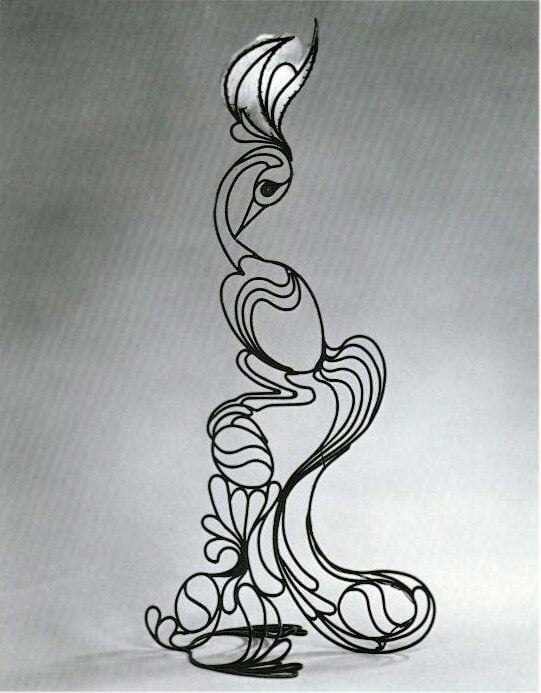
Floor lamp, titled Phoenix, iron, c. 1935.
His work was often inspired by the scenery and people around him. Many of his paintings depict rural landscapes or scenes from Lincoln in the period around the 1940s to 1950s. In the 1940s, while Thomas and his wife, Fay, were living in Lincoln, he completed a series of drawings paired with original poems that explored African American spirituality and racial themes. At the end of his life, he completed another series of drawings and reflections on Native American spirituality.
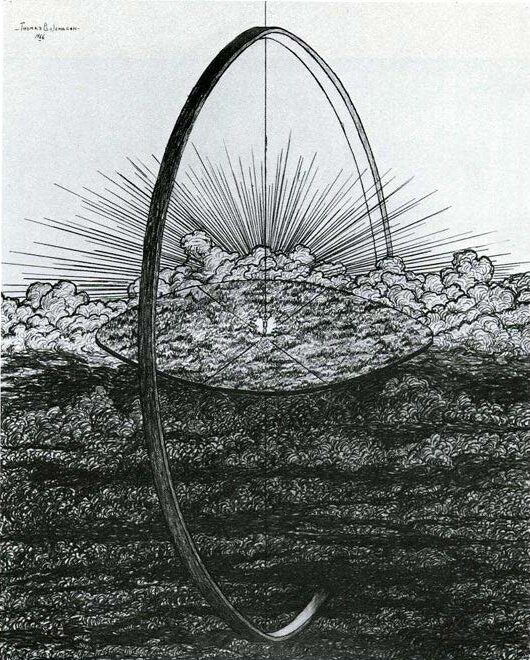
Center of the Universe, pencil, 1966.
The point at which any man stands “is the center of the
Universe…a huge gyroscope.” He stands at the center of a
Terrestrial (horizontal) rotating wheel and a celestial (vertical)
Rotating wheel. Let a man move where he will… “beneath [his]
Feet is the center of the universe.”
Johnson retired from the university in 1956, and then he and his wife moved to Seward, Nebraska. There, he continued to produce art inspired by his surroundings.
The Nebraska State Historical Society (NSHS) holds a large portion of his artistic productions, including sketches, block prints, and paintings. These were donated by Johnson’s wife after his death and have been displayed in the Nebraska History Museum in Lincoln, as well as in Seward. Both towns were the setting of several of his works.

Antelope Creek Bridge (or Blue Rhapsody) (Lincoln), oil, 1949. Johnson constructed frames for many of his paintings.

Noon Chores (rural Seward), oil, 1951.
Two of the paintings in the NSHS collection recently came to the Gerald Ford Conservation Center for treatment. The heavy impasto technique that is a hallmark of Johnson’s painting style necessitates certain maintenance over time. The brushstrokes are so heavily textured that they collect dirt and grime quickly.
One painting, called “Portrait of the Johnsons” had sustained a small tear and needed stabilization. This was done by attaching a lining to the back of the canvas using a reversible adhesive. This standard procedure was complicated in this instance by the overall thickness of the paint layer and its heavy texture. Typically, rollers are used to press down on the canvas as it is being lined in order to push out air pockets and ensure that the canvases bond together well. This rolling technique was not possible, so extra care had to be taken to ensure that the new lining was well adhered.
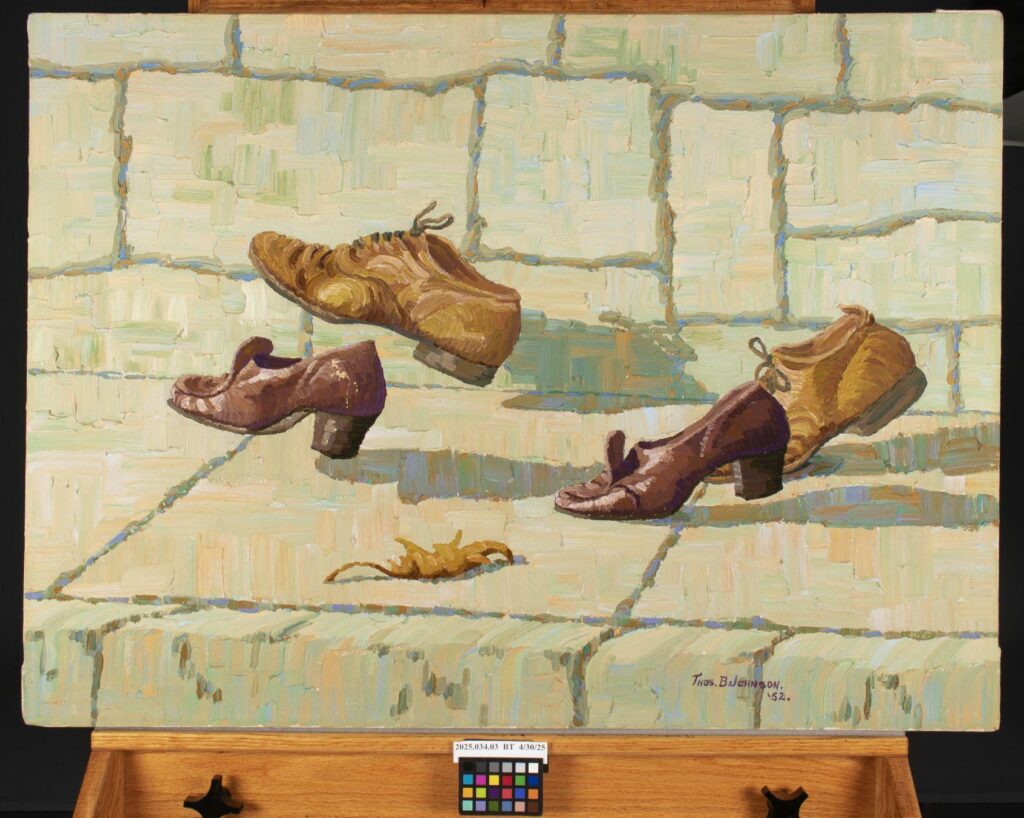
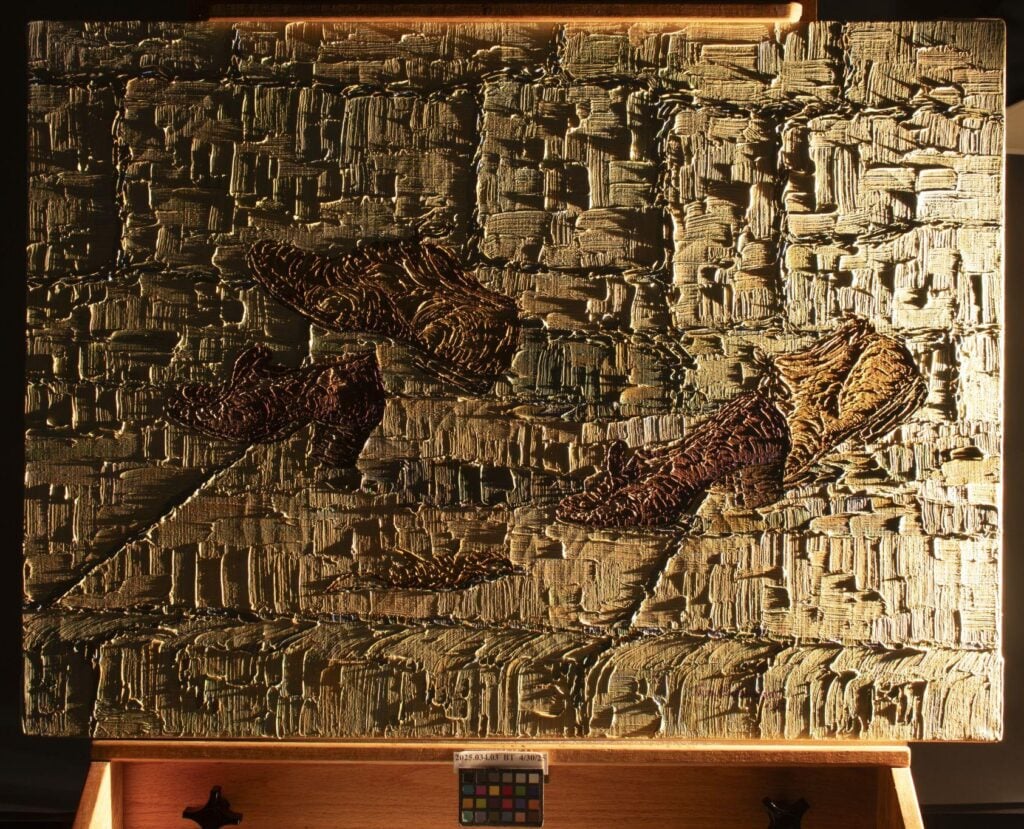
Under normal light conditions, it is difficult to make out the extent of the textured impasto, so raking light is used to easily see the artist’s thick application of paint.

In this detailed image, the damage on the heel of the woman’s shoe is visible. There is a tear in the canvas, and some paint has been lost from the surrounding area.
The images above illustrate another hallmark of Johnson’s work. He often applied two or more different colors to his brush at a time, creating a striated effect throughout his brushstrokes and adding dimension and movement to his compositions.
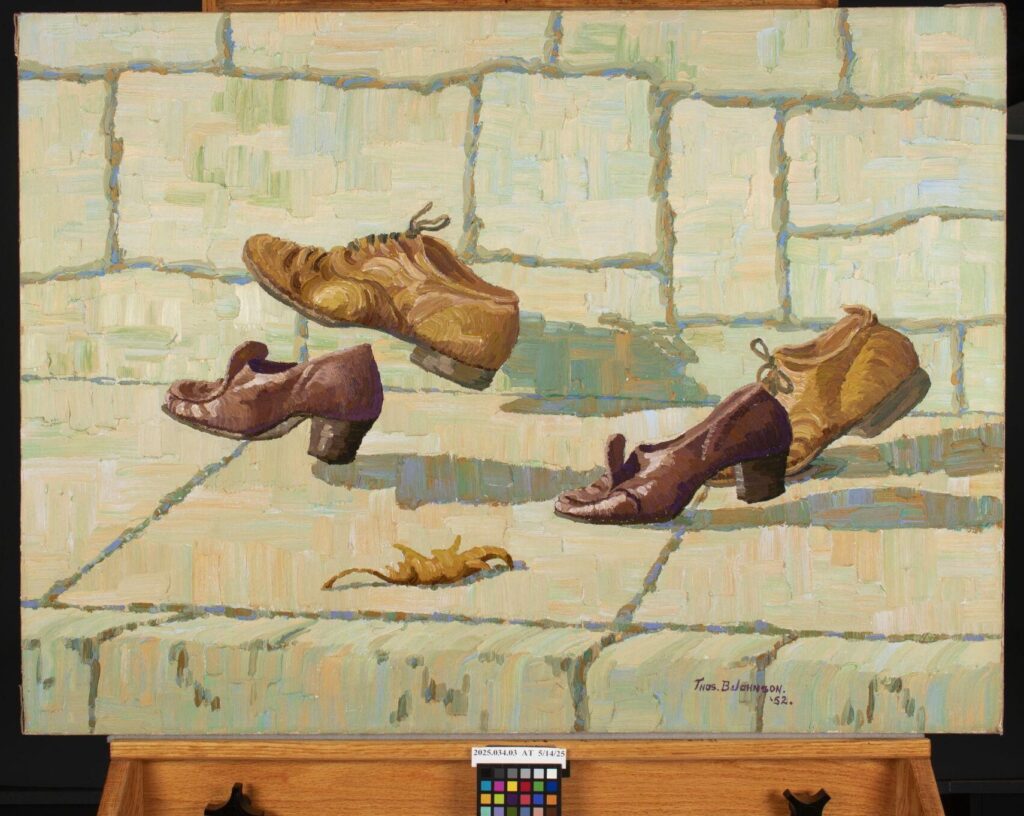
In the after-treatment image above, the surface grime has been removed and the tear has been repaired.
Now that they have been cleaned and stabilized, these two Johnson paintings will return to the NSHS headquarters in Lincoln.