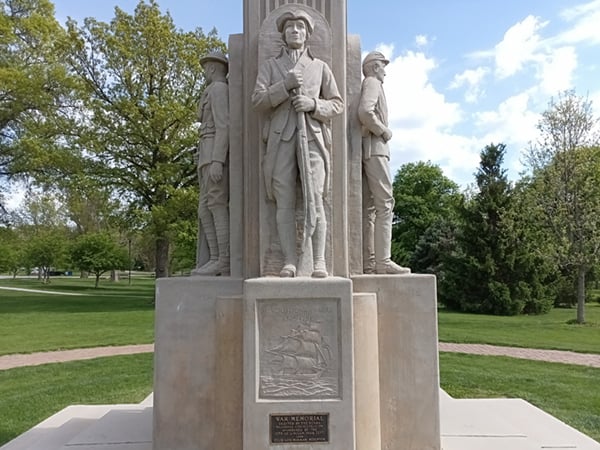
Though its subject matter was traditional, Antelope Park’s 1936 war memorial was unusual for its materials and methods. Instead of carved stone, sculptor Ellis Burman used molded concrete—a choice newfangled enough to merit press coverage.
The monument was also very much of its time in its use of Depression-era “New Deal” funds. It was built by workers from the Works Progress Administration, a federal agency that sponsored public works projects to provide jobs for unemployed workers.
Thirty-two feet tall, the monument features seven-foot-tall figures representing soldiers of the American Revolution, the Civil War, Spanish-American War, and “the World War.” In 1942 the Lincoln State Journal noted that Mr. Burman and the parks department “probably had no thought that it would be so quickly outmoded. No niche has been provided for a warrior of the present conflict.”
This is what generations of Americans expected when they thought of commemorating their nation’s history and anniversaries. For the 1976 Bicentennial, however, Nebraska took a very modern approach to commemorative public art – more about that in an upcoming post.
—David L. Bristow, Editor. Posted 2/18/2026
Sources:
“Cement is Used for War Memorial” Nebraska Beacon (Lincoln), Nov. 19, 1936: 2.
Quotation is from “Seeing Lincoln” Evening State Journal, Oct. 16, 1942: 8.