
The United States has one Constitution, of course, but archives across the nation hold many state constitutions and local charters past and present—plus a countless array of governing documents of voluntary organizations. The Nebraska State Historical Society has digitized dozens of Nebraska examples from its collections.[1]
Perhaps your idea of pleasurable reading does not include the Constitution of the History and Art Club of Albion, Nebraska, or that of the Buffalo County Agricultural Society, or the Johnson County Woman Suffrage Society, or the Dakota Congregational Women of Santee.
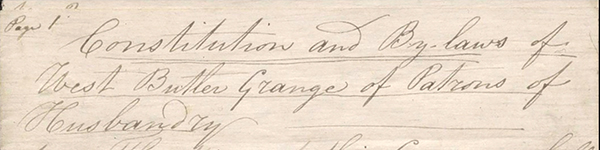
Detail from the Constitution and By-Laws of the West Butler Grange #476, Columbus, Nebraska. RG4344.AM
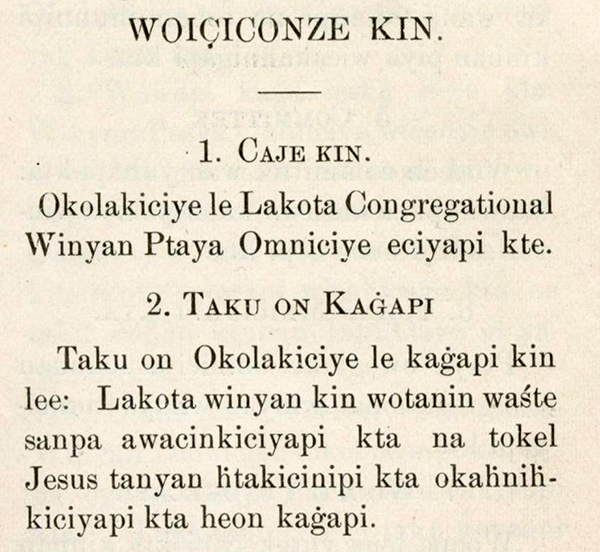
Detail from the Constitution and By-Laws of the Conference of Dakota Congregational Women, 1897. Facing pages show the same content in English. NSHS RG2497.AM
But together these and other documents tell a story of American democracy and our “nation of joiners.”
Touring the United States in 1831-32, the young French nobleman Alexis de Tocqueville noted an unusual habit among Americans:
“In no country in the world has the principle of association been more successfully used, or applied to a greater multitude of objects, than in America,” Tocqueville writes in Democracy in America. In Europe, people waited for the central authorities to deal with problems, but in America:
“If a stoppage occurs in a thoroughfare, and the circulation of vehicles is hindered, the neighbors immediately form themselves into a deliberative body; and this extemporaneous assembly gives rise to an executive power, which remedies the inconvenience before anybody has thought of recurring to a pre-existing authority superior to that of the persons immediately concerned.”[2]
In 1944, historian Arthur M. Schlesinger Sr. wrote a much-quoted essay, “Biography of a Nation of Joiners.” He says that during colonial America’s first century, cooperative undertakings were limited to religious activities, but that a broader volunteerism emerged by the mid-1700s. Benjamin Franklin is the classic example of a founder and joiner of groups dedicated to community improvement.
Facing increased British imperial control in the 1760s and 1770s, Americans responded by forming local protest groups and interprovincial alliances. Thus, by halting steps, “the colonial era saw the emergence of what was to become a dominant American trait,” Schlesinger argues.[3] People discovered, as Unitarian minister William Ellery Channing wrote in 1829, that they “can do jointly what they cannot do singly.” By Channing’s day, a growing profusion of voluntary associations formed what Channing called “a sort of irregular government created within our constitutional government.”[4]
Overland trail historian Merrill Mattes says that before heading west, emigrants first established traveling companies. “As with any good American organization,” he writes in The Great Platte River Road, “there was usually a document of some kind, which might be called a constitution, code, resolution, or bylaws.”[5]
And this is where we see the influence not only of the US Constitution, but also of the state constitutions that were debated and refined starting in 1776. Despite their differences, the constitutions in the NSHS collections are united by common threads.
The constitutions vary greatly in length and detail. Founded in the 1880s, the Johnson County Woman Suffrage Society adopted a three-page, handwritten constitution. But in 1945, an African American spinoff of the Elks Club—the Grand and Subordinate Temples of the Daughters of Improved, Benevolent, Protective Order of Elks of the World—issued their constitution as a 64-page booklet that covers organizational matters such as financial accountability in great detail. The document also addresses members’ rights, requiring that the “freedom of speech of members of the Order shall not be denied or abridged… to the end that no woman’s creed shall be a bar to her membership in this Order.”[6]
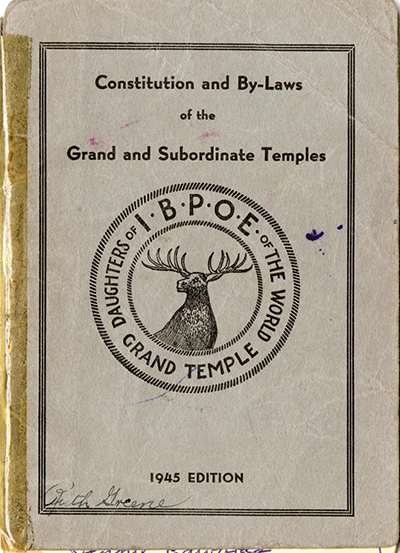
Cover of the Constitution and By-Laws of the Grand and Subordinate Temples, a 64-page booklet. RG5349.AM
Other constitutions have features specific to the group. Published by the Santee Normal School Press in 1897, the constitution of the Dakota Congregational Women is printed both in Dakota and English. The Johnson County Woman Suffrage Association required that its president be a woman, while membership in the North Star Relief Society (a Lincoln-based lodge and mutual-aid society) was restricted to those of Scandinavian descent.[7] Members of the West Butler Grange #476 of Columbus, Nebraska, could be expelled for cruelty to animals, and “Chewers of tobacco are requested not to spit on the floor; it makes the room so disgusting and filthy.”[8]
The constitutions share several important structural elements. They define their membership and usually also state the organization’s purpose in a preamble. Each constitution specifies the duties and terms of officers and sets rules for elections. Almost all the constitutions also establish an amendment process.
These features are so ordinary that we might take them for granted, but they are profound. They are rooted in the assumption that—from the federal government to the History and Art Club of Albion, Nebraska—people have the right and responsibility to choose their leaders and to set limits on their power. Each constitution is obviously structured in the hope of preventing any one person from gaining too much control. Or, to put it in terms that were new and radical in the eighteenth century, each provides “checks and balances” and “separation of powers.”
Writing during World War II, Schlesinger observed that group behavior is not always benevolent. He lamented “the extent to which men do things as members of an organization that they would be ashamed or afraid to do as individuals.”[9] Even so, it does not take much imagination to see these old documents and the local groups that wrote them as so many community gardens of constitutional democracy.
—David L. Bristow, Editor
(Posted 3/18/26; adapted from the forthcoming Summer 2026 issue of Nebraska History magazine.)
Notes
[1] Search for “constitution” or for specific document titles at nebraska.access.preservica.com.
[2] Alexis de Tocqueville, Democracy in America, Part 1 (1835), Chapter XII: “Political Associations in the United States.”
[3] Arthur M. Schlesinger, “Biography of a Nation of Joiners,” The American Historical Review, Vol. L, No. 1 (Oct. 1944): 5.
[4] Quoted from William E. Channing, “Remarks on Associations,” in Schlesinger, “Biography of a Nation of Joiners,” 21.
[5] Merrill Mattes, The Great Platte River Road (Lincoln: Nebraska State Historical Society, 1969), 34.
[6] Constitution and By-Laws of the Johnson County Woman Suffrage Society (Nebraska), Erasmus Michael Correll Collection, RG4430.AM, NSHS; Constitution and By-Laws of the Grand and Subordinate Temples, 1945, Ruth (Talbert) Greene Folley Collection RG5349.AM, NSHS.
[7] Congregational Winyan Ptaya Omniciye, Woiciconze Qa Woope, (Constitution and By-Laws of the Conference of Dakota Congregational Women, 1897), Santee Normal Training School (Santee, NE) Collection, RG2497.AM, NSHS; North Star Relief Society Constitution and By-laws, North Star Relief Society Collection, RG5387.AM, NSHS.
[8] Constitution and By-Laws of the West Butler Grange #476; Columbus, Nebraska, Undated, Nebraska State Grange Collection, RG4344.AM, NSHS.
[9] Schlesinger, 23.