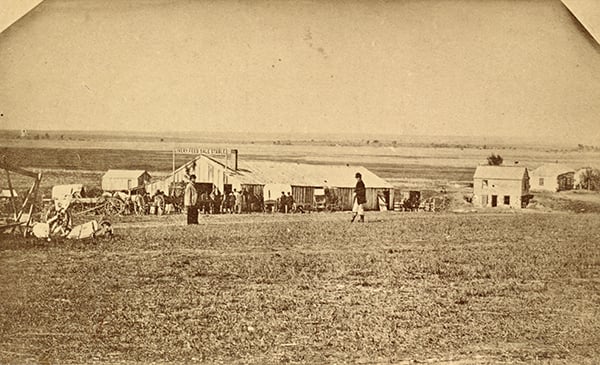
Southwest corner of Ninth and O streets, Lincoln, 1868. NSHS RG2158-PH10-55
By David L. Bristow
Nebraskans knew that Lincoln would be the new state capital before they knew where Lincoln would be.
Omaha had been the territorial capital since 1855. It had maintained its status through shady parliamentary maneuvers, bribery, and at times even by physical intimidation. By 1867 most Nebraskans wanted to start fresh someplace else.
The Platte River was Nebraska’s big dividing line. The unbridged river was tricky to cross, and most Nebraskans lived south of it. They wanted the capital on their side of the river.
The legislature debated a bill to move the capital to a to-be-determined location within a four-county area: Seward, Lancaster, or the southern half of Butler or Saunders counties.
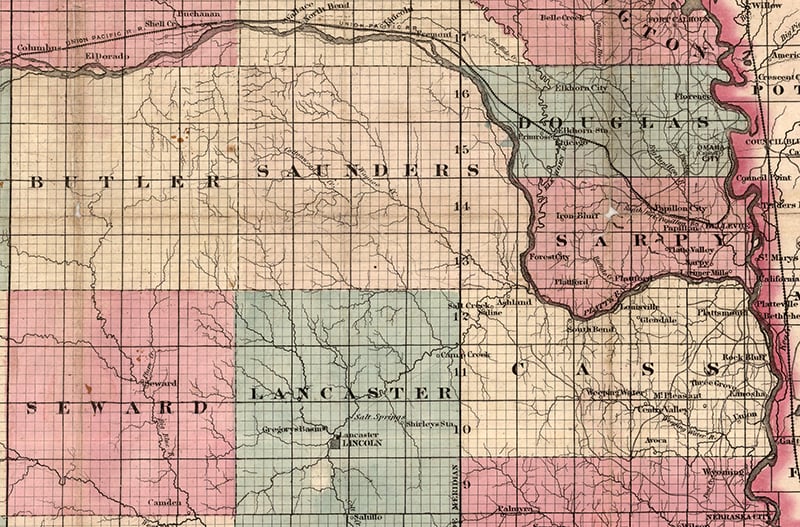
Detail of Colton’s New Sectional Map of the State of Nebraska, 1868, showing “Omaha City” and the four-county area (Seward, Lancaster, and southern Butler and Saunders) in which the capital city was to be located. NSHS M782 1868 C72 C2
Omaha did not have the votes to stop the bill. The best they could do was to attach some poison-pill amendments in the hope of siphoning off votes. One amendment required that the capital city would also get the state university, agricultural college, prison, and insane asylum. Omahans hoped this would discourage towns not in the running for the capital to vote against the bill.
Another amendment required the capital city to be named “Lincoln” in honor of the late president—an idea sure to be unpopular in the heavily Democratic South Platte region.
But the bill passed anyway. That summer, a three-man commission toured the four-county region in search of Lincoln. They selected Lancaster, population 30. The village was far from any railroad or navigable river. Omaha, meanwhile, had a major river for steamboats, a soon-to-be-complete transcontinental railroad, and was on its way to 16,000 residents by 1870.
The commissioners reasoned that Lancaster was centrally located in relation to the state’s main cities at the time: Omaha, Fremont, Columbus, Plattsmouth, Nebraska City, and Pawnee City. They also thought—mistakenly, it turned out—that Lancaster’s salt deposits would prove commercially valuable.
Omahans were furious. “Nobody will ever go to Lincoln who does not go to the legislature, the lunatic asylum, the penitentiary, or some of the state institutions,” said one Omaha paper. Lincoln is “destined for ultimate oblivion,” said another.
Feelings in Omaha ran so high that the state auditor conspired to have two wagonloads of furniture and books removed secretly in the middle of the night. The wagons were well out of town before daylight.
Thus, Lincoln got its name at least partly out of spite and got the original contents of the capitol through a clandestine operation that looked like a nighttime burglary.
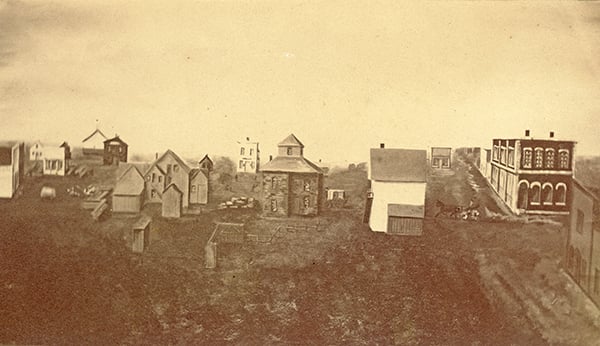
Market Square, Lincoln. Photo of an 1868 painting. NSHS RG2158-PH0-217
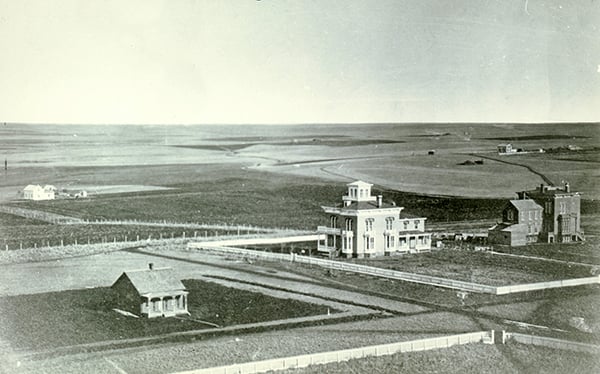
The new capital struggled at first. The selection commissioners built fine houses to demonstrate their confidence in the new “city.” One of these, the Thomas P. Kennard House (shown in 1872, left center), still stands as the Nebraska Statehood Memorial. RG2158.PH0-000011-a
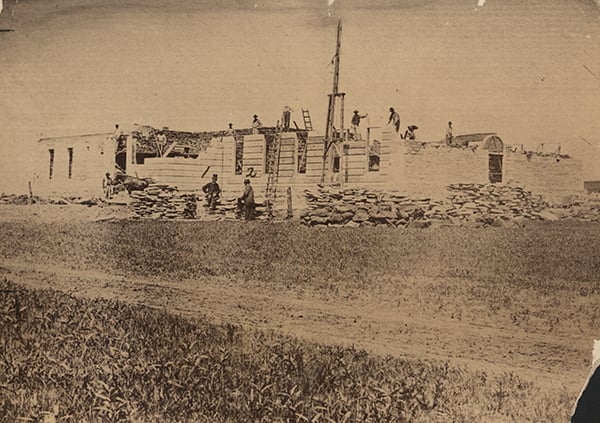
The new state capitol, shown here under construction in 1868, was a rush job to ensure that the legislature had a place to meet. Replaced in 1879-88, it stood on the site of the present capitol. NSHS RG1234-PH4-4

Lincoln had grown considerably by 1872. This view to the northwest from the tower of the state capitol shows the lone building of the new University of Nebraska. RG2158-PH0-23
This article was first published in the October 2025 issue of NEBRASKAland magazine.
Sources:
- Naugle, Montag, and Olson, History of Nebraska, Fourth Edition (Lincoln: University of Nebraska Press, 2014), 122-127.
- “Capital Removal,” Nebraska State Historical Society, https://history.nebraska.gov/publications_section/capital-removal/