By David L. Bristow
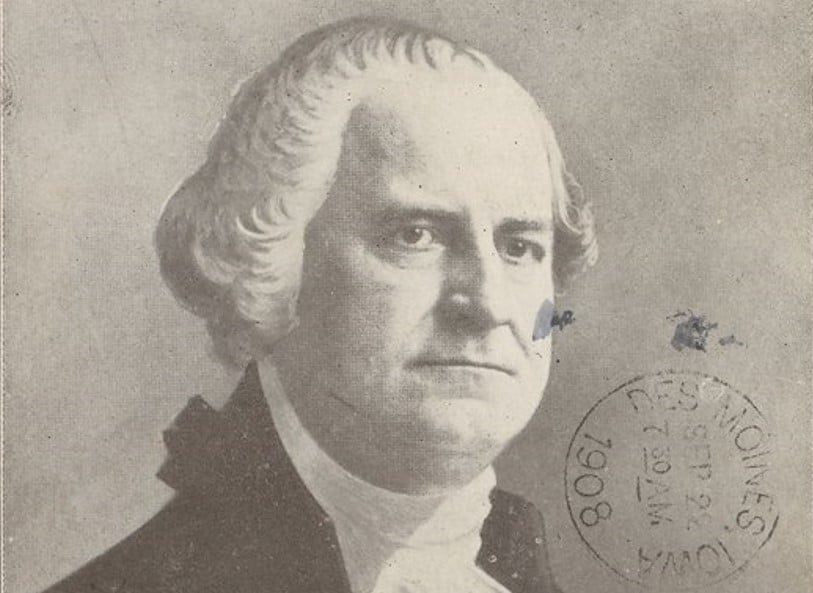
Countless politicians have tried to claim a piece of George Washington’s legacy. This detail from a campaign postcard is a silly composite, but it makes a serious point.
By the summer of 1908, William Jennings Bryan of Lincoln, Nebraska was for the third time the Democratic Party’s nominee for president. During his first campaign in 1896, the 36-year-old was portrayed by his enemies as dangerously radical.
But like many American reformers, Bryan framed his platform not so much as something new, but as a return to the Founders’ principles. While, for example, criticizing U.S. monetary policy in his famous “Cross of Gold” speech, Bryan said, “I stand with Jefferson” and cited the third president’s principles. The Bryan campaign’s later use of Washington’s image made a similar point using the techniques of the emerging advertising and public relations industry.
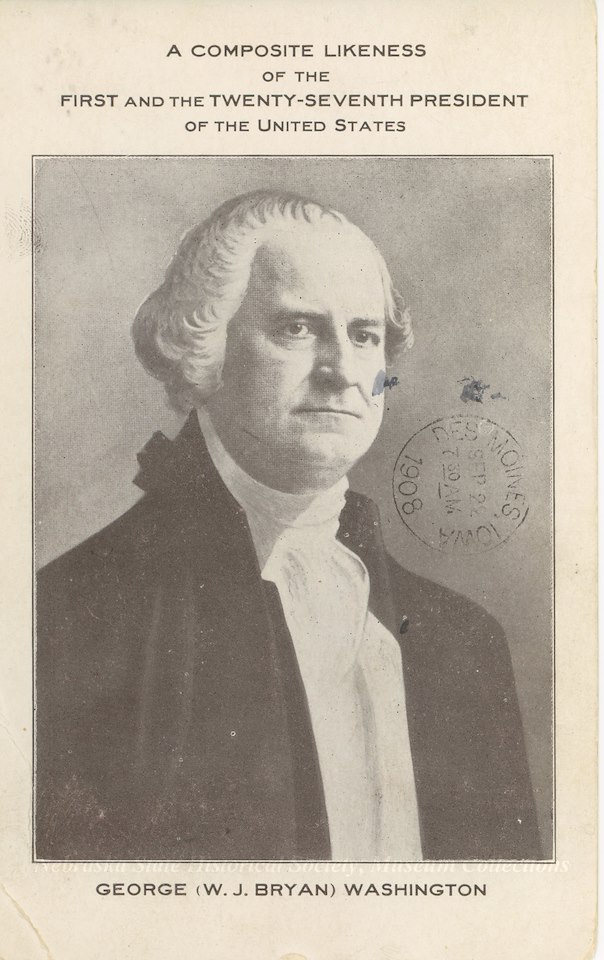
This postcard was mailed September 21, 1908. A handwritten message on the back “welcomes” the new George Washington. NSHS 7956-6053
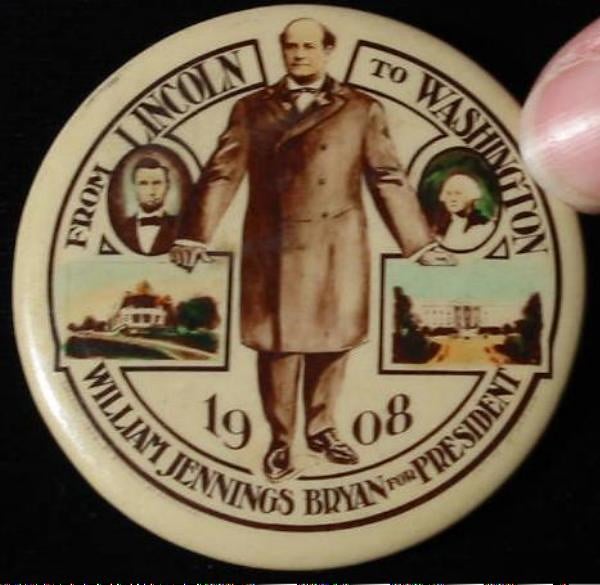
Button from the 1908 campaign. NSHS 10506-90
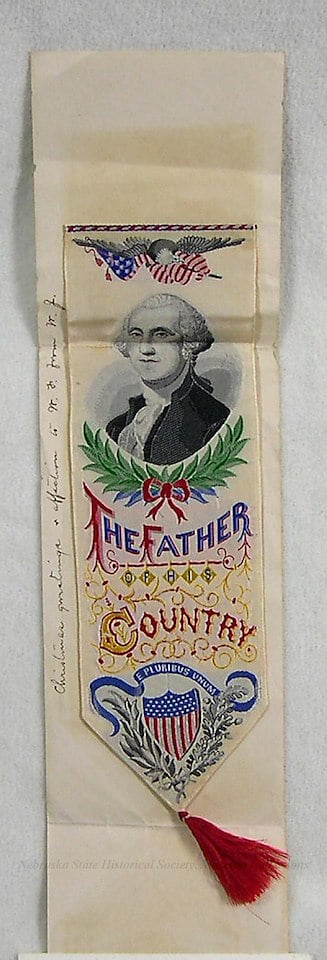
“The father of his country; E Pluribus Unum.” This ribbon was among materials belonging to Bryan’s campaign manager. NSHS 11082-49
But invoking the Founders could cut both ways. Bryan’s adversaries cited Washington, the Declaration of Independence, and even a re-animated Benjamin Franklin against him.
Washington did not campaign
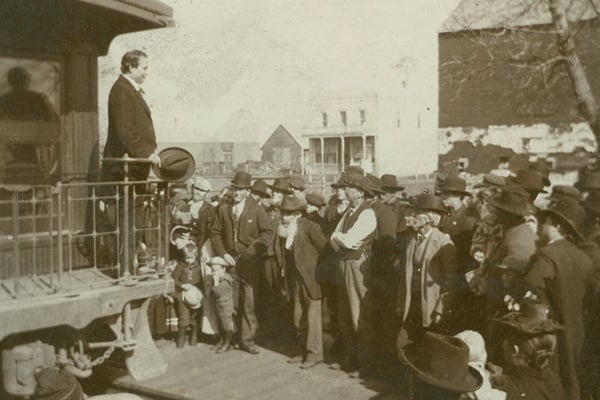
Bryan speaking at a whistlestop during the 1896 campaign. NSHS RG3198-34-3
In 1896 William Jennings Bryan broke precedent by actively campaigning for the presidency on a multi-city whistle-stop train tour. Until this time, it was considered undignified for presidential candidates to campaign openly. George Washington had set the precedent for not campaigning. The idea was that only a man who did not actively seek power could be trusted with the presidency.
This was a huge issue when the Constitution was being debated in 1787-89. The early United States had no head of state because the people feared that a chief executive would tend to acquire king-like powers. The Constitution was ratified with the tacit understanding that the first president to be elected would be Washington—who as a victorious general had resigned his commission rather than seek political power.
During the 1896 campaign, Bryan’s Republican opponent made a point of honoring Washington’s example by staying home. William McKinley gave speeches in front of his home in Ohio. Granted, bleachers were set up and McKinley ended up speaking to about 700,000 people during the campaign. Nevertheless, he created the appearance of letting the people come to him.
Benjamin Franklin would have hated “Free Silver”
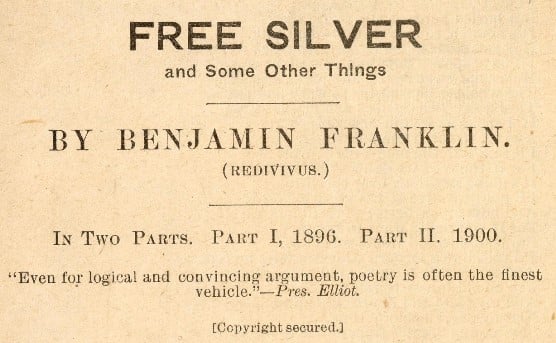
Bryan supported the unlimited coinage of silver (“free silver”) to create inflation and thus reduce the indebtedness of farmers, who could then repay loans in depreciated dollars. This pamphlet takes the form of a poem, in which Benjamin Franklin comes back to life and is asked about the free silver question. Franklin—the Founder most revered for his financial prudence—denounces it as dishonest not to honor a debt and says the plan would dishonor the country.
Anti-imperialism misuses the Declaration
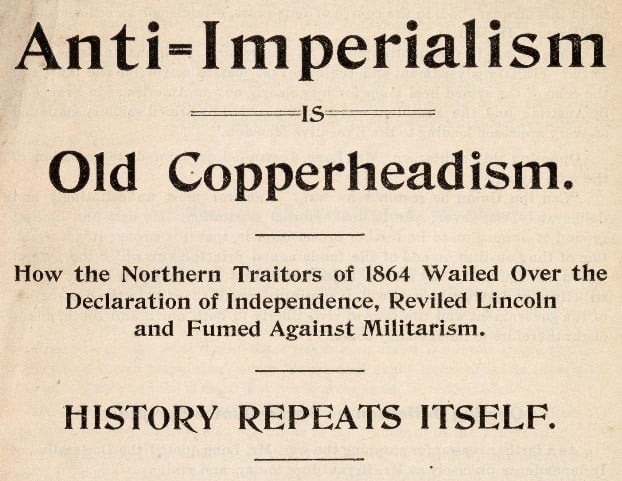
The 1900 presidential campaign was partly a referendum on American imperialism. During the Spanish-American War of 1898, the U.S. seized Puerto Rico, Guam, and the Philippines, and established a “protectorate” over Cuba. This pamphlet takes issue with of Bryan’s anti-imperialist speeches.
In his speech, Bryan criticized American imperialism as being contrary to the statement in the Declaration of Independence that “governments derive their just powers from the consent of the governed.”
The pamphlet’s author accuses Bryan of misinterpreting the Declaration. “Interpreting this as if it requires in all cases… an absolute rule by majority… Mr. Bryan necessarily contemplates a partial paralysis of the Constitution and the courts.”
Rather than explain why the principle of self-government should not apply to people of the former Spanish possessions, the pamphlet’s author uses an extended analogy—comparing Bryan’s arguments to those of northern “Copperheads” (Confederate sympathizers) during the Civil War. The idea is that just as Copperheads misused American ideals to condemn Lincoln’s “militarism” in defense of the Union, so Bryan was misusing the Declaration against McKinley’s defense of American national interests. One heading accuses Bryan of “Quoting Jefferson as Satan Quotes Scripture.”
These few examples from Bryan’s career illustrate a larger point about American politics: that much of it is an extended argument about what the American Revolution means and how its ideals apply to the circumstances of later generations.
(Posted 10/1/2025)