September is upon us again, and for the Nebraska community of archeologists, that means we’re back to the best month of the year—Nebraska Archeology Month! It should come as no surprise that the team at the Nebraska State Archeology Office (SAO) has continued to be extremely busy working on archeological projects all over the state. In fact, since September 2025, SAO staff have reviewed or completed fieldwork for projects in 70 of Nebraska’s 93 counties! To highlight the impressive work of the SAO staff, as well as the numerous other archeologists working across Nebraska, we welcome you to celebrate with us all month long through social media content and programs at the Nebraska History Museum, including virtual field trips, a Lunchbox Lecture, Scout Merit Badge workshop, and Homeschool Day. We kicked off the festivities the morning of September 1 with the signing of a proclamation by Governor Jim Pillen declaring September as Nebraska Archeology Month.
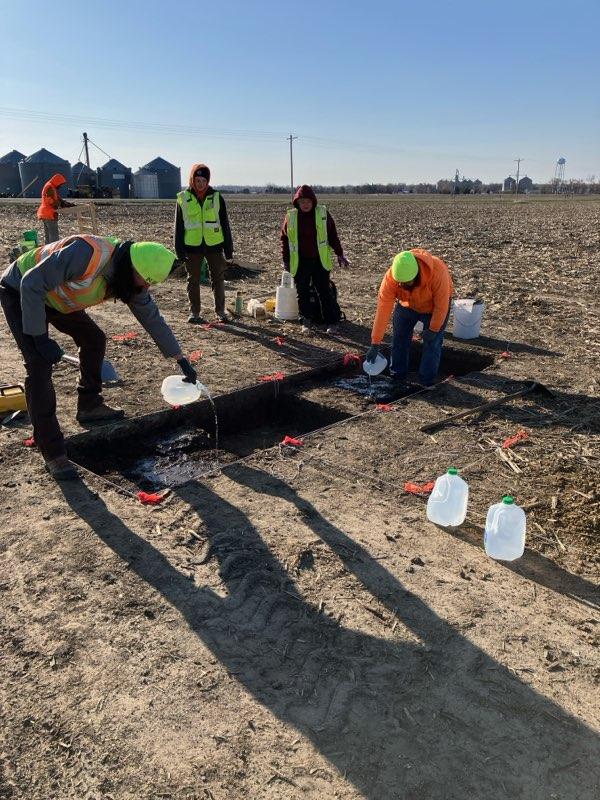
SAO archeologists dumping water into excavation units at the Sharp Homestead to soften the dirt.
Since last year, staff at the SAO have worked on some interesting projects in all corners of the state. Most significantly, the team spent much of the winter and spring completing lab analysis and an associated report to complete the Sharp Homestead project we shared about last year. The final report was submitted to the Nebraska Department of Transportation (NDOT) in July. Back in May, Archeological Technician MaK Coufal and I visited land owned by the Nebraska State Historical Society catty-corner to the Neligh Mills buildings in Antelope County. The purpose of this survey was to establish an updated site condition assessment, as the entire property is listed in the National Register of Historic Places and had not been thoroughly reviewed for over 15 years. Several earthen dike structures and a concrete dam that were used in the late 1800s and early 1900s to facilitate mill activities are present—though not easily accessible—and our survey was successful in relocating the features.
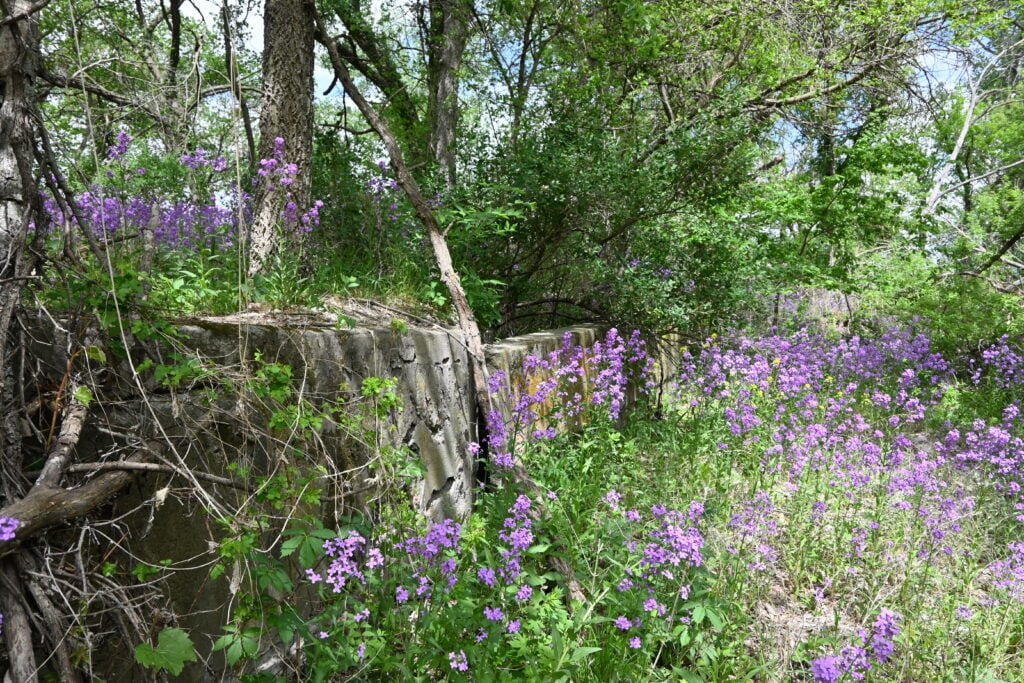
Overview of concrete dam structure at NSHS’s Neligh property.
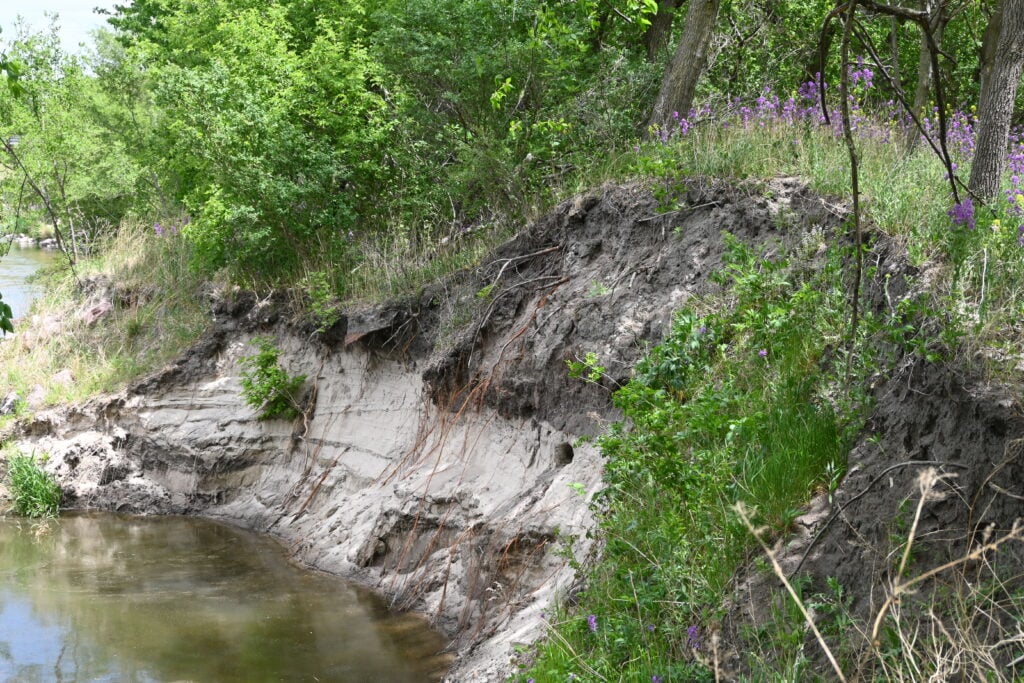
Remnant of earthen dike structure at NSHS’s Neligh property. The dark upper soil is fill used to construct the dike on top of the sandy subsoil.
Finally, in August, an SAO team completed survey for an NDOT project in the Sandhills of Arthur County. Prior to this survey, no archeological sites had been professionally documented within the county. However, because of the SAO’s efforts, not one but two new archeological sites were documented! With these new sites, we now have recorded archeological sites in every Nebraska county, totaling over 11,000 for the entire state. As with every other Nebraska archeological site, the SAO will maintain site files, project reports, digital data, and other associated records for the new sites in Arthur County.
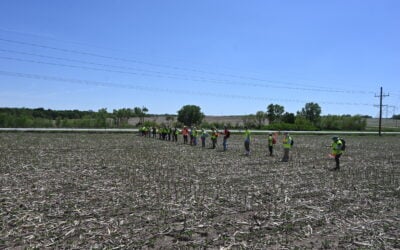
Outside of contract and compliance survey work, members of the SAO team engaged in several outreach activities statewide, reaching hundreds of members of the public, students, and other professionals through virtual programs, conference poster and paper presentations, workshops, and other events. Archeologist Nolan Johnson has continued to provide great programming for the University of Nebraska-Lincoln (UNL) Osher Lifelong Learning Institute (OLLI). This year Nolan once again taught a popular course about the history and archeology of the Kennard House in downtown Lincoln, and he introduced a new multi-part course on the SAO’s Highway Archeology Program. In late May, the UNL archeological field school joined Archeologist Jennifer Banks and me on a small highway survey near Hickman, NE. The survey allowed undergraduate and graduate students to gain valuable and practical survey experience on a typical cultural resource management project. As a result of survey, the students helped locate a new archeological site containing a large artifact scatter representing a late 20th century farmstead and schoolhouse! Later, in July, Jennifer also attended the Ashfall Fossil Beds 35th Anniversary celebration to provide information about artifact identification. Around 400 individuals attended the event!
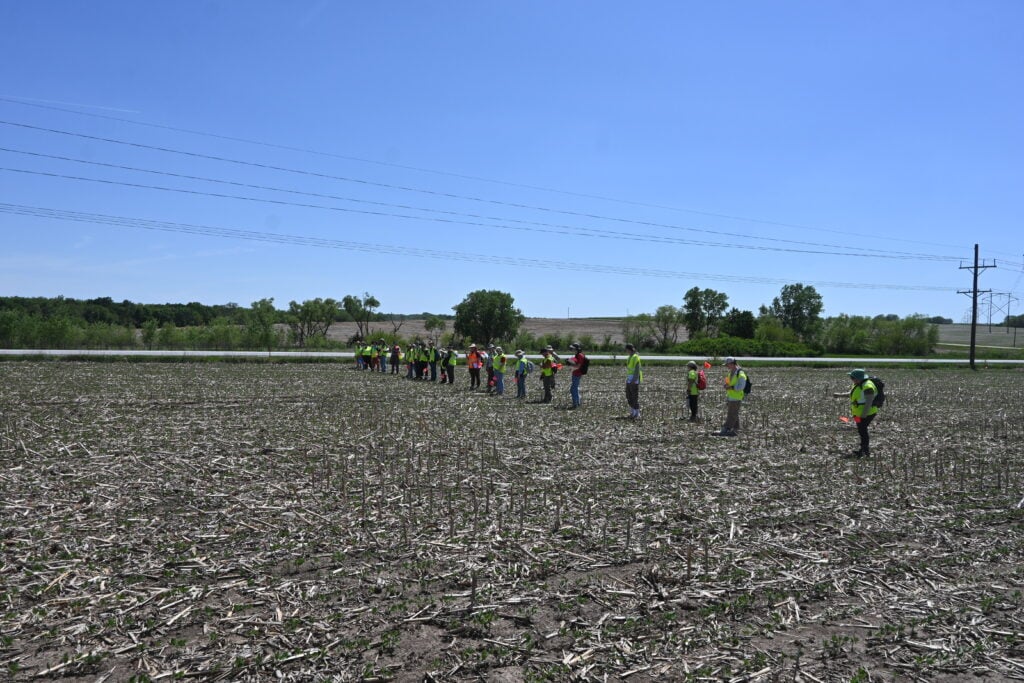
UNL Field School students assist with survey and documentation of a new late 20th century archeological site in Lancaster County, Nebraska.
Two other sets of nationwide programming included an archeology theme this year. Starting in the fall school semester, multiple SAO staff advised school groups from Nebraska and beyond with development of their First LEGO League (FLL) projects. FLL is a global STEAM competition involving LEGO robotics for students aged 4-16. This year’s FLL centered on the theme “Unearthed,” tasking teams with identifying real-world issues faced by archeologists and proposing a solution—an Innovation Project—to their selected issue. Additionally, teams designed, built, and programmed Lego robots to compete in a timed archeology-themed obstacle course with specific tasks to complete, such as placing markers, brushing debris, and lifting objects. Teams were judged on a combination of robot performance, project innovation, robot design, and competition core values. Among the 100-plus active FLL teams in Nebraska, three assisted by SAO staff performed exceptionally well, with two earning invitations to national competitions! A similar theme of “Unearth a Story” was selected for the nationwide Collaborative Summer Library Program in 2026. I was invited to multiple Nebraska libraries, including the Hastings Public Library and Plymouth Public Library, to show off some artifacts and teach community members about “unearthing” the story of Nebraska archeology. These types of outreach engagements are some of the most meaningful interactions we have at the SAO.
In more serious news: you may have seen recent reports regarding proposed regulatory changes to Section 106 of the federal National Historic Preservation Act by the Advisory Council on Historic Preservation. As discussed last year as part of our reporting on the Sharp Homestead mitigation project in Stanton County, Section 106 stipulates that a project–or “undertaking”–carried out under the direction or funding of a lead federal agency must undergo a review to identify any cultural resources (which include archeological sites) that could be impacted by the project, then determine the project’s potential to adversely affect those cultural resources. The proposed regulatory changes, if passed and put into effect, would likely significantly reduce the number of archeological sites and other historic properties identified, documented, preserved, and protected nationwide, potentially resulting in a good deal of our shared local, regional, and national history being lost.
Since last September, SAO staff have responded to nearly 500 requests for background information by external archeological professionals. These record searches are a requirement of the Section 106 process and inform those professionals, as well as project planners and construction crews, about whether a planned project area has been investigated by cultural resources professionals previously, thereby establishing a need to investigate as part of the current project. Additionally, the background search results show whether any cultural resources are present within the project area, as well as the historic significance of those cultural resources, if that has been determined. This is all to illustrate that a not insignificant number of projects—an average of around 700 total projects per year in Nebraska—are reviewed, surveyed, and reported on prior to construction occurring by archeologists and other cultural resources professionals as part of Section 106.
If you would like to learn more about the proposed regulatory changes, or about Section 106 in general, the National Trust for Historic Preservation has a detailed resource page available.
I was recently asked by a current UNL graduate student where I’ve enjoyed doing archeology the most. After a few moments of thinking about where I’ve worked—all over the Great Plains, Midwest, Rocky Mountains, Great Basin, and even down on the Pacific Coast of Oaxaca, Mexico—my response was, “Right here in Nebraska.” From the deep archeological history dating back at least 13,000 years and the wide variety of archeological site types and material culture, to the beautiful landscapes and the people with whom we work on a daily basis, the nearly 5 years I’ve been in my role as Nebraska State Archeologist have been some of the most memorable, rewarding years of my career. With that in mind, I want to extend my sincerest appreciation and thanks for your continued interest and support of Nebraska archeology and the SAO’s incredible work to preserve, explore, and interpret Nebraska’s archeological resources. Our work at the SAO wouldn’t exist without your support.
Thank you, and Happy Nebraska Archeology Month!
Dave Williams, Nebraska State Archeologist
Dave.Williams@nebraska.gov